
- PRICING
- LIVE QUOTES
- LEARN
- HELP


EN
Is Pharmacy Focused Expansion Altering The Investment Case For CVS Health (CVS)?
- CVS Health recently opened its first pharmacy-focused CVS Pharmacy location in the Boston area and outlined plans for nearly 20 similar sites in 2026, while also collaborating with The Midlife Collective on research into women’s midlife health and wellbeing.
- This combination of smaller, pharmacy-centric stores and deeper engagement with women’s midlife needs suggests CVS Health is refining its care model around targeted local access and under-served life stages, rather than relying on broad retail footprints alone.
- We will now look at how CVS Health's pharmacy-focused rollout may influence the existing investment narrative around integrated healthcare execution.
Scan how CVS Health’s targeted pharmacy model and focus on women’s midlife care compare with other potential healthcare ideas by reviewing our curated list of 33 healthcare AI stocks.
CVS Health Investment Narrative Recap
For CVS Health, the big picture an investor needs to believe in is execution on integrated health care, with Aetna margin repair, pharmacy benefit management discipline and tech driven cost cuts feeding into steadier earnings. In the shorter term, the key swing factor still appears to be medical benefit ratios and Health Care Delivery performance. This new information does not materially change that core earnings driver.
The biggest operational risk still comes from potential membership losses in Health Care Benefits and Caremark, along with ongoing pressure in 340B related PBM activity that could dilute pharmacy gains. The Boston pharmacy rollout and midlife research focus mainly refine the retail and engagement story rather than altering those headline risks.
The most relevant update is CVS Health’s push into smaller, pharmacy focused locations. That format reflects the company’s plan to realign the retail footprint while supporting script growth and access, which is important for the Pharmacy & Consumer Wellness and Caremark catalysts tied to cost based reimbursement and lowest net cost models.
For you as a shareholder, the operational question is whether these compact pharmacies can sustain volume, support cost discipline and integrate with Aetna and PBM offerings without adding new fixed cost strain. Execution in this area is closely linked to the margin story, particularly as CVS Health manages debt levels, 340B headwinds and health plan membership risk.
CVS Health Forecasts and Valuation Check
CVS Health's narrative projects US$458.7b revenue and US$11.3b earnings by 2029. That profile assumes 3.6% yearly revenue growth and a US$6.4b earnings increase from US$4.9b today.
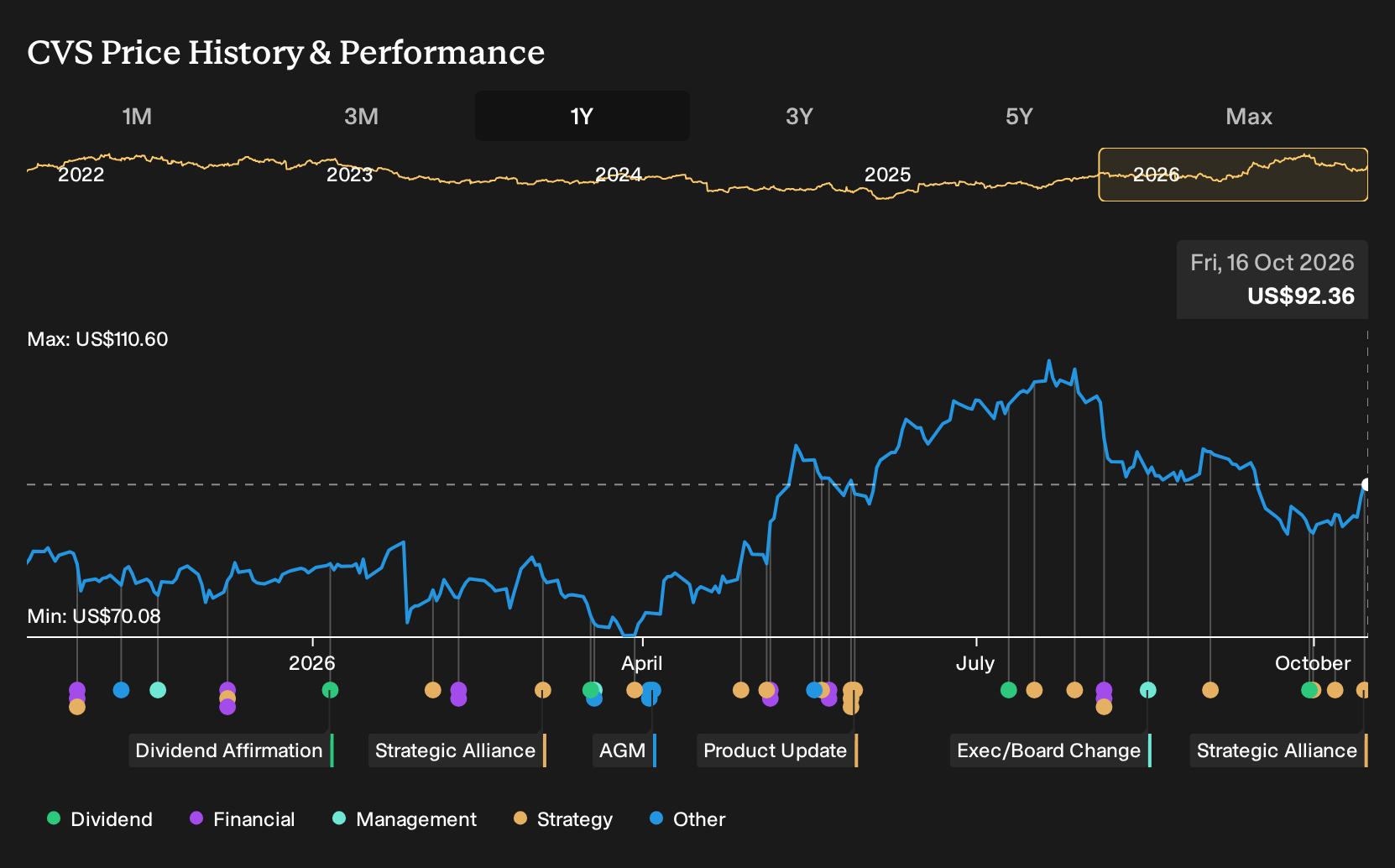
Uncover why CVS Health's fair value indicates a 26% potential upside to its current price before that valuation gap closes.
Exploring Other Perspectives
Five fair value estimates from the Simply Wall St Community span roughly US$104 at the low end to about US$277 at the top, which is a wide band for CVS Health. That spread sits against risks around medical benefit ratios and membership churn, but also potential catalysts in tech driven cost savings and pharmacy focused expansion. You can use these contrasting views to stress test your own thesis and explore several alternative viewpoints before acting.
Explore 4 other CVS Health fair value estimates, including one that suggests it could be worth just $104.01.
The Verdict Is Yours
Disagree with existing narratives? Extraordinary investment returns rarely come from following the herd, so go with your instincts.
- A great starting point for your CVS Health research is our analysis highlighting 4 key rewards and 2 important warning signs that could impact your investment decision.
- See our latest analysis for CVS Health. The report includes a comprehensive fundamental analysis summarized in a single visual, the Snowflake, making it easy to evaluate CVS Health's overall financial health at a glance.
Looking for more investment ideas beyond CVS Health?
Once you have a view on CVS Health, it can help to compare it with other opportunities that fit different risk, income and balance sheet profiles using the Simply Wall St Screener.
- If you are comfortable with higher risk in search of potentially outsized moves, you might scan a curated group of 14 elite penny stocks with strong financials that already show stronger financial footing than many peers.
- If value and balance sheet strength sit at the top of your checklist, focus your research on a 33 high quality undervalued stocks that combine healthier cash flows with disciplined financial positions.
- If capital preservation matters most, concentrate on a 32 resilient stocks with low risk scores that screen for businesses with more resilient risk scores and steadier fundamentals.
This article by Simply Wall St is general in nature. We provide commentary based on historical data and analyst forecasts only using an unbiased methodology and our articles are not intended to be financial advice. It does not constitute a recommendation to buy or sell any stock, and does not take account of your objectives, or your financial situation. We aim to bring you long-term focused analysis driven by fundamental data. Note that our analysis may not factor in the latest price-sensitive company announcements or qualitative material. Simply Wall St has no position in any stocks mentioned.
Have feedback on this article? Concerned about the content? Get in touch with us directly. Alternatively, email editorial-team@simplywallst.com