
- PRICING
- LIVE QUOTES
- LEARN
- HELP


EN
After eight consecutive declines, Philadelphia Semiconductor finally welcomed a rebound! The “wave of AI computing power” spurs semiconductor production expansion, and Damo outlines a blueprint for $280 billion in equipment spending
The Zhitong Finance App learned that the semiconductor sector of the US stock market rebounded sharply on Monday after experiencing a continuous decline for many days. The Philadelphia Semiconductor Index, which includes the world's top chip giants such as Nvidia, AMD, Intel, and Micron, rose sharply by about 3% at the beginning of the US stock market. At about the same time that semiconductors began a counterattack on Monday, Wall Street financial giant Morgan Stanley released a research report on further accelerating the expansion of semiconductor equipment spending, which can be described as adding fuel to the phased rebound of semiconductors, emphasizing that the global semiconductor equipment supply chain, such as lithography, etching, film deposition, CMP, advanced packaging, and process yield monitoring, which are closely related to global chip manufacturing production capacity, is still expanding production for a larger AI investment cycle.
According to information, market data shows that as of October 16, the Philadelphia Semiconductor Index had been falling for eight consecutive trading days, with a cumulative decline of about 15.7%; it fell 11.4% last week, retreating about 24% from its high point, and has entered a technical bear market. The pressure on the storage sector is particularly obvious. The stock price of US memory chip manufacturing giant Micron fell sharply by 14.6% last week. Korea's KOSPI Index, which has the title of “AI computing power trading weather vane”, fell by a cumulative total of about 14.5% last week. Although it closed up 1.76% on Monday, it still fell by about 15.6% since October. This round of adjustments has returned profits from a high level and evolved into a centralized reassessment of the market's ability to realize future AI profits brought about by strong AI computing power, continued capital expenditure, and rising financing costs related to AI infrastructure.
At the beginning of the session on Monday, the market began to recover from this sharp decline. As of 9:37 Beijing time on October 19, the cost rose 2.88% to 11458.24 points; according to historical closing data, it has still fallen by about 9.3% since October, and is still about 21.8% below the high point, but the cumulative increase during the year still reached 61.8%. The opening market at 13:35 Beijing time showed that Asmack, Fanlin Group, and Applied Materials rose 2.35%, 3.84%, and 3.74% respectively, while Micron rose 3.92%. The gradual deep decline coexists with large increases during the year, which means that the market is re-measuring how much of the strong growth expectations previously included in stock prices can be fulfilled.
According to the “Semiconductor Capital Equipment: SEMICON West Exhibition Review” released by Morgan Stanley on October 19, maintaining the North American semiconductor equipment industry's view of “synchronizing with the market”, the global fab equipment expenditure (WFE) is expected to reach US$223 billion in 2027, an increase of 37% over the previous year; the supply chain is increasing its willingness to expand production to prepare for the optimistic scenario of US$280 billion in 2028, but component shortages and customer cleanroom delays have already occurred. The research report also focuses on the three main lines of applied materials entering process control, MKS and Advanced Energy dealing with supply bottlenecks, and advanced packaging to increase test value. It supports the judgment that equipment demand is still resilient, and also shows that the next round of profit improvement in the global semiconductor industry requires more solid evidence of actual delivery.
In terms of specific configuration, MKS (MKSI.US) and Advanced Energy (AEIS.US), which received positive feedback from the semiconductor equipment industry this time, both received “increased” ratings; KLA (KLAC.US), Fanlin Group (LRCX.US), and Onto Innovation (ONTO.US) also “increased their holdings.” Applied Materials (AMAT.US), Camtek (CAMT.US), Nova (NVMI.US), and Teradyne (TER.US) are “weighted on an equal footing with industry.”
As the Philadelphia Semiconductor Index experienced a rebound on Monday after a sharp decline, Morgan Stanley's latest research can be described as providing strong industrial support for the long-term growth prospects and bullish trend of semiconductor equipment and the semiconductor sector as a whole: demand for AI-related equipment remains strong, and the supply chain is expanding further to prepare for a larger investment cycle. As the growth momentum shifts from increasing the utilization rate of existing production capacity to climbing new production capacity, the key to realizing profits in the next phase is whether the expansion of production by equipment suppliers, the supply of key components, and the construction of customer fabs can proceed simultaneously, turning strong demand into revenue delivered on schedule.
The $223 billion increase will pass the “delivery hurdle”: the expansion of semiconductor equipment linked to AI computing power has entered an even more difficult stage
The growth in 2026 is mainly due to increasing the utilization rate of existing production capacity, while in 2027 it is necessary to climb the slope with additional production capacity. The Daimo analyst team pointed out that the annualized operation scale of the industry increased from about 125 billion US dollars in the fourth quarter of 2025 to about 200 billion US dollars in the fourth quarter of 2026; the 200 billion US dollars here is a quarterly annualized scale and cannot be directly used as annual expenses. Entering 2027, even if the benchmark forecast of $223 billion is achieved, suppliers will need to build and release new production capacity.
Damo said that during the exchange, the main sub-suppliers mentioned that Applied Materials plans to double production capacity by 2028. More companies are worried that poor production expansion will give orders to competitors, so they are willing to invest resources for the optimistic scenario of 2028 billion US dollars. This shows that the industry is still allocating capital for growth, but equipment manufacturing, personnel training, and supplier certification will make it more complicated to achieve growth.
The real constraints are already present at both the manufacturing end of the device and the receiving end of the fab. According to the Damo Research Report, the PCB supplier gave priority to meeting AI customer needs and squeezing equipment subsystem vendor supply quotas; another DRAM customer delayed equipment delivery from the December quarter to the March quarter of the following year due to unprepared clean rooms. This type of delay first affects equipment revenue recognition and wafer capacity release time.
Meanwhile, Damo said that the North American semiconductor equipment supplier MKS said there is no need to worry about 95% of the supplier supply situation, and the remaining 5% require key management; some competitors are slow to climb the slope, and customers have asked MKS to increase the supply of dual-vendor products. Both MKS and Advanced Energy have increased their inventory of potentially scarce parts ahead of schedule, and Damo is positive about this. The investment implication behind this is that a small number of parts may be stuck in the delivery of the complete machine, and supply chain execution can thus be converted into market share.
Valuation adjustments have also changed the conditions required for the rise. Damo's forecast for 2026 has been revised up by a total of 26%, and the market is gradually getting used to continuing to exceed expectations; now, the valuation of some equipment stocks based on the bank's strong profit forecast for 2027 is close to the low level of the cycle, reflecting investors beginning to doubt whether the 2028 boom will continue.
Damo said that the exhibition strengthened the credibility of supply chain expansion, but did not provide sufficient new evidence to confirm profit in 2028. Combined with the current market environment, if semiconductor equipment stocks and even the global semiconductor sector are to continue, the return on investment and financing capacity of cloud vendors is needed to achieve a new expansion path in the context of continued stability, and further reflected in customers receiving equipment and equipment vendor revenue and cash flow on schedule. These factors determine how much stronger demand ultimately translates into shareholder returns.
The more expensive the AI chip, the more valuable the yield: inspection and test equipment compete for added value
Applied Materials, a semiconductor equipment giant headquartered in the US, is increasing investment in pioneering optical wafer inspection and material measurement, and is trying to expand electron beam advantages and new optical products to advanced packaging. Damo acknowledged its logic of challenging KLA's future advantage: the applied materials process control business grew by more than 50% this year, higher than the bank's estimate of about 25% of KLA (KLEI); however, this only made the former slightly higher than the peak in 2022, and more continuous growth is needed to prove its share increase.
Damo said that advanced packaging technology and market share are more controversial in the industry: ONTO believes that applied materials may overestimate market space, while Nova emphasizes that measurement equipment with a unit price of millions of dollars and a limited number of customer configurations must rely on performance and comprehensive usage costs to win orders. KLA's advanced packaging revenue will not exceed 1 billion US dollars until 2026. If applied materials reach the same scale, they will need to seize a significant share. The expansion of advanced packaging brings opportunities, but the throughput, sensitivity, and customer verification capabilities of different inspection technologies determine how much revenue each company can share.
The changes in the testing process are more structured. The report cites Teradyne's “Test Forward” framework, and tests throughout the wafer, post-cut die, intermediate layers and substrates, post-cut devices, final testing, and system-level testing, with the goal of finding defects at the earliest economically feasible stage. The underlying reason behind this is — when production capacity for computational dies, HBM, and advanced packaging is scarce, a defective die goes into an expensive package, which may waste multiple high-value resources at the same time and reduce deliverables that cannot be quickly repaired.
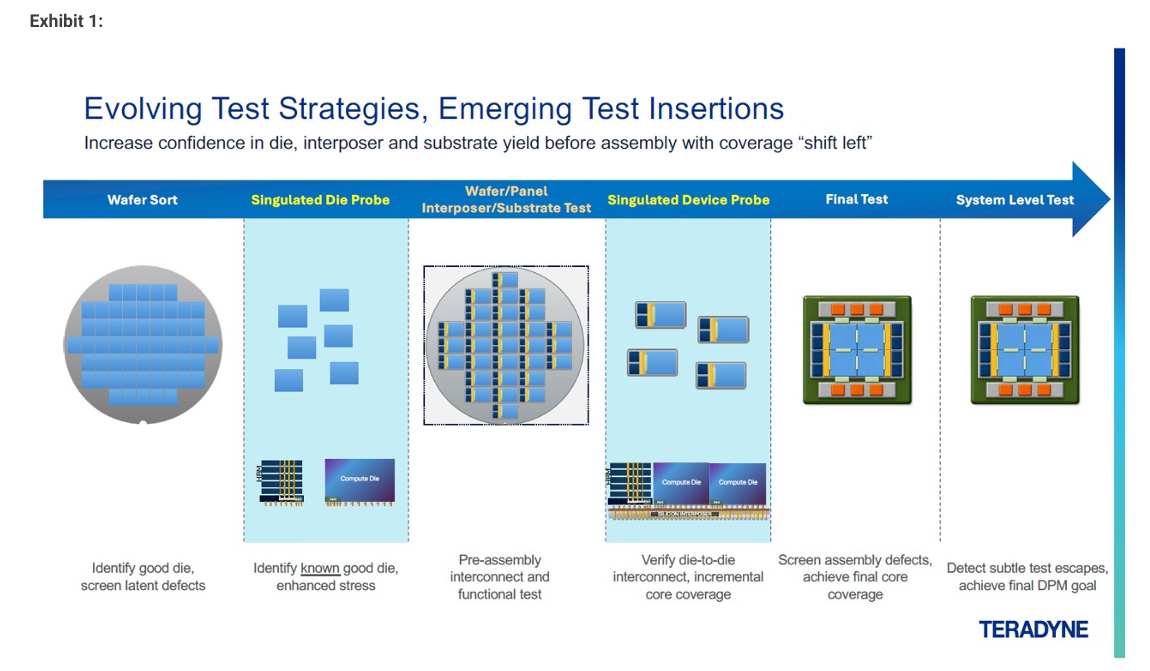
The test also undertakes parameter modification, fuse programming, and product classification, which directly affects whether the chip can be sold. Damo expects the ratio of testing expenditure to WFE to rise from 5.8% in 2020-2024 to 8.5% in 2026; acknowledging the increase in value, while questioning how much testing intensity can be increased. The most significant change in semiconductor equipment investment here is that testing begins to protect the efficiency of scarce production capacity into revenue. In other words, test equipment improves the delivery capacity of qualified chips by screening out defects in advance, reducing waste of high-value components and scarce packaging production capacity, thereby ensuring revenue delivery.
By identifying defects earlier, waste of expensive chips and scarce packaging production capacity is reduced, and limited production resources can ultimately produce more qualified products that can be sold. For example, screening out a defective computational die in advance can prevent it from exposing problems only after completing an expensive package with a qualified HBM, causing loss of investment in other components and packages. When production capacity is tight, this loss also means less product delivery and less revenue recognition, so customers are more willing to invest in effective testing.