
- PRICING
- LIVE QUOTES
- LEARN
- HELP


EN
SanDisk Stock Is Caught in the China Chip Selloff. Here’s What Investors Are Missing.
China's latest memory-chip breakthrough has sent SanDisk (SNDK) stock into a tailspin. SNDK stock has surged 447% year-to-date (YTD), but the rally has stalled, with shares down 18% over the past five days as investors brace for tougher competition in the memory space. But the market may be overlooking an important distinction. Not all memory chips serve the same purpose. The new technology from China that is shaking up the market focuses on DRAM, but SanDisk mainly works with NAND flash storage.
That distinction could be getting lost in the selloff. Let's take a closer look.
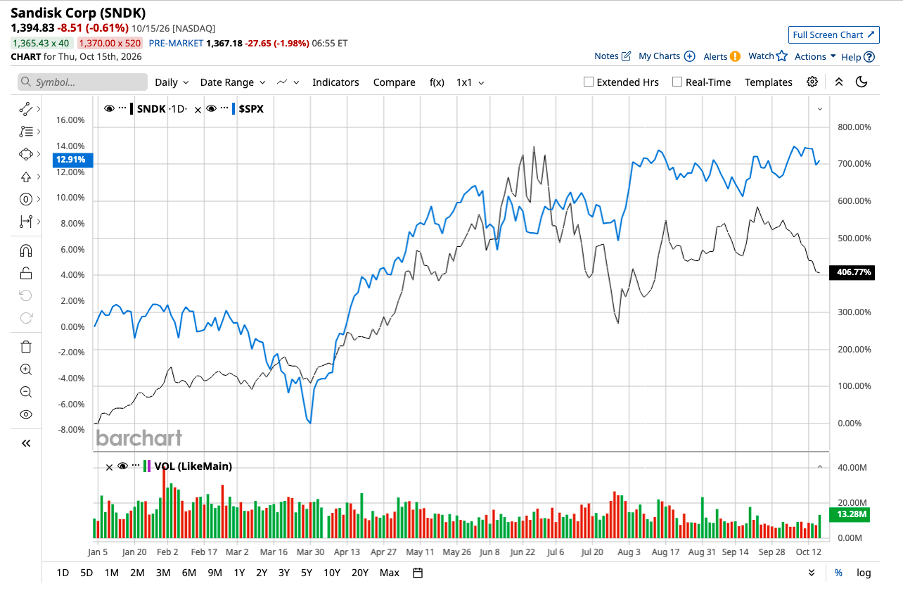
China's Latest Memory Breakthrough Has Spooked Investors
Memory stocks faced new pressure after Chinese memory chipmaker ChangXin Memory Technologies (CXMT) recently announced it is working to increase the density of its DRAM products. The company has made progress on a new 4F² chip design and expects to bring its new server-focused DRAM technology to market before the end of 2026. This technology makes each memory cell smaller, so manufacturers can fit more memory into the same amount of space.
This news has renewed worries about China's potential to compete with established memory manufacturers. SanDisk shares fell alongside other memory and semiconductor stocks like Micron (MU), Samsung, and SK Hynix (SKHY) as investors reassessed the competition and questioned how long the artificial intelligence (AI) investment surge might last.
SanDisk Makes NAND, Not DRAM
If CXMT eventually produces competitive chips at scale, Micron, Samsung, and SK Hynix face a direct competitive threat from the DRAM breakthrough. SanDisk, however, may be less affected because its main business is NAND flash storage.
DRAM gives processors fast, temporary working memory that computers and servers use while running applications. NAND, on the other hand, keeps data even when the power is off and is widely used in solid-state drives and other storage devices. Both are important for present-day computing, but they have different uses and cannot always replace each other. This means CXMT's new DRAM architecture does not directly replace the NAND products that SanDisk currently sells. So, even if the selloff makes it seem that way, it does not have direct competitive consequences for SanDisk.
CXMT's plans could intensify DRAM competition, especially if it delivers strong server-memory products at scale. Still, announcing new technology is not the same as proving a product can be made reliably, sold at a good price, and attract customers from established suppliers.
SanDisk's Numbers Show Why Bulls Aren't Giving Up
In the fourth quarter of fiscal 2026, SanDisk reported revenue of $8.97 billion, up 51% from the prior quarter and 372% year-over-year (YOY). Management said this strong result came from increased sales and better prices, thanks to a healthy market for NAND products.
Data-center demand played a key role. SanDisk reported $2.98 billion in data-center revenue for the quarter, up 103% sequentially. For fiscal 2026, revenue stood at $20.25 billion, a 175% YOY increase driven by data-center revenue growth of 437%. These numbers highlight how quickly the company has gained from the rising need for storage infrastructure.
SanDisk’s profits grew even more during the quarter. Adjusted gross margin was 84.6% in Q4, while adjusted diluted EPS jumped to $39.25 from $0.29 a year earlier. Management explained that higher prices accounted for about two-thirds of the quarter's revenue growth, while increased sales volume accounted for the rest. This combination shows that the company is benefiting from both higher demand and better pricing.
Management believes that growing AI infrastructure will increase demand for NAND. As more AI models run inference, data centers are required to store and access more data. Enterprise SSDs are important here, especially when capacity, power use, and data access are key. This gives SanDisk a chance to expand beyond just consumer storage devices. SanDisk expects strong demand and profitability to continue into Q1 fiscal 2027. The company expects Q1 revenue between $10.3 billion and $10.8 billion, adjusted gross margin of about 83% to 85%, and adjusted diluted EPS ranging from $44 to $46.
Although CXMT's latest development is focused on DRAM, the wider effects of China's growing semiconductor industry are still something to watch. Yangtze Memory Technologies (YMTC), another Chinese company, makes NAND flash memory. That means its progress likely matters more to SanDisk, since both companies compete in the NAND market.
What the China Chip News Means for SNDK Stock
SanDisk’s recent drop may not only be about concerns over China. It could also reflect worries about more competition in the memory market, questions about AI spending, and some investors cashing in after a big rally. While China’s memory progress is worth watching, SanDisk’s NAND business is holding its ground. The company's long-term outlook will depend on how well its storage products compete and whether growing demand for AI infrastructure drives steady earnings growth. Analysts project earnings to climb 201% in fiscal 2027, followed by 21% growth in fiscal 2028.
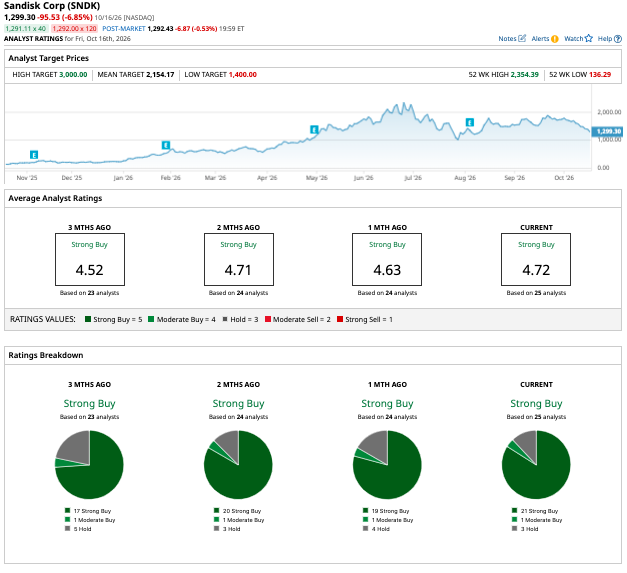
On Wall Street, SNDK stock has a consensus “Strong Buy” rating overall. Of the 25 analysts covering the stock, 21 recommend a “Strong Buy,” one analyst has a “Moderate Buy,” and three suggest a “Hold” rating. The average price target of $2,154.17 suggests potential upside of around 66% from current levels, while the Street-high estimate of $3,000 indicates SNDK stock could gain as much as 131% this year.
On the date of publication, Sushree Mohanty did not have (either directly or indirectly) positions in any of the securities mentioned in this article. All information and data in this article is solely for informational purposes. For more information please view the Barchart Disclosure Policy here.