
- PRICING
- LIVE QUOTES
- LEARN
- HELP


EN
3 US Infrastructure Stocks Tied To Defense Spending And Supply Chain Buildouts
Fresh capital is pouring into US security focused infrastructure, with JPMorgan and its peers outlining hundreds of billions for projects tied to defense, energy, supply chains and advanced manufacturing. That kind of funding can reshape which stocks quietly become long term winners. This article walks through three companies from a targeted screener that appear exposed to this news flow and explains why each might deserve a closer look or a wider berth.
The three stocks discussed below are simply a sample pulled from a broader theme, while the full screen surfaced 32 more U.S. security focused infrastructure and industrial builders with similarly detailed business stories that are not covered here. To identify and analyze potential high conviction ideas across grid, defense, critical minerals and contractors in one place, head straight into the U.S. Security-Focused Infrastructure and Industrial Builders screener.
Dycom Industries (DY)
Overview: Dycom Industries is a U.S. specialty contractor that designs, builds and maintains fiber rich telecom and utility networks for critical digital infrastructure.
Operations: Dycom generates about US$6 billion in Communications revenue plus an US$889 million segment adjustment, almost entirely from U.S. customers.
Market Cap: US$7.6 billion
Dycom Industries sits close to the nerve system of the screener theme, wiring the fiber and utility projects that underpin security focused infrastructure and drawing interest as large pools of capital line up behind those build outs.
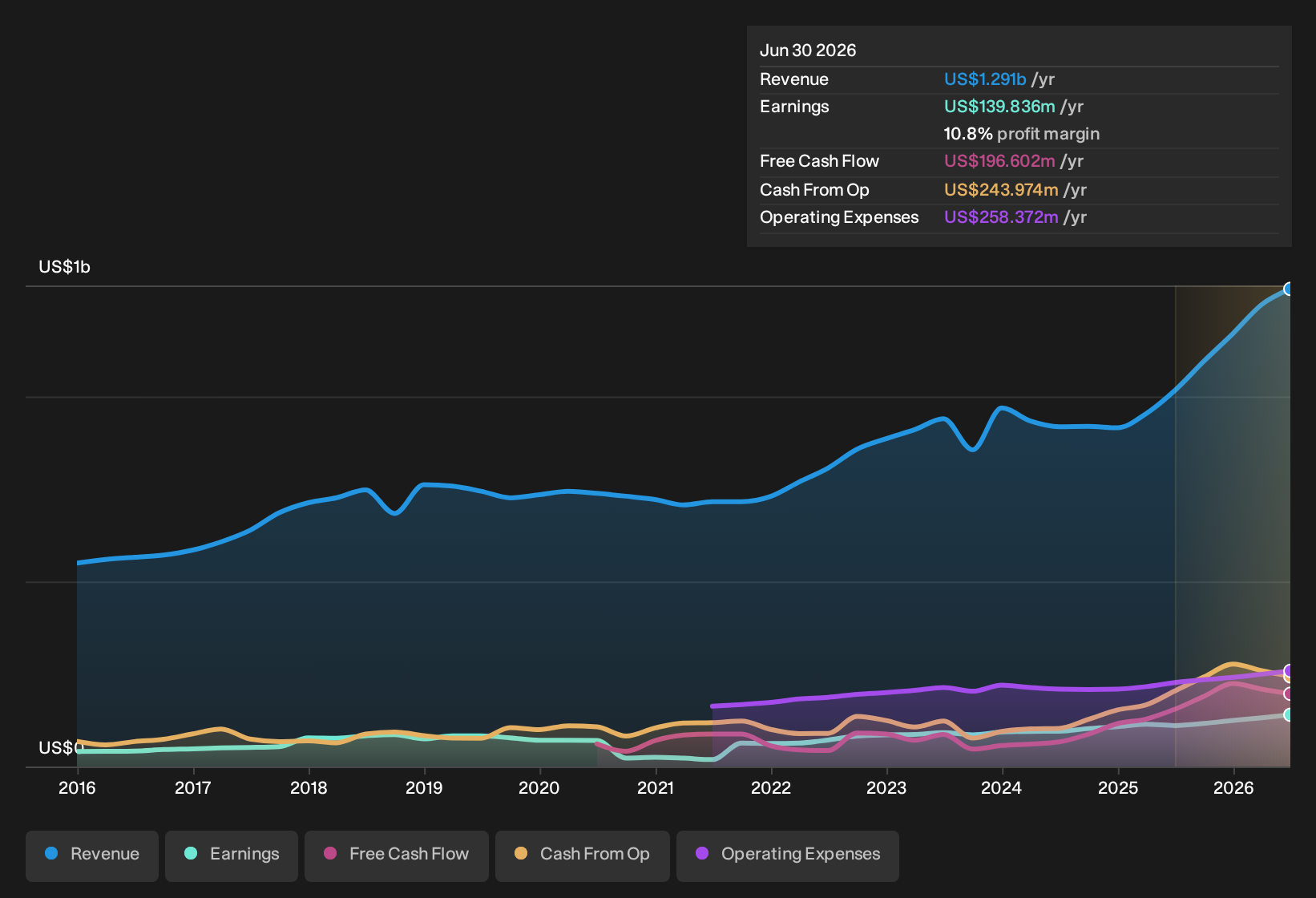
"A large, multi year build out of long haul, middle mile and inside the fence fiber to connect data centers nationwide is feeding a contracted addressable market that management sizes at about US$20b."
For investors, what really matters next is how one unseen pressure on project economics plays out against that multi year fiber opportunity.
That pressure point is exactly where the story gets interesting, and the full narrative for Dycom Industries explains how project risk, capital cycles and fiber commitments could be decoupling expectations.

United States Antimony (UAMY)
Overview: United States Antimony produces antimony based flame retardants, metals and zeolite in North America for defense, energy and industrial uses.
Operations: United States Antimony generates about US$32 million from Antimony and US$4 million from Zeolite, with roughly US$35 million from U.S. and Canadian customers.
Market Cap: US$427 million
United States Antimony matters for this security focused screen because it tries to turn a home grown antimony supply chain into leverage with defense, energy storage and industrial customers that want less dependence on foreign sources.
"US Antimony is expanding its domestic processing capacity (for example, a sixfold increase at the Thompson Falls facility expected by year-end) and increasing ore supply both from its own Montana and Alaska projects and multiple new international sources, which is expected to drive higher production volumes and sustained revenue growth through increased throughput and supply security."
The real swing factor is how one unresolved piece of the cost structure ultimately shapes margins if demand for secure antimony supply holds.
That unresolved cost piece is exactly where the risk and upside start to pull apart, and the full narrative for United States Antimony explains how capital intensity, pricing power and supply security could intersect for United States Antimony.

ESCO Technologies (ESE)
Overview: ESCO Technologies supplies mission critical components, filtration and testing systems that plug directly into U.S. aerospace, naval and grid security infrastructure.
Operations: ESCO Technologies generates about US$633 million from Aerospace & Defense, US$391 million from Utility Solutions and US$267 million from Test, largely in the U.S.
Market Cap: US$6.5 billion
ESCO Technologies matters for this security focused screen because its hardware and testing gear sit inside the aircraft, submarines and electrical infrastructure that big defense and grid budgets are being built around.
"Despite ESCO Technologies reporting record backlog and a book to bill comfortably above 1.0, in the recent quarter revenue of US$309.3 million grew 33.5% yet still fell about 3.4% short of expectations. This suggests execution or timing risk on long cycle aerospace, naval and grid programs that could leave future revenue and earnings below what the current backlog implies."
The crux for ESCO Technologies now is what happens to investor expectations if one pressure point quietly reshapes how that backlog turns into profit.
If that pressure point has your attention, the full narrative for ESCO Technologies examines whether backlog, execution risk and U.S. security spending are quietly masking a stronger ESCO Technologies story.
Seeking Fresh Alternatives Before They Run
Fresh themes are breaking out, momentum is building, and under-the-radar ideas are emerging before the crowd catches on. Consider acting while it still matters.
- Look for potential turnaround stories early and explore 14 elite penny stocks with strong financials that could be quietly building momentum before bigger investors start paying attention.
- Follow structural tech shifts by scanning 55 AI infrastructure stocks that may benefit as data demand, power usage, and hardware intensity influence how digital rails are built.
- Focus on durable cash generators and review the list of solid balance sheet and fundamentals (25 results) to identify resilient operators with cleaner finances when markets become more volatile.
This article by Simply Wall St is general in nature. We provide commentary based on historical data and analyst forecasts only using an unbiased methodology and our articles are not intended to be financial advice. It does not constitute a recommendation to buy or sell any stock, and does not take account of your objectives, or your financial situation. We aim to bring you long-term focused analysis driven by fundamental data. Note that our analysis may not factor in the latest price-sensitive company announcements or qualitative material. Simply Wall St has no position in any stocks mentioned.
Have feedback on this article? Concerned about the content? Get in touch with us directly. Alternatively, email editorial-team@simplywallst.com