
- PRICING
- LIVE QUOTES
- LEARN
- HELP


EN
Sakata Seed (TSE:1377) Could Be 26% Below Fair Value As Earnings Raise Margin Questions
Why Sakata Seed’s Latest Earnings Caught Attention
Sakata Seed (TSE:1377) just posted first quarter numbers that pulled investors in two directions. Sales reached ¥24,670 million, ahead of last year, while net income and basic EPS declined compared with the prior period.
Recent price action has been muted, with the 30 day share price return down 4.5% and the 90 day move lower by 4.3%, even as the 1 year total shareholder return of 9.3% points to longer term holders still being rewarded. The latest earnings release and October board meeting appear to have cooled near term momentum in Sakata Seed’s share price, as investors weigh stronger sales against weaker profitability and reassess what they are willing to pay for that trade off.
Spot fresh ideas facing similar margin questions by scanning our hand picked 73 high quality undiscovered gems, which pair solid fundamentals with under the radar price action.Sakata Seed now trades at ¥4,210, with analyst targets and intrinsic estimates sitting well above that mark. Does fair value really cluster near those higher ranges, or is it closer to where the market has just marked the stock down?
Price-to-Earnings of 16.4x: Is it justified?
Sakata Seed now trades on a P/E of 16.4x, which leaves the share price at ¥4,210 while valuation checks point to a different fair value range compared with both peers and the wider food sector.
The P/E ratio compares the current share price with earnings per share, so it tells you how much investors are paying for each unit of profit. For a seeds and horticulture business like Sakata Seed, that figure reflects how the market weighs a mix of earnings growth forecasts, recent pressure on net margins and a long operating history in a specialised niche.
Against the JP Food industry average P/E of 16.4x and a peer group average of 15.1x, this multiple looks punchy rather than cheap. The estimated fair P/E of 17.3x sits slightly higher than where the stock trades today, which indicates that if profitability stabilises and forecast earnings growth of 5.7% a year is met, the valuation level could move toward that fair ratio rather than sharply away from it.
Explore the SWS fair ratio for Sakata Seed.
Result: Price-to-Earnings of 16.4x (ABOUT RIGHT)
Still, the recent decline in near term returns and weaker net income leave Sakata Seed exposed if earnings stumble again or if sentiment toward food stocks cools further.
Find out about the key risks to this Sakata Seed narrative.
Another View: What The DCF Model Says About Sakata Seed
The market might see Sakata Seed as fairly priced on a P/E of 16.4x, but the SWS DCF model presents a different perspective. On that cash flow view, the shares at ¥4,210 sit about 26% below an estimated value of ¥5,706.68. Is that a genuine margin of safety or just optimistic modelling?
Look into how the SWS DCF model arrives at its fair value.
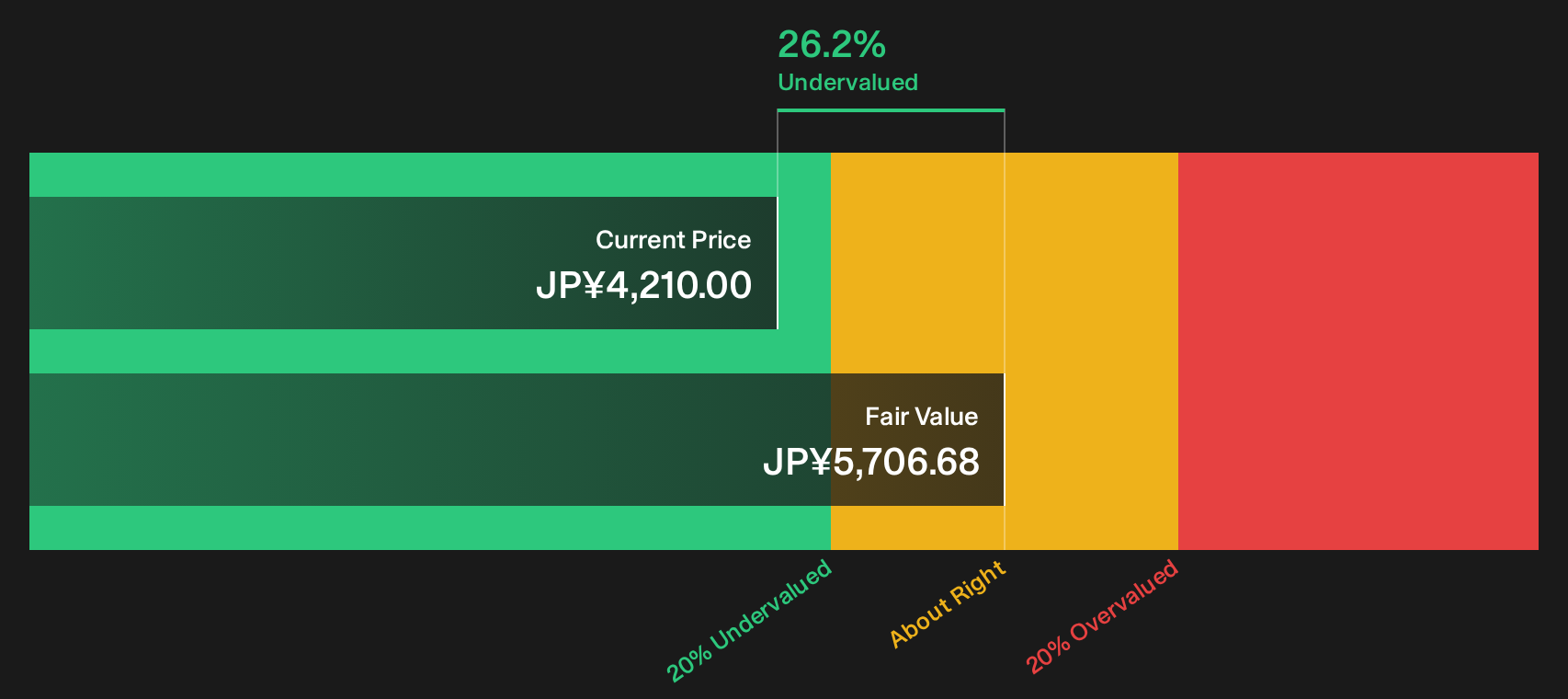
Simply Wall St performs a discounted cash flow (DCF) on every stock in the world every day (check out Sakata Seed for example). We show the entire calculation in full. You can track the result in your watchlist or portfolio and be alerted when this changes, or use our stock screener to discover 13 high quality undervalued stocks. If you save a screener we even alert you when new companies match - so you never miss a potential opportunity.
Next Steps
Mixed signals around Sakata Seed’s valuation and earnings can feel messy, so move quickly, review the underlying figures, and shape your own view with 2 key rewards and 1 important warning sign.
Ready for more investment ideas beyond Sakata Seed?
If Sakata Seed has you thinking harder about price, quality, and risk, do not stop at a single ticker. Broader idea hunting often reveals better fits.
- Target resilient income by scanning companies we flag as potential income anchors in the 29 dividend fortresses.
- Hunt for mispriced opportunities using the 13 high quality undervalued stocks to spot businesses where fundamentals and market pricing look meaningfully out of sync.
- Prioritise capital protection by filtering for sturdier balance sheets with the 22 resilient stocks with low risk scores, so you are not caught off guard by hidden fragility.
This article by Simply Wall St is general in nature. We provide commentary based on historical data and analyst forecasts only using an unbiased methodology and our articles are not intended to be financial advice. It does not constitute a recommendation to buy or sell any stock, and does not take account of your objectives, or your financial situation. We aim to bring you long-term focused analysis driven by fundamental data. Note that our analysis may not factor in the latest price-sensitive company announcements or qualitative material. Simply Wall St has no position in any stocks mentioned.
Have feedback on this article? Concerned about the content? Get in touch with us directly. Alternatively, email editorial-team@simplywallst.com