
- PRICING
- LIVE QUOTES
- LEARN
- HELP


EN
Not So Fast! One Warren Buffett's Core Positions at Berkshire Hathaway May Not Get the Heave-Ho by Successor Greg Abel After All.
Key Points
Berkshire Hathaway’s longtime CEO, Warren Buffett, retired on Dec. 31, and his successor, Greg Abel, has wasted little time reshaping the company’s $363 billion investment portfolio.
America’s most interest-sensitive large bank has been repeatedly pared down by Berkshire’s current and former bosses.
However, the Federal Reserve’s rate-hiking cycle has made this top-five holding at Berkshire Hathaway far more attractive.
For the first time in well over half a century, Berkshire Hathaway (NYSE:BRKA)(NYSE:BRKB) entered the year in uncharted territory. On Dec. 31, Warren Buffett retired as CEO, paving the way for his protégé, Greg Abel, to oversee the company's day-to-day operations and its closely watched $363 billion investment portfolio.
Abel didn't waste much time making his mark. He disposed of 16 stocks in the first quarter and pared down six others, including one of the Oracle of Omaha's core holdings, Bank of America (NYSE:BAC)(also known as BofA).
Missed AI’s "Act 1"? Act 2 Could Be 15x Bigger. Most investors think they missed the AI boat because they didn't buy Nvidia in 2005. But according to our analysts, we’re only at the end of "Act 1"—the R&D phase. "Act 2" is the global rollout. Continue »
Warren Buffett has officially passed the baton to Greg Abel. Image source: Getty Images.
In the six quarters leading up to Buffett's retirement, he was a persistent seller of BofA stock. This pattern has continued through Abel's first two quarters as CEO, with Buffett and Abel collectively selling more than 549 million shares since July 2024, or 53% of what had been a 1.03-billion-share position.
The writing looked to be on the wall that Bank of America would get the heave-ho -- but that may not be the case any longer.
Buffett and Abel collectively sold over 549 million shares of Bank of America
As recently as a few months ago, there were three reasons to believe that BofA's time as a prominent Berkshire Hathaway holding would come to an end.
Firstly, Buffett and Abel have always been sticklers for value. When the Oracle of Omaha first invested in BofA's preferred stock in August 2011, its common stock was trading at a 62% discount to book value. As recently as August, BofA peaked at a 65% premium to book value.
Secondly, Bank of America is the most interest-sensitive of the country's money-center banks. With the Federal Reserve lowering rates six times between September 2024 and December 2025, no large bank was at greater risk of its net interest income shrinking than BofA.
Third and finally, Greg Abel's first annual letter to shareholders excluded Bank of America in his discussion of companies that can compound over multiple decades.
The writing looked to be on the wall that Bank of America would soon get the heave-ho.

Image source: Getty Images.
Greg Abel's tune on Bank of America may have changed
While additional selling is possible, several catalysts that had made Bank of America stock less attractive have reversed course.
For example, Bank of America's ongoing profitability and prudent lending have allowed its book value per share to steadily rise. When coupled with the recent pullback in BofA's share price, the company's stock is now trading at only a 30% premium to book value following its third-quarter operating results. BofA may not be a screaming bargain like it was in August 2011, but it remains attractive at just a 30% premium to book.
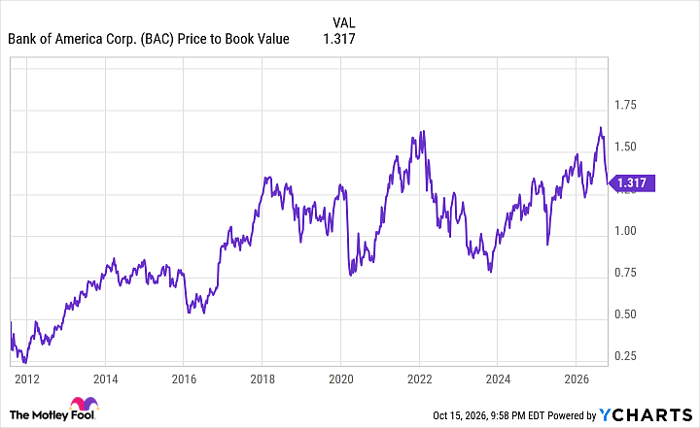
BAC Price to Book Value data by YCharts.
Additionally, the central bank kicked off only its fourth rate-hiking cycle of the century on Sept. 16. According to the CME Group's (NASDAQ:CME) FedWatch Tool, the odds are incredibly high that the Fed will implement several rate hikes over the next year. As the most interest-sensitive large U.S. bank, BofA's net interest income should benefit.
The narrative surrounding Bank of America appears to be changing, making it less likely that Warren Buffett's successor sends it to the chopping block.
Bank of America is an advertising partner of Motley Fool Money. Sean Williams has positions in Bank of America. The Motley Fool has positions in and recommends Berkshire Hathaway and CME Group. The Motley Fool has a disclosure policy.