
- PRICING
- LIVE QUOTES
- LEARN
- HELP


EN
3 Bank Stocks To Watch As Interest Rates Reshape Global Financials
Global financial institutions are back under the spotlight as regulators tighten the rules, central banks coordinate their next moves and inflation control retakes center stage. This combination can reshape how large-cap banks and market infrastructure groups earn, lend and manage risk, which matters directly to your portfolio. This article walks through 3 stocks from our Global Large-Cap Financial Institutions screener that appear positively exposed to these policy shifts.
The three stocks highlighted next are only a sample, and the full screen surfaced 42 more large-cap financial institutions with equally compelling narratives that are not covered here. To identify your own highest conviction ideas, head straight into the Global Large-Cap Financial Institutions screener to filter, analyze and focus on the global institutions that best fit your approach.
Banco Santander (BME:SAN)
Banco Santander is the flagship example of what this Global Large-Cap Financial Institutions theme is about, a huge, diversified bank whose scale, regulation-heavy footprint and cross-border reach make policy shifts around risk and interest rates directly relevant to how it earns and protects returns.
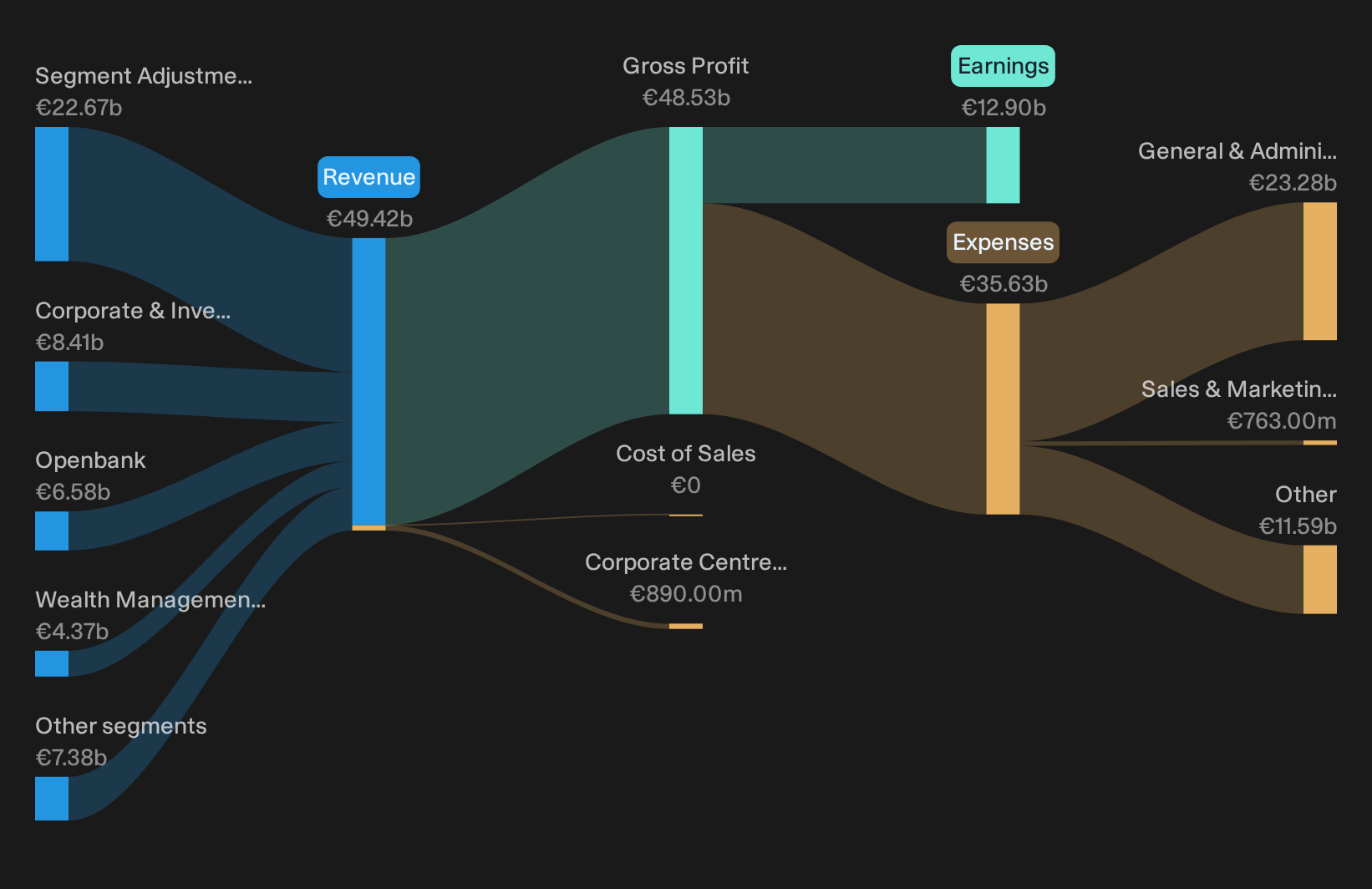
Banco Santander runs a broad mix of retail, corporate, investment, wealth and payments activities worldwide, with around €22.7b from Segment Adjustment, €8.4b from Corporate & Investment Banking, €4.4b from Wealth Management & Insurance, €4.1b from Payment Solutions and €6.6b from Openbank, and a market value close to €173.2b.
Expansion of Banco Santander’s ONE Transformation and global platform consolidation, with group costs in constant euros already declining while revenue rises and management targeting a move in the efficiency ratio from around 45% in 2025 to about 36% in 2028, could further widen operating jaws and support earnings growth.
What happens to that margin story depends heavily on how one unseen pressure plays out across its most credit sensitive books.
That pressure point is where the story really turns, and the full narrative for Banco Santander shows how credit risk, capital and policy shifts could be quietly reshaping the upside.
Absa Group (JSE:ABG)
Absa Group is a good fit for this Global Large-Cap Financial Institutions theme, with a broad mix of banking, insurance and wealth services that leans directly into tighter rules, coordinated policy and a push for safer, better capitalised institutions across Africa.
Absa Group runs retail, business, corporate, investment banking, insurance and wealth operations, mainly in South Africa where it generates about ZAR82.4b of revenue, with a further ZAR35.6b from the wider Africa Regions, and the stock carries a market value of roughly ZAR180.3b.
Ongoing digital transformation, including significant growth in digitally active customers and further investment in proprietary platforms, is expected to lower the group's cost-to-income ratio and enable scalable, higher-margin fee-based offerings, which would support net margins.
The real test comes from how one credit and capital pressure point interacts with this push for leaner, more fee-rich earnings.
How that pressure reshapes Absa Group’s earnings mix is exactly what the full narrative for Absa Group unpacks, including where regulatory shifts might be masking upside potential.

Banco de Crédito e Inversiones (SNSE:BCI)
Banco de Crédito e Inversiones fits this Global Large-Cap Financial Institutions theme as a universal bank with multi country operations in Chile, the U.S. and Peru and a balance sheet scale that gives regulators and cross border funding providers confidence when rules tighten and policy coordination ramps up.
Banco de Crédito e Inversiones runs a universal banking model across retail, corporate, investment, transactional and insurance services in Chile, the U.S. and Peru, and the stock carries a market value of roughly CLP14,069.4b.
For investors looking at how large, well capitalized lenders handle tighter rules and more coordinated central bank moves, Banco de Crédito e Inversiones offers a clear test case of how a universal bank can use its multi country footing to reshape how it earns fees and interest income.
Structural efficiency work that is already moving Banco de Crédito e Inversiones from an efficiency ratio in the mid 50s to the mid 40s, with management explicitly tying this to technology, process simplification and AI, creates room for a further mix shift from headcount and branch costs into fee and digital revenues that could widen net margins.
What matters next is how one quiet shift in where and how those earnings are generated affects the durability of those margins when policy settings change again.
That quiet shift is exactly what the full narrative for Banco de Crédito e Inversiones lays out, highlighting where earnings resilience could be strengthening or at risk as policy cycles continue to accelerate.

Seeking Fresh Alternatives Before They Fly
Fresh ideas often move first. By the time every chart shows a breakout, early momentum has already been captured. Scan these under the radar lists before the window closes, and consider acting sooner rather than later.
- Spot income workhorses built for staying power and pinpoint reliable payers using the curated 217 dividend fortresses before yield hunters crowd the field.
- Track potential future growth stories early and sift through the curated 613 high quality undiscovered gems while they remain under most radars and prices still look reasonable.
- Target companies with resilient balance sheets on your terms and comb through the curated list of solid balance sheet and fundamentals (203 results) before more defensive money rotates into the same safe harbors.
This article by Simply Wall St is general in nature. We provide commentary based on historical data and analyst forecasts only using an unbiased methodology and our articles are not intended to be financial advice. It does not constitute a recommendation to buy or sell any stock, and does not take account of your objectives, or your financial situation. We aim to bring you long-term focused analysis driven by fundamental data. Note that our analysis may not factor in the latest price-sensitive company announcements or qualitative material. Simply Wall St has no position in any stocks mentioned.
Have feedback on this article? Concerned about the content? Get in touch with us directly. Alternatively, email editorial-team@simplywallst.com