
- PRICING
- LIVE QUOTES
- LEARN
- HELP


EN
How Investors May Respond To Bank of America Stock After AML Penalties
- Bank of America recently faced more than US$1.21b in Treasury penalties for past anti money laundering and sanctions failures, and at the same time confirmed ongoing dividend payments across multiple preferred stock series and fresh issuance of long dated fixed income notes.
- The combination of admitted compliance weaknesses, required third party remediation work, and continuing capital commitments through preferred payouts and bond offerings highlights pressure on Bank of America’s cost base and regulatory risk management.
- We will now look at how this Bank of America enforcement action and admitted AML failures could reshape the bank’s investment narrative.
Bank of America Investment Narrative Recap
For Bank of America, the big picture is still about turning a huge transaction and deposit base into steady interest income and higher fee revenue, while holding the quarterly expense line near US$18.6b. In the short term, the key swing factor remains execution on digital and AI projects that are meant to support earnings without letting costs run away.
The recent US$1.21b AML and sanctions penalties and the related class action suit put regulatory risk front and center as the biggest near term threat. Higher compliance spend and potential future penalties could offset efficiency gains, so the core question is whether everyday banking engines can comfortably absorb that drag.
The Treasury enforcement action makes Bank of America’s compliance spend and capital priorities more important to watch. In that context, the board’s decision to continue regular dividends across multiple preferred series, with clearly scheduled record and payment dates, signals that the institution is keeping its existing capital structure commitments in place despite the regulatory hit.
Those preferred payouts sit alongside new fixed income offerings such as the US$90m 6.00% notes due 2032 and US$7m 6.75% notes due 2046. Together, they shape the near term catalyst path. Investors can track how added interest expense, plus elevated compliance costs, interact with net interest income guidance and digital efficiency efforts over the next few quarters.
What The Current Forecasts Assume For Bank of America
Bank of America’s current analyst narrative leans heavily on steady expansion in its core business lines, with a detailed set of revenue and earnings targets that investors can track against the new compliance overhang. Analysts are modeling revenue growth of 6.6% per year over the next few years, paired with a slight compression in profit margins from 28.2% today to 27.7% by year three. That margin trim sits in the background, while the bigger story stays anchored on how much earnings the bank might generate against its capital and regulatory demands.
On the earnings line, the consensus view points to profit of US$38.2b by about 2029, compared with US$32.1b today. That is an increase of roughly US$6.1b in absolute terms, which gives a concrete yardstick for what the existing digital, AI and deposit monetization plans need to produce. With that backdrop in mind, the stock analysis frameworks now have to factor in higher compliance costs and potential future penalties when assessing whether that projected earnings lift still feels realistic.
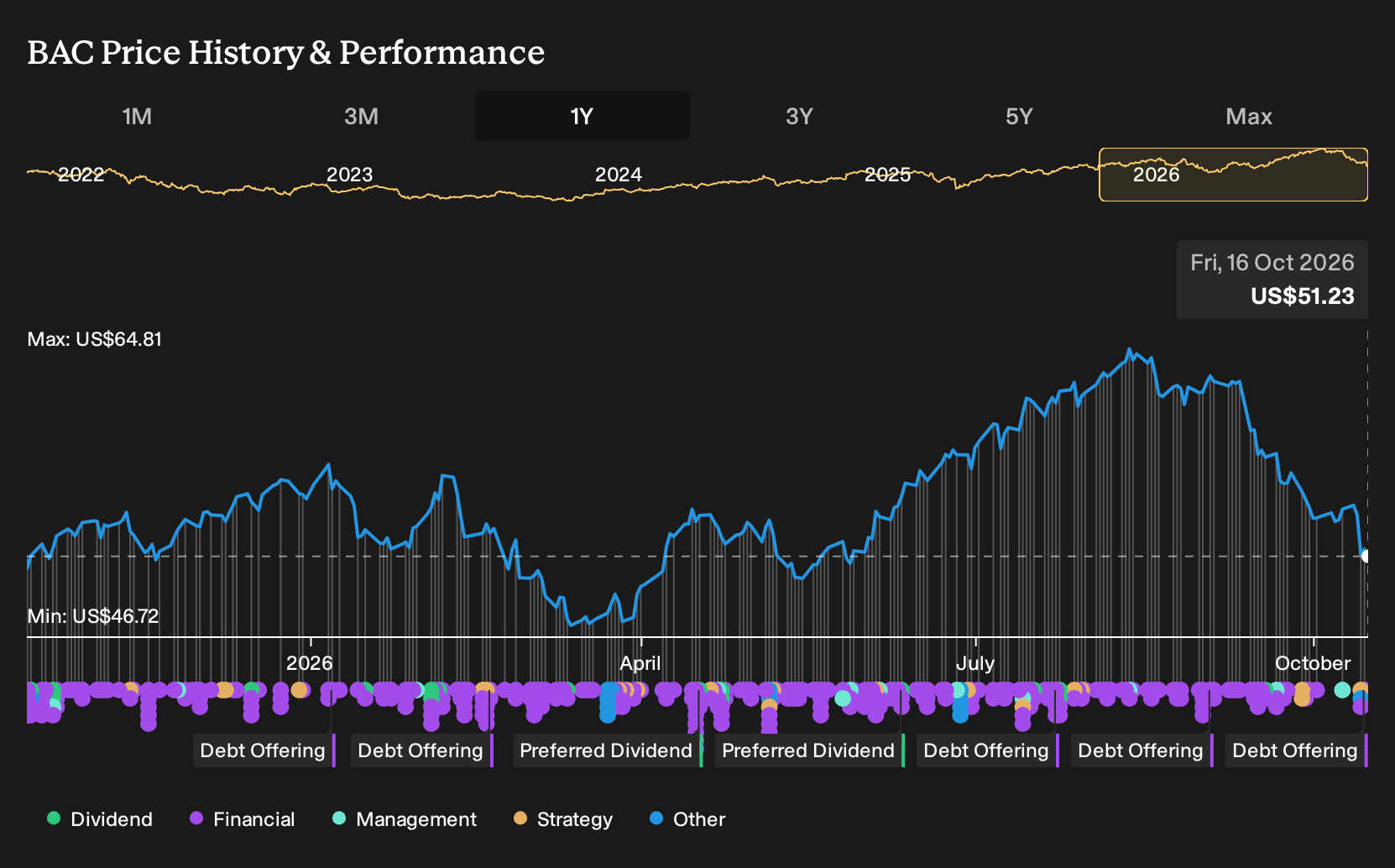
Valuation work in the public reports ties these operating forecasts to a Bank of America price target of US$67.33 per share. This is based on a P/E of 14.0x applied to those 2029 earnings. That compares with a current multiple of about 11.6x and an industry level quoted at 11.4x. The scenario effectively assumes investors are willing to pay more per dollar of profit than they do today for both the bank and the broader US banks sector. A current share price of US$53.52 leaves about 20.5% upside to that target within the consensus framework, but the range between the most optimistic US$75.00 and the most cautious US$62.00 shows that professional opinion is far from uniform.
For readers evaluating Bank of America in the context of its recent AML penalty, these valuation anchors provide a way to stress test assumptions. If compliance and remediation work keep expenses higher for longer, or if revenue growth from AI driven initiatives and international expansion tracks below the 6.6% annual forecast, the implied P/E and price targets in these models may need to be revisited. If earnings instead track the US$38.2b consensus, then the impact of regulatory costs becomes a question of mix and timing rather than overall profit capacity.
Bank of America's narrative projects US$137.8b revenue and US$38.2b earnings by 2029. This implies 6.6% yearly revenue growth and about a US$6.1b earnings increase from US$32.1b today.
Uncover how Bank of America's fair value indicates a 31% potential upside to its current price, which could narrow quickly if sentiment turns.
Exploring Other Perspectives
Seven fair value estimates from the Simply Wall St Community cluster between about US$63 and US$85 per share, with some members seeing Bank of America close to the bottom of that band and others closer to the top. You are weighing those pre penalty views against fresh legal, regulatory and expense risks, so exploring several alternative viewpoints now matters.
Explore 6 other Bank of America fair value estimates, including one that suggests it could be worth just $63.45!
Reach Your Own Conclusion
Disagree with existing narratives? Extraordinary investment returns rarely come from following the herd, so go with your instincts.
- A great starting point for your Bank of America research is our analysis highlighting 5 key rewards that could impact your investment decision.
- See our latest analysis for Bank of America. The report includes a comprehensive fundamental analysis summarized in a single visual, the Snowflake, making it easy to evaluate Bank of America's overall financial health at a glance.
Looking for more investment ideas beyond Bank of America?
If the Bank of America story has sharpened your thinking on risk, income and valuation, you can use that same lens to scan a wider field of opportunities with the Simply Wall St Screener.
- For investors who want potential upside combined with quality fundamentals, you might start with a curated set of 33 high quality undervalued stocks that already screen for resilient balance sheets and cash flows.
- If capital preservation matters just as much as return, you can focus on businesses that score well on stability and financial strength through a list of solid balance sheet and fundamentals (25 results) to see which ones fit your comfort level.
- Those hunting for income ideas can look at companies with higher yields and resilient payout profiles by scanning our 8 dividend fortresses and comparing those options with Bank of America's own income profile.
This article by Simply Wall St is general in nature. We provide commentary based on historical data and analyst forecasts only using an unbiased methodology and our articles are not intended to be financial advice. It does not constitute a recommendation to buy or sell any stock, and does not take account of your objectives, or your financial situation. We aim to bring you long-term focused analysis driven by fundamental data. Note that our analysis may not factor in the latest price-sensitive company announcements or qualitative material. Simply Wall St has no position in any stocks mentioned.
Have feedback on this article? Concerned about the content? Get in touch with us directly. Alternatively, email editorial-team@simplywallst.com