
- PRICING
- LIVE QUOTES
- LEARN
- HELP


EN
From digitizing assets to reconstructing financial channels! BlackRock (BLK.US) accelerates the entry of tokenized funds into the core Wall Street system
The Zhitong Finance App learned that Wall Street's acceptance of blockchain technology is going beyond simply creating digital versions for stocks, bonds, and money market funds to pursue a more ambitious goal — changing the way these assets circulate in the financial system. BlackRock (BLK.US) has not only promoted cryptocurrencies into mainstream portfolios, but also introduced traditional funds to the blockchain. The company believes that tokenized assets have many opportunities, including acting as collateral, enabling round-the-clock transfers between investors, and reducing the need to redeem assets when ownership is transferred.
Some of these apps have already launched. Dan Marley, who is responsible for BlackRock's cash business in Asia Pacific, said BlackRock's tokenized funds have been used as collateral in the digital asset market. However, to extend this use to the traditional financial sector, the situation is much more complicated. This requires banks and other institutions to accept these instruments as collateral, require existing market infrastructure to support these instruments, and require regulatory rules to provide sufficient certainty. Furthermore, although fund tokens can change hands around the clock, this doesn't mean investors can redeem them for cash at any time. In an interview, Marley said, “What really unlocks greater potential is when you can apply it to the traditional financial ecosystem.”
Traditional money market funds are already used as collateral for trading positions, including initial margin and variable margin. Tokenization is expected to make it easier to transfer these positions without prior redemption, which may enable institutions to keep their assets invested for a longer period of time.
But the relevant barriers are not limited to the technical level. The International Monetary Fund (IMF) has stated that tokenized finance still faces a series of problems, including platform fragmentation, legal uncertainty, and difficulties in connecting with existing financial infrastructure.
Similarly, the International Swaps and Derivatives Association (ISDA) believes that a series of operational-level barriers are still preventing the extension of tokenization into traditional finance. ISDA is a global derivatives industry organization responsible for formulating widely used legal standards and documentation specifications in the field of derivatives transactions and collateral. Scott O'Malia, CEO of the association, said, “Issues relating to the escrow and asset segregation framework, capital and security deposit handling, cross-border recognition, and legal certainty must be addressed through industry standards and clear regulatory rules.”
These questions help explain why tokenized assets can be efficiently transferred on the blockchain, yet are not yet widely used in traditional collateral and settlement systems.
For BlackRock, the key difference is that tokenization does not change the assets held by money market funds, but rather changes the underlying channels that ownership transfers rely on. Fund shares in the form of tokens can be transferred between approved investors, which is expected to enable institutions to transfer assets without first redeeming them for cash.
The earliest users were mainly from the cryptocurrency sector. BlackRock's digital asset team director Nikhil Sharma said that many users are investors who hold stablecoins on the chain, and they want to find a way to earn revenue. “The extension to the collateral sector also comes from this group,” Sharma said.
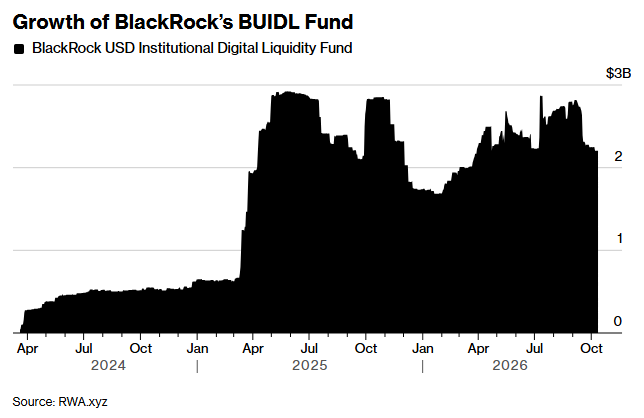
BlackRock is expanding the scope of application of this model. The company's first tokenized money market fund, BUIDL, has grown to around $2.3 billion since its launch in 2024, making it one of the largest funds in its class. Since then, BlackRock has also launched tokenized cash products in the US and Europe, and was approved in September to launch a Hong Kong dollar digital liquidity fund. The fund can accept both traditional and digital forms of cash.
The challenge now is how to enable traditional financial institutions to incorporate such assets into existing systems rather than requiring them to set up separate digital asset operating models. Sharma said investors are asking how tokenized products fit into current workflows, including connecting through established custodians and asset service providers.
“Obviously, investors will need time to figure out where these products can be integrated into the workflow and how to extend existing behavioral models to these products,” he said. He also added that adoption of these newer products “will gradually accelerate from now on.”