
- PRICING
- LIVE QUOTES
- LEARN
- HELP


EN
3 US Bank Stocks That Could Benefit If The Fed Holds Rates Higher Longer
With prediction markets now leaning heavily toward a Fed pause in October, yet inflation data still keeping rate hike risk alive, cash has become more than just a parking bay. Investors are quietly rethinking where idle balances sit, as higher yields and sudden volatility can quickly reward or punish choices around money-market style products. This article unpacks that tension and walks through 3 US stocks tied to this rate-sensitive story.
The stocks covered next are just a small sample of this theme, with the full screen surfacing 30 more U.S. cash-focused financials and asset managers that carry similarly detailed stories not unpacked here. If you want to identify, compare, and analyze the higher-conviction ideas first, head straight to the US Cash-Rich Financials and Money-Market Product Providers screener.
Dime Commercial Bancshares (DCOM)
Overview: Dime Commercial Bancshares is a New York based community-focused bank that turns business, consumer, and municipal deposits into loans and cash-management services across the United States.
Operations: The group generates about US$439 million of revenue from community banking activities in the United States, centred on lending and deposits.
Market Cap: US$1.7b
Dime Commercial Bancshares matters in this cash-focused screen because commercial clients do not just borrow from the bank, they also park sizeable operating balances that can influence how profits respond when interest rates settle rather than spike.
"The scheduled repricing or maturity of about US$2.5b of fixed and adjustable-rate loans at an average rate of 4.25% over the next 18 months provides a clear path for higher earning asset yields, which is expected to feed into net interest margin and earnings over the next several years."
The real swing factor is how one unresolved pressure on deposit pricing and customer behaviour shapes those future margins and cash flows.
That deposit squeeze is exactly where the story gets interesting, and the full narrative for Dime Commercial Bancshares unpacks how repricing, funding mix, and fee income could reshape that margin path.

Hope Bancorp (HOPE)
Overview: Hope Bancorp runs Bank of Hope, a U.S. retail and commercial bank that turns everyday operating and savings deposits into loans and cash-management services.
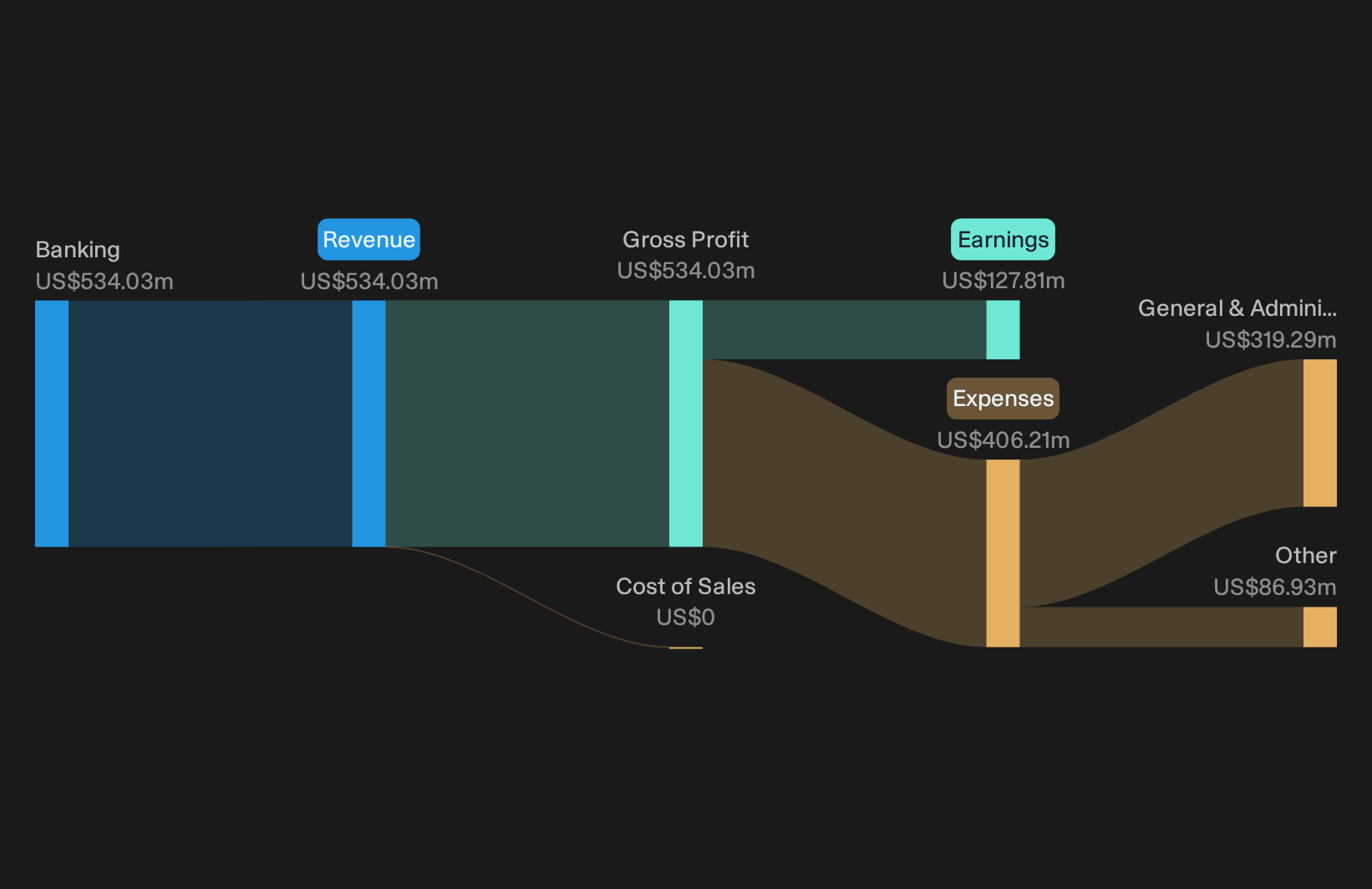
Operations: Hope Bancorp generates about US$534 million of revenue from banking activities in the United States, with all reported income tied to that segment.
Market Cap: US$1.7b
Hope Bancorp matters for a cash-focused screen because its mix of checking, savings, and money market balances gives it room to earn more from short-term yields if the Fed holds rates steady for longer than markets once feared.
"The SMBC MANUBANK commercial banking unit acquisition is expected to add roughly US$2.3b to US$2.7b of loans and US$2.6b to US$2.7b of largely non CD deposits, which could lift Hope Bancorp’s future net interest income and earnings once the book is integrated and repriced."
What happens to Hope Bancorp's margins now largely depends on how one evolving pressure on the cost of deposits and repricing unfolds.
That funding squeeze is the real hinge, and the full narrative for Hope Bancorp shows how deposit pricing, integration risk, and fee income could be decoupling from headline loan growth.
Seacoast Banking Corporation of Florida (SBCF)
Overview: Seacoast Banking Corporation of Florida is a Florida based regional bank that provides deposit, lending, cash management, and wealth services to households and businesses.
Operations: Seacoast Banking Corporation of Florida generates about US$682 million of integrated financial services revenue, essentially all from customers in the United States.
Market Cap: US$3.1b
Seacoast Banking Corporation of Florida fits this cash focused screen because its Florida deposit base, money market accounts, and sweep balances link directly to how higher short term rates feed into earnings quality rather than just headline loan growth.
"Growth in wealth management, with assets under management up 45% year over year and income up 42% year over year by Q2 2026, points to a larger recurring fee stream that can increase noninterest revenue and smooth earnings for Seacoast Banking Corporation of Florida."
This raises the question of what happens when one subtle shift in how those cash heavy clients allocate balances across deposits, sweeps, and wealth products shapes future margins.
When that allocation shift starts to bite, the full narrative for Seacoast Banking Corporation of Florida shows how Seacoast Banking Corporation of Florida’s cash rich clients could be quietly reshaping earnings quality and risk.

Seeking Fresh Alternatives Before They Fly
Fresh ideas often move first, then the data catches up. Spot breakouts while they are still under the radar for now and before momentum gets fully priced in, and consider acting before conditions change.
- Explore durable income streams before yields get caught in a rush by scanning a curated set of high-payout opportunities through the 8 dividend fortresses.
- Track early AI momentum while many investors are still looking the other way by zeroing in on focused opportunities inside the 39 profitable AI stocks that aren't just burning cash.
- Look at potential infrastructure breakouts as electrification spending builds by reviewing a concentrated group inside the 42 power grid technology and infrastructure stocks.
This article by Simply Wall St is general in nature. We provide commentary based on historical data and analyst forecasts only using an unbiased methodology and our articles are not intended to be financial advice. It does not constitute a recommendation to buy or sell any stock, and does not take account of your objectives, or your financial situation. We aim to bring you long-term focused analysis driven by fundamental data. Note that our analysis may not factor in the latest price-sensitive company announcements or qualitative material. Simply Wall St has no position in any stocks mentioned.
Have feedback on this article? Concerned about the content? Get in touch with us directly. Alternatively, email editorial-team@simplywallst.com