
- PRICING
- LIVE QUOTES
- LEARN
- HELP


EN
How Investors May Respond To Centene (CNC) Gold Card Program Launch
- Centene announced the National Performance-Based Gold Card Program, set to start in November 2026, giving more than 160,000 qualifying providers streamlined prior authorization for select outpatient services based on objective performance metrics and compliance standards.
- The Gold Card approach ties reduced administrative friction directly to evidence-based ordering and documentation quality, which can influence Centene's operating efficiency, medical cost control, and relationships with high-performing providers.
- We will now look at how Centene's investment narrative could be affected by this nationwide Gold Card effort to simplify prior authorizations.
Scan how Centene's push to cut friction in healthcare compares with other companies easing operational pressure across the sector by reviewing list of solid balance sheet and fundamentals (25 results) today.
Centene Investment Narrative Recap
To own Centene, you need to believe its push to clean up government program economics will eventually outweigh near term pressure in Medicaid and Marketplace volatility. The Gold Card program fits that story only at the margin. It aligns with cost discipline and quality, but the heavy lifting still comes from rate yields, benefit design and medical cost controls.
The most important near term swing factor remains Medicaid margin recovery and keeping the 2026 HBR and composite rate outlook on track while eligibility tightening plays through. Policy risk around Medicaid funding and Marketplace premium support still looks like the biggest threat to that reset.
The recent decision to redeem the remaining US$568.7m of 4.25% notes due 2027 ties closest to the operating catalysts. Cleaning up that slice of debt can simplify the balance sheet and interest line, which matters when investors are watching every lever tied to future earnings power and P/E debate.
For you as a shareholder, the link is straightforward. Margin work in Medicaid, Marketplace and Medicare needs support from leaner overhead and efficient funding. Gold Card and CHOICE programs speak to day to day execution, while debt redemption shows Centene still adjusting its capital structure alongside those operating targets.
Centene's current analyst narrative points to revenues of US$205.7b and earnings of US$3.2b by 2029, built on an assumed 4.5% yearly revenue growth rate and a shift from a loss of US$5.1b today to that future profit. This implies an earnings improvement of about US$8.3b over the period.
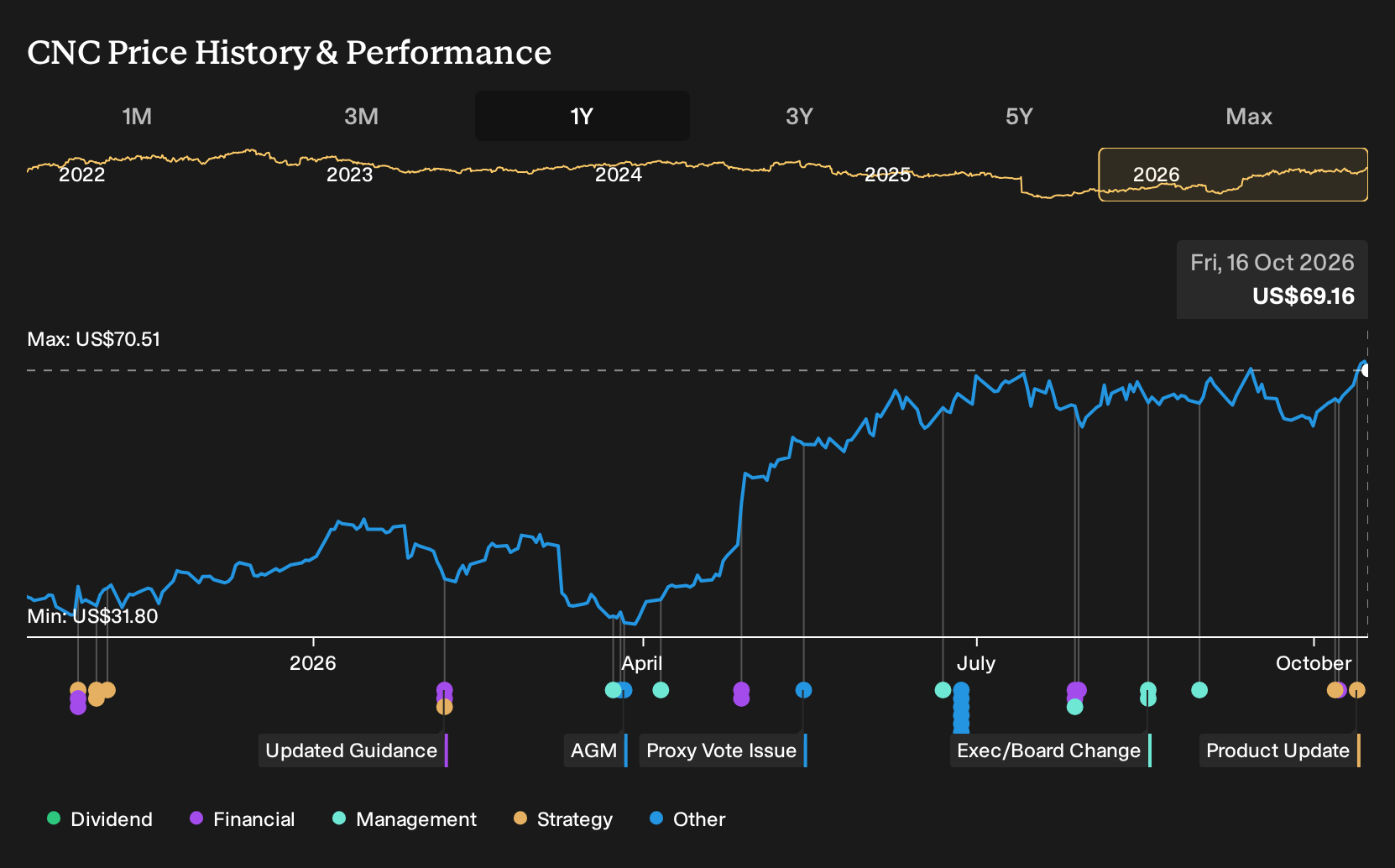
Uncover why Centene's fair value indicates a 4% potential upside to its current price, a gap that could narrow quickly.
Exploring Other Perspectives
One alternate view says Medicaid pressure, not Gold Card style efficiency wins, should sit at the front of your Centene thesis. The most bearish analysts were only penciling in roughly US$191.9b of revenue and US$3.3b of earnings by 2029. That is a tighter story, and the new program could eventually push those expectations around.
Explore 4 other Centene fair value estimates, including one that suggests it could be worth just $71.78.
Decide For Yourself
Disagree with existing narratives? Extraordinary investment outcomes rarely come from following the herd, so consider developing your own view.
- A great starting point for your Centene research is our analysis highlighting 3 key rewards and 1 important warning sign that could impact your investment decision.
- See our latest analysis for Centene. The report includes a comprehensive fundamental analysis summarized in a single visual, the Snowflake, making it easy to evaluate Centene's overall financial health at a glance.
Looking for more investment ideas beyond Centene?
Once you have a view on Centene, it can help to set it alongside a few different types of opportunities so you see where it really fits in your portfolio.
- If you want potential mispricing with sturdier finances, start with a focused group of 33 high quality undervalued stocks that pair quality with disciplined balance sheets.
- For income-oriented positions that still aim to keep risk controlled, scan a curated set of 8 dividend fortresses that combine higher yields with financial resilience.
- When capital preservation matters just as much as upside, review a 32 resilient stocks with low risk scores that screens for companies with steadier fundamentals and lower risk scores.
This article by Simply Wall St is general in nature. We provide commentary based on historical data and analyst forecasts only using an unbiased methodology and our articles are not intended to be financial advice. It does not constitute a recommendation to buy or sell any stock, and does not take account of your objectives, or your financial situation. We aim to bring you long-term focused analysis driven by fundamental data. Note that our analysis may not factor in the latest price-sensitive company announcements or qualitative material. Simply Wall St has no position in any stocks mentioned.
Have feedback on this article? Concerned about the content? Get in touch with us directly. Alternatively, email editorial-team@simplywallst.com