
- PRICING
- LIVE QUOTES
- LEARN
- HELP


EN
Raised Earnings Outlook Might Change The Case For Investing In United Rentals Stock (URI)
- United Rentals heads into its next earnings release with Wall Street projecting quarterly EPS of $13.75 and revenue of $4.67b, both above the prior year.
- The focus now sits on how effectively United Rentals turns its large project pipeline and expanding specialty rental footprint into returns on heavy CapEx.
- Next, the discussion looks at how United Rentals' higher projected EPS shapes the broader investment narrative around projects, margins, and capital deployment.
Scan how United Rentals compares with other heavy capital users by reviewing hand-picked industrials on the list of solid balance sheet and fundamentals (25 results) that show resilience when big projects and cash generation really matter.
United Rentals Investment Narrative Recap
To own United Rentals, you need to be comfortable with a heavy equipment rental model that leans on big infrastructure, power, and data center projects, plus a fast growing Specialty segment. The near term hinge is how cleanly those projects convert into cash on the US$5.25b CapEx plan and the existing fleet, without time utilization slipping.
The biggest risk is still a slowdown in large projects while local customers grow only modestly. That would hit rental volumes just as ancillary and re rent revenue, which carry thinner margins, take a bigger mix. The latest earnings projections do not change that risk reward equation in a material way.
The most relevant recent datapoint is the lift in projected quarterly EPS to US$13.75 on US$4.67b of revenue. Those expectations put execution under the microscope. If United Rentals keeps Specialty rental revenue growing from the Q2 2026 base, with those 11 cold starts contributing, the market gets more evidence that the expanded fleet is earning its keep.
Higher earnings forecasts also sharpen attention on margins and cash conversion. Ancillary revenue is growing at roughly three times the pace of core rentals, while also dragging on profitability, and that raises the bar for cost control. For you as a shareholder, the real watch items around this announcement are project momentum, EBITDA mix, and whether heavy CapEx still leaves room for flexible capital returns.
United Rentals' current analyst storyline points to revenues of US$22.4b and earnings of US$4.0b by 2029, built on assumed revenue growth of 10.0% a year and an earnings increase of US$1.4b from US$2.6b today.
Uncover why United Rentals' fair value indicates a 23% potential upside to its current price before other investors close that valuation gap.
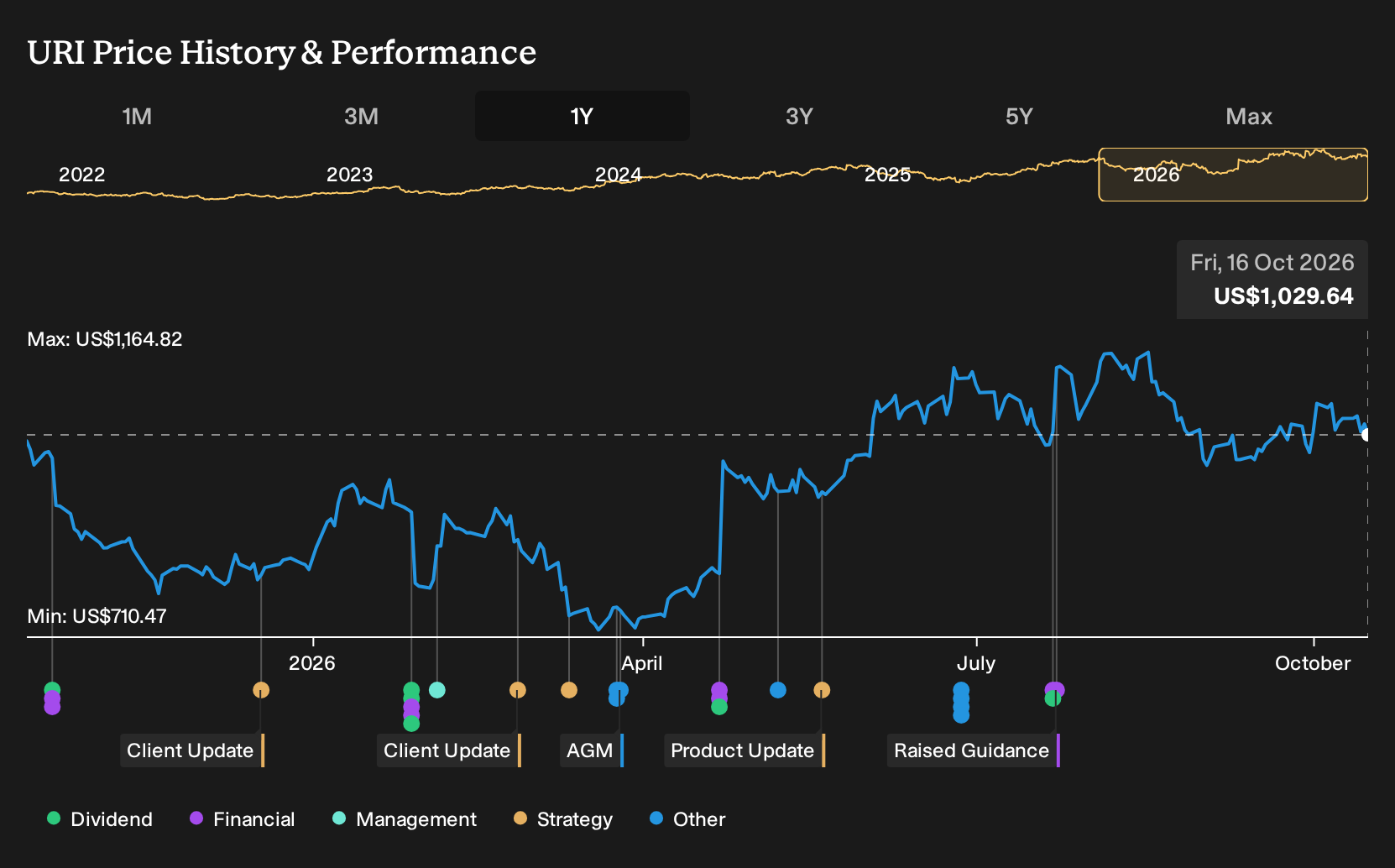
Exploring Other Perspectives
One alternate view on United Rentals zooms in on return on invested capital. Bullish analysts argue that if ROIC stabilises or improves, their higher 2029 earnings view of about US$4.3b on US$23.5b in revenue could look reasonable. Before this earnings news, that camp already sketched a much more optimistic path, which may shift again as fresh data lands.
Explore 2 other United Rentals fair value estimates, including one that suggests as much as 23% potential upside from the current price.
Decide For Yourself
Don't just follow the ticker. Dig into the data and build a conviction that's truly your own.
- A great starting point for your United Rentals research is our analysis highlighting 4 key rewards and 2 important warning signs that could impact your investment decision.
- See our latest analysis for United Rentals. The report includes a comprehensive fundamental analysis summarized in a single visual, the Snowflake, making it easy to evaluate United Rentals' overall financial health at a glance.
Looking For More Investment Ideas Beyond United Rentals?
Once you have a view on United Rentals, it helps to compare it against other businesses that fit clear financial filters so you can see where the risk and return trade off feels right for you.
- If you want a short list of companies that combine robust finances with room to grow, start with a list of solid balance sheet and fundamentals (25 results) that keeps financial resilience front and center.
- For investors who care most about price versus fundamentals, a focused set of opportunities on the 33 high quality undervalued stocks can highlight where expectations and current pricing may be out of sync.
- If lower volatility and capital preservation matter more to you than aggressive upside, consider stocks filtered by the 32 resilient stocks with low risk scores to see which businesses the Screener flags as more resilient.
This article by Simply Wall St is general in nature. We provide commentary based on historical data and analyst forecasts only using an unbiased methodology and our articles are not intended to be financial advice. It does not constitute a recommendation to buy or sell any stock, and does not take account of your objectives, or your financial situation. We aim to bring you long-term focused analysis driven by fundamental data. Note that our analysis may not factor in the latest price-sensitive company announcements or qualitative material. Simply Wall St has no position in any stocks mentioned.
Have feedback on this article? Concerned about the content? Get in touch with us directly. Alternatively, email editorial-team@simplywallst.com