
- PRICING
- LIVE QUOTES
- LEARN
- HELP


EN
Pfizer (PFE) Stock Looks Richly Priced On Current Earnings
Pfizer shares have climbed back into focus after a year of double digit gains, and the current quote raises a straightforward question about whether that price lines up with what the business is earning today. Recent headlines around new cancer treatments, vaccines and legal challenges only sharpen the need to ask how much of those shifting expectations is already reflected in the stock.
- With a 29.1% return over the past year, Pfizer has rewarded shareholders recently and put more weight on the question of how much of its earnings power is already reflected in the valuation.
- The expanded approval for Tukysa in HER2 positive breast cancer and the pipeline work in areas like Sec61 inhibitors and infectious disease vaccines can influence how investors think about the sustainability and timing of future profit streams.
- The analysts covering Pfizer have run their own numbers. See what analysts think Pfizer's shares could be worth.
The issue now is whether Pfizer's current share price is appropriately supported by its earnings when set against the Fair Ratio benchmark.
If you are weighing whether Pfizer's recent 29.1% one-year return is fairly supported by its earnings, it may help to compare that question across 33 high quality undervalued stocks.
Has Pfizer Run Too Far on Earnings?
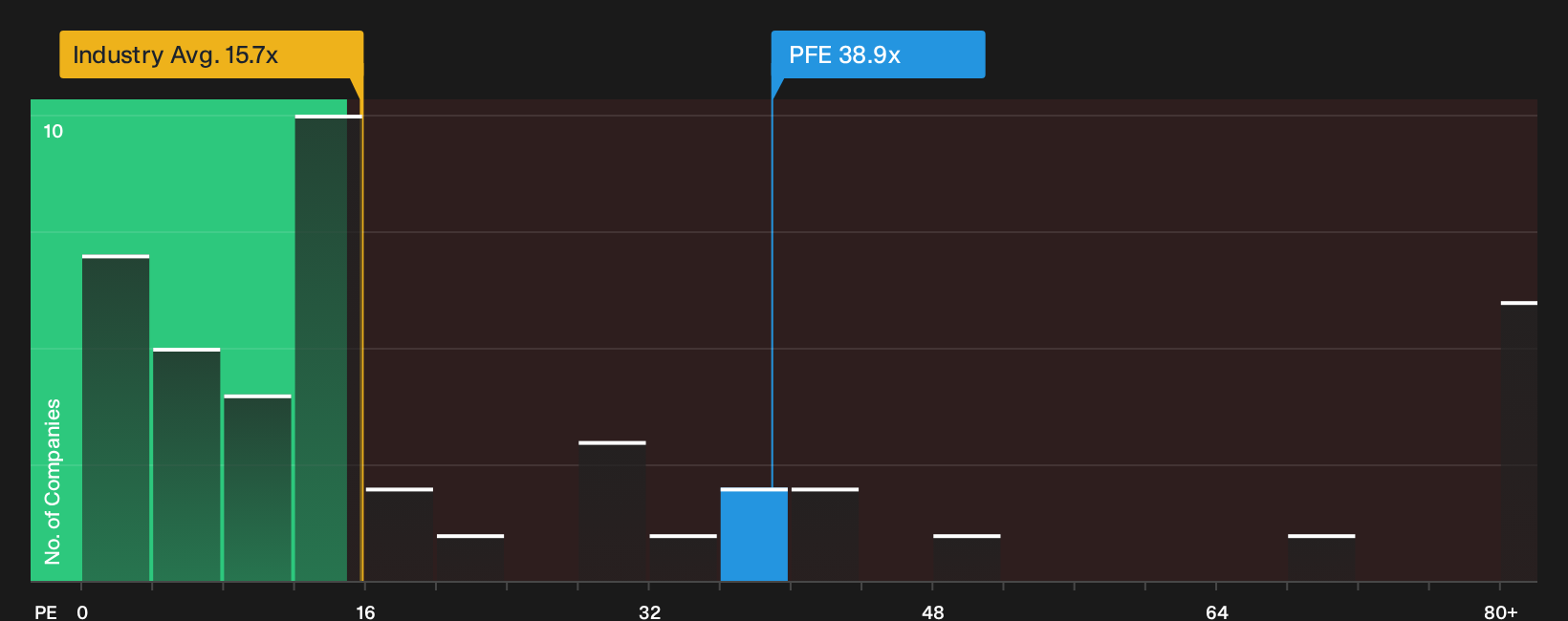
The P/E ratio suits Pfizer because earnings remain the main anchor for how investors weigh its mix of established drugs and newer oncology and vaccine assets. On this measure, Pfizer trades on about 38.9x earnings, which is above the wider Pharmaceuticals industry average of 15.7x and still below the peer group at roughly 58.3x. That leaves the stock on a richer multiple than the sector overall, yet not at the upper tier of large drug makers on this metric.
The Fair Ratio, which adjusts for Pfizer's own growth profile, margins, scale and risk, sits below the current P/E, so the shares screen as overvalued on this framework. Despite recent enthusiasm around the expanded Tukysa approval and the broader oncology pipeline, the earnings multiple already embeds a relatively full view of Pfizer's profit potential on these assumptions. For readers weighing whether that premium is justified, the next step is to consider how much conviction they have in the durability of the cash flows behind that 38.9x figure. Explore the numbers behind Pfizer's P/E valuation.
The Pfizer Narrative: What Would Justify Today's Price?
Pfizer's current valuation raises a clear question about what would need to happen next for earnings, margins and reinvestment to support a higher or lower share price, and Simply Wall St Narratives are built to spell out those implied paths. Instead of a single P/E or model output, each scenario sets out the earnings and cash flow assumptions behind its view of fair value so you can compare those expectations with Pfizer's actual results as they are reported on the Community page.
Pfizer draws two camps right now, with one community cohort seeing more long term potential in the pipeline and dividend support than the other.
Bull case: 18% undervalued
"Management’s stated intent to preserve the dividend even under stretched scenarios and to resume dividend growth after the 2028 loss of exclusivity period…"
Discover why this Narrative puts Pfizer at 18% undervalued.
Bear case: roughly fairly valued
"COVID revenues are guided to decline from about US$11b in 2024 to an expected US$4b in 2026 after a reduction in the 2026 outlook…"
Explore why this Narrative puts Pfizer at roughly fairly valued.
Pfizer's valuation still leaves one big piece of the puzzle unresolved
Price multiples tell you what the market thinks of Pfizer right now, but the projected earnings path a few years out offers a different lens on what that judgment implies. Explore where analysts expect Pfizer to be in a few years.
This article by Simply Wall St is general in nature. We provide commentary based on historical data and analyst forecasts only using an unbiased methodology and our articles are not intended to be financial advice. It does not constitute a recommendation to buy or sell any stock, and does not take account of your objectives, or your financial situation. We aim to bring you long-term focused analysis driven by fundamental data. Note that our analysis may not factor in the latest price-sensitive company announcements or qualitative material. Simply Wall St has no position in any stocks mentioned.
Have feedback on this article? Concerned about the content? Get in touch with us directly. Alternatively, email editorial-team@simplywallst.com