
- PRICING
- LIVE QUOTES
- LEARN
- HELP


EN
Will ChatGPT Pet Insurance Change MetLife (MET) Narrative
- MetLife announced that MetLife Pet Insurance integrated its portal with a ChatGPT plugin, allowing pet owners to use conversational input to obtain personalized quotes, complete applications and connect to the MetLife Pet website to purchase coverage, marking a first for a major pet insurer.
- The move highlights how MetLife is using AI tools to reduce friction in customer onboarding, with potential implications for acquisition costs, digital engagement and the efficiency of scaling the pet segment within the broader business.
- We will now look at how MetLife's investment narrative could be influenced by this new AI driven ChatGPT pet insurance integration.
See how MetLife’s AI driven pet insurance initiative compares with other insurers and technology-focused financial stocks by checking out the 33 high quality undervalued stocks that already screen well on quality and value.
MetLife Investment Narrative Recap
To own MetLife, you need to believe that management can keep executing on the New Frontier program and grow earnings from a mix of capital light fee businesses and retirement products. The key near term swing factor is still execution on spreads and fee income. The pet insurance ChatGPT plugin is directionally helpful for digital engagement, but not a major short term catalyst on its own.
The biggest operational risk remains pressure on fee based earnings and spreads, especially with MetLife Investment Management guiding 2026 adjusted earnings toward the low end of its range and Retirement and Income Solutions operating below its spread target. Weak investment performance or muted demand could keep margins under strain and make earnings delivery harder.
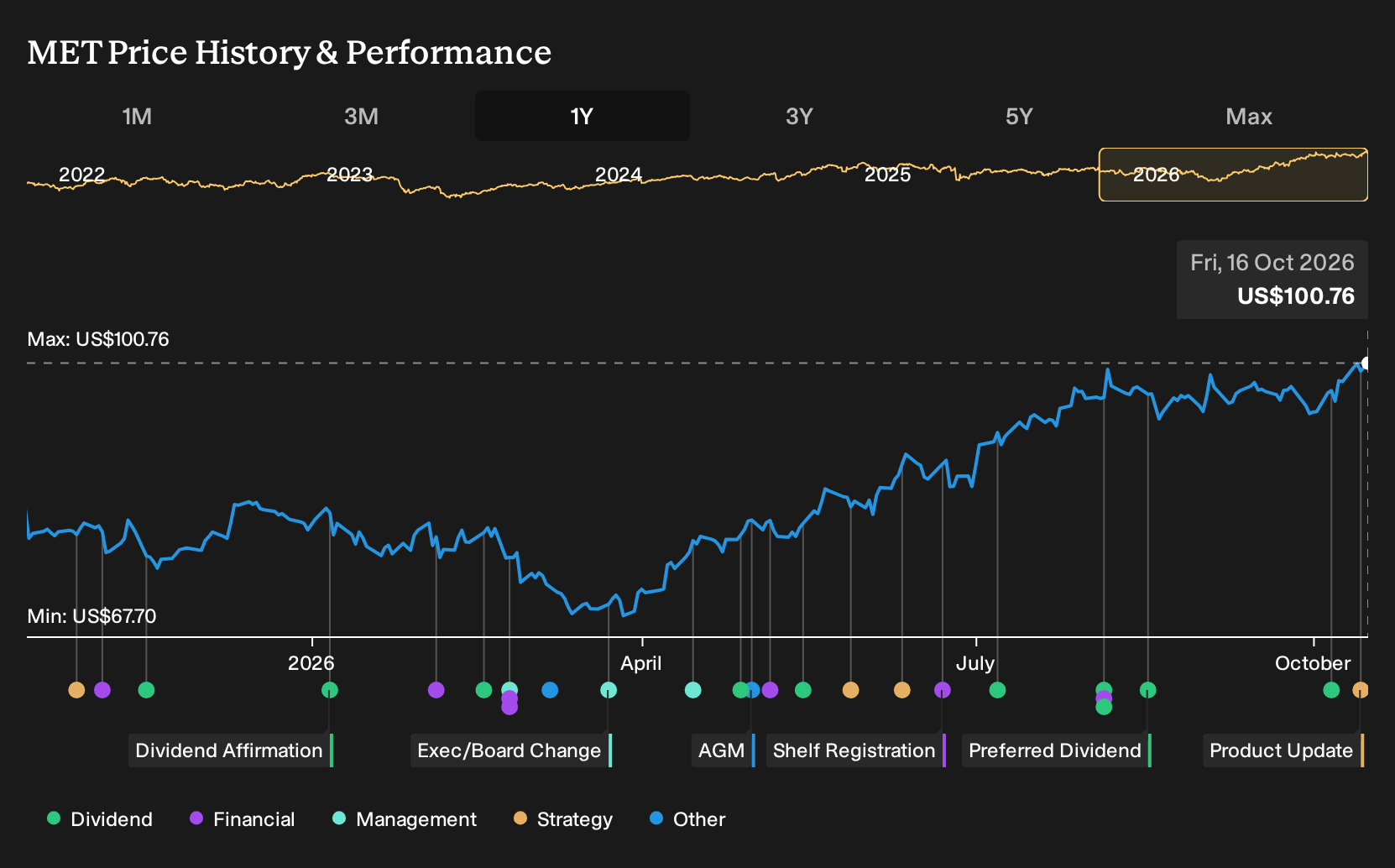
Among the recent updates, the fourth quarter 2026 dividend declaration of US$0.5925 per share is particularly relevant when you think about catalysts. For income focused holders, a regular payout indicates that current earnings and capital remain sufficient to support ongoing distributions, even while parts of the business work through spread and fee pressure.
That dividend, together with prior commentary about dividend coverage and buybacks, keeps capital returns in focus as a practical driver of shareholder value. The sustainability of those returns still depends on execution on technology projects such as the MetLife Pet ChatGPT plugin, international expansion and the New Frontier cost and efficiency targets, because those areas support cash generation over time.
MetLife's current analyst narrative points to revenues of US$89.7b and earnings of US$7.1b by 2029, based on forecast revenue growth of 4.2% per year and an increase in profit from US$3.4b today, which implies roughly a doubling of earnings over the period.
Uncover how MetLife's fair value indicates a 7% potential upside to its current price before that valuation gap closes.
Exploring Other Perspectives
Two fair value estimates from the Simply Wall St Community span roughly US$107 to US$174, so retail views on MetLife’s worth differ sharply. That spread appears against a backdrop of pressure on fee based earnings and spreads, alongside ongoing AI investment such as the pet insurance plugin. Use these contrasts to test your own thesis.
Explore another MetLife fair value estimate, including one that suggests it could be worth just $107.38.
Decide For Yourself
Don't just follow the ticker. Dig into the data and build a conviction that's truly your own.
- A great starting point for your MetLife research is our analysis highlighting 3 key rewards and 1 important warning sign that could impact your investment decision.
- See our latest analysis for MetLife. The report includes a comprehensive fundamental analysis summarized in a single visual, the Snowflake, making it easy to evaluate MetLife's overall financial health at a glance.
Looking For More Ideas Beyond MetLife?
Once you have a view on MetLife, it can help to compare that thesis with other opportunities that fit different risk and income profiles. A targeted screener gives you a fast way to surface companies that match the kind of portfolio you want to build.
- If you want potential upside with strict quality filters in place, scan through our 20 high quality undiscovered gems that already clear tough fundamental checks.
- For steadier candidates that aim to limit downside shocks, narrow the field with a 32 resilient stocks with low risk scores tailored to resilience and lower volatility.
- If income is first on your checklist with an eye on durability, then a 8 dividend fortresses can point you toward businesses built around robust cash payouts.
This article by Simply Wall St is general in nature. We provide commentary based on historical data and analyst forecasts only using an unbiased methodology and our articles are not intended to be financial advice. It does not constitute a recommendation to buy or sell any stock, and does not take account of your objectives, or your financial situation. We aim to bring you long-term focused analysis driven by fundamental data. Note that our analysis may not factor in the latest price-sensitive company announcements or qualitative material. Simply Wall St has no position in any stocks mentioned.
Have feedback on this article? Concerned about the content? Get in touch with us directly. Alternatively, email editorial-team@simplywallst.com