
- PRICING
- LIVE QUOTES
- LEARN
- HELP


EN
Upcoming Results Might Change The Case For Investing In P&G Stock
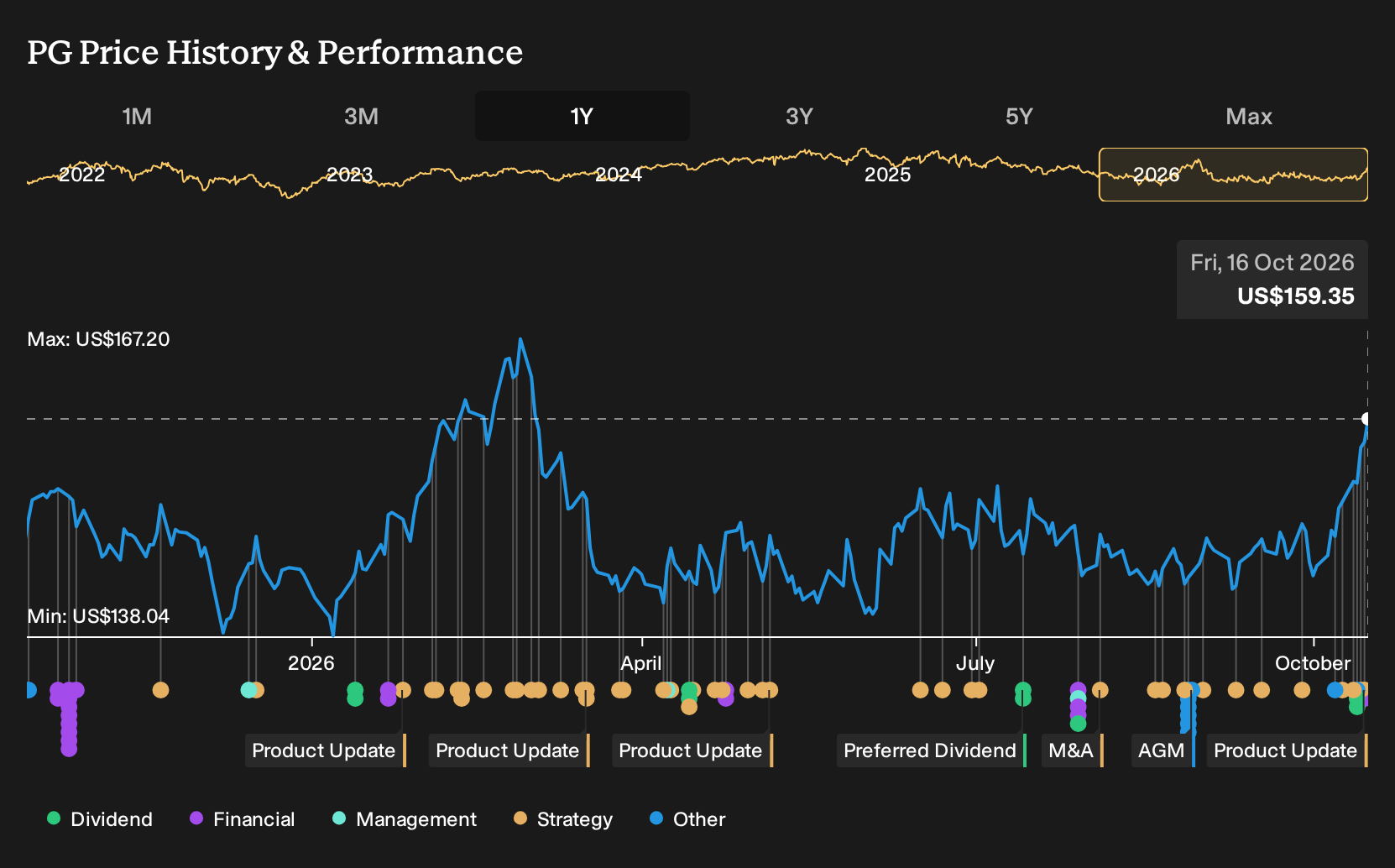
- In the past week, Procter & Gamble held its 2026 annual shareholder meeting, detailed multiple shareholder proposal rejections, confirmed common and preferred dividends, filed a new debt shelf, and continued to roll out fresh launches across Crest, Head & Shoulders, Charmin, and Pampers.
- The mix of fresh shelf capacity, ongoing dividend commitments, and brand refreshes in core categories keeps investor focus on how Procter & Gamble balances funding new products against input cost pressure and softer consumer demand as it approaches its next quarterly update.
- We will now look at how Procter & Gamble's capital returns and new debt shelf shape its investment narrative ahead of upcoming results.
Compare how Procter & Gamble is handling product spending, dividends and fresh debt capacity with other consumer stocks using our hand-picked list of solid balance sheet and fundamentals (25 results) as a starting point.
Procter & Gamble Investment Narrative Recap
To own Procter & Gamble, you need to believe that everyday branded products can keep pulling steady demand even while retailer orders and input costs stay choppy. The near term swing factor is whether productivity savings and pricing can offset the US$1.4b cost and FX drag that management has flagged for fiscal 2027.
The biggest current risk is that retailer inventory moves in the US and Europe keep distorting sell in, leaving organic sales softer than underlying consumption. This week’s shareholder votes and product launches do not materially change that risk, but they keep attention on execution ahead of the next quarterly results.
The new shelf registration for debt securities is the announcement that really ties this week together for Procter & Gamble. Extra funding flexibility gives the business more room to support launches like Crest Sensitivity Relief, Head & Shoulders Scalp Care and Charmin Ultra Strong Wider Sheets while still honoring sizeable dividend commitments.
For you as an investor, the key question is how any future issuance under that shelf would be used. If management channels fresh capital into productivity projects, capacity and brand support that help absorb cost headwinds, the shelf can reinforce existing catalysts. If leverage rises without clear returns, it could aggravate the main risk around margins.
Procter & Gamble's current analyst story links a forecast revenue figure of US$94.5b and earnings of US$18.2b by 2029 to an assumed 2.8% yearly increase in sales and an earnings rise of US$2.4b from US$15.8b today.
Uncover why Procter & Gamble's fair value indicates Procter & Gamble is roughly in line with its current price.
Exploring Other Perspectives
The 17 fair value estimates from the Simply Wall St Community stretch from US$107.52 to about US$196.96, so some members see Procter & Gamble as heavily stretched while others view it as materially undervalued. With the recent dividend affirmation, the new debt shelf and product launches considered together, investors may reasonably arrive at very different views on future resilience. Use this range of estimates to test your own assumptions and explore alternative viewpoints before relying on any single narrative.
Explore 16 other Procter & Gamble fair value estimates, including one that suggests as much as 33% downside from the current price.
Form Your Own Verdict
Don't just follow the ticker; dig into the data and build a conviction that's truly your own.
- A great starting point for your Procter & Gamble research is our analysis highlighting 4 key rewards and 2 important warning signs that could impact your investment decision.
- See our latest analysis for Procter & Gamble. The report includes a comprehensive fundamental analysis summarized in a single visual, the Snowflake, making it easy to evaluate Procter & Gamble's overall financial health at a glance.
Looking for more Procter & Gamble style investment ideas?
If Procter & Gamble helps you think about quality, income, and resilience, it can be useful to stress test that framework against a broader watchlist using the Simply Wall St Screener.
- If you want potential value on your side, start by checking companies flagged as attractively priced through the 33 high quality undervalued stocks.
- If income is a priority, look for companies that aim to combine higher yields with stability using the 8 dividend fortresses.
- If resilience matters most to you, filter for businesses with strong financial footing through the 32 resilient stocks with low risk scores.
This article by Simply Wall St is general in nature. We provide commentary based on historical data and analyst forecasts only using an unbiased methodology and our articles are not intended to be financial advice. It does not constitute a recommendation to buy or sell any stock, and does not take account of your objectives, or your financial situation. We aim to bring you long-term focused analysis driven by fundamental data. Note that our analysis may not factor in the latest price-sensitive company announcements or qualitative material. Simply Wall St has no position in any stocks mentioned.
Have feedback on this article? Concerned about the content? Get in touch with us directly. Alternatively, email editorial-team@simplywallst.com