
- PRICING
- LIVE QUOTES
- LEARN
- HELP


EN
Metro (HMSE:B4B0) Could Be 81% Undervalued Following Its Strong 2026 Share Price Run
Metro (HMSE:B4B0) has drawn investor attention after recent trading left the wholesale-focused retailer with a market value of about €2.6b and an intrinsic discount figure that suggests the shares trade well below estimated fair value.
Recent trading has pushed Metro's share price to €7.20, and the stock has built a strong run with a year to date share price return of 25.87% alongside a 1 year total shareholder return of 28.34%, indicating positive momentum as the market reassesses its discounted valuation.
Scan how Metro's valuation story compares with other potential opportunities by reviewing a hand-picked set of 191 high quality undervalued stocks that currently trade at a discount on Simply Wall St.
The wholesale specialist has already delivered a strong run, yet Metro still trades at a steep implied discount to estimated fair value. Is most of the upside already reflected in the price, or is that gap still meaningful?
Preferred Price-to-Sales Multiple of 0.1x: Is it justified?
Metro looks deeply discounted on a sales basis, with the P/S ratio at roughly 0.1x compared with peers and the wider European Consumer Retailing group, which are both higher. That low multiple sits against a last close of €7.20 and an intrinsic discount flag from the SWS DCF model that points to a large gap versus estimated fair value.
The price to sales metric compares the market value of the equity with the annual revenue the business generates. For a wholesaler like Metro that runs on thin margins but very large volumes, investors often pay closer attention to this yardstick because earnings can swing around more than top line turnover.
On €33.1b of reported revenue and a market value of about €2.6b, investors are currently paying only a fraction of each euro of sales that the peer group commands. The SWS DCF model reinforces that message by flagging a future cash flow value per share of €37.46 against the current €7.20 price. This is a very large implied discount and suggests the market is pricing in persistent pressure on profitability and balance sheet risk rather than giving credit for the scale of the wholesale network.
Relative to the European Consumer Retailing industry P/S of 0.4x, Metro trades at one quarter of the sector level, and it also sits well below the 0.2x peer average cited in the checks above. That is strong comparative evidence that the stock is being valued more harshly on sales than direct competitors, even before accounting for the SWS DCF output that points to a sizeable gap between market price and cash flow based value.
See what the numbers say about this price — find out in our valuation breakdown.
Result: Price-to-sales of 0.1x (UNDERVALUED)
Still, Metro carries clear risks, including its reported net loss of €264m and thin wholesale margins. These factors could keep the market cautious on the stock.
Find out about the key risks to this Metro narrative.
Another View on Metro's Value
Price to sales paints Metro as cheap, but the SWS DCF model goes much further. At a share price of €7.20, the future cash flow value per share is estimated at €37.46, which implies the stock trades at a steep discount. Is the market being cautious or overly pessimistic?
Look into how the SWS DCF model arrives at its fair value.
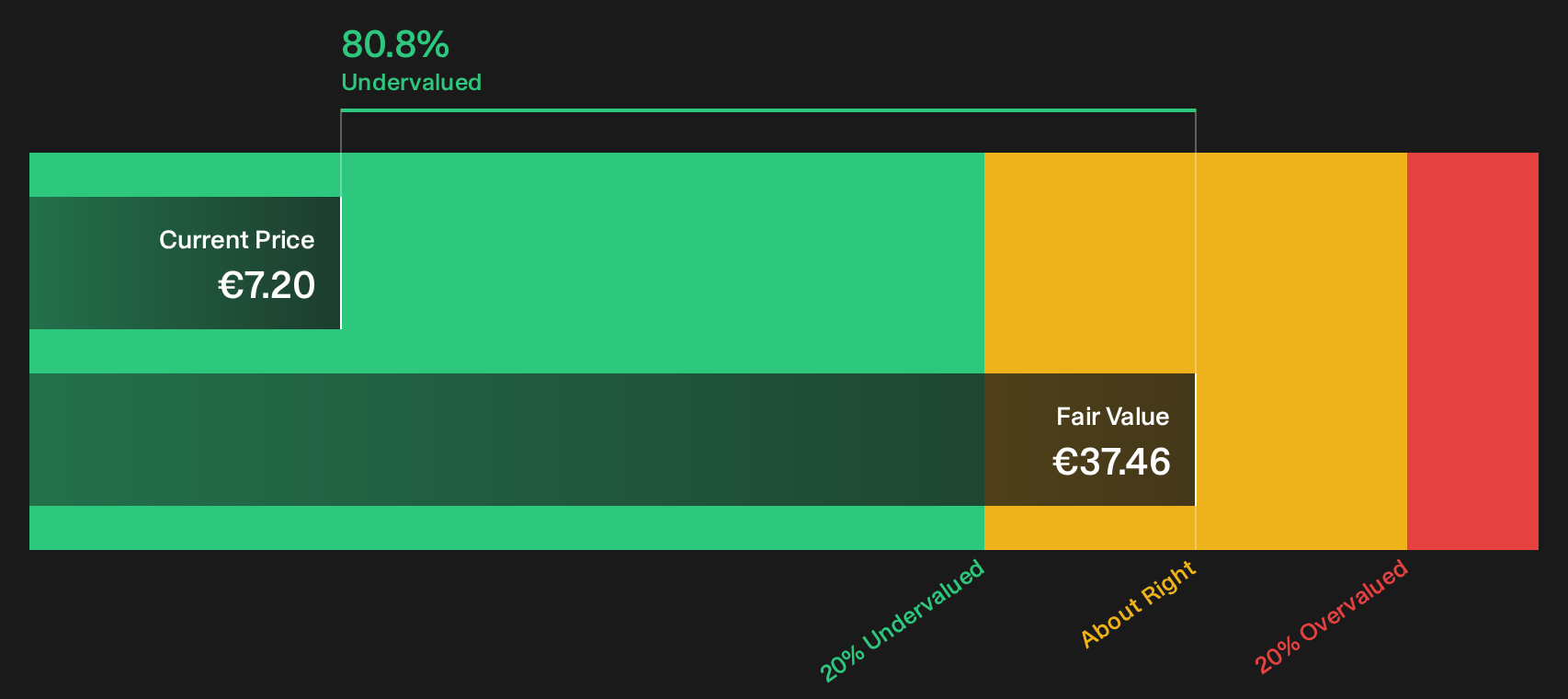
Simply Wall St performs a discounted cash flow (DCF) on every stock in the world every day (check out Metro for example). We show the entire calculation in full. You can track the result in your watchlist or portfolio and be alerted when this changes, or use our stock screener to discover 191 high quality undervalued stocks. If you save a screener we even alert you when new companies match - so you never miss a potential opportunity.
Next Steps
Curious whether Metro's discount reflects real risk or just low expectations being priced in? Act quickly, review both sides of the story, and weigh the 1 key reward and 2 important warning signs.
Looking for more investment ideas beyond Metro?
If Metro has sharpened your focus on value, do not stop here. Broaden your watchlist with a few carefully filtered sets of stocks that might fit different goals.
- Explore potential mispricing by reviewing a hand picked batch of companies that screen as attractively valued using the 191 high quality undervalued stocks.
- Consider more dependable income candidates by scanning a curated pool of high yield payers through the 216 dividend fortresses.
- Emphasise resilience and capital protection by focusing on businesses highlighted in the 234 resilient stocks with low risk scores.
This article by Simply Wall St is general in nature. We provide commentary based on historical data and analyst forecasts only using an unbiased methodology and our articles are not intended to be financial advice. It does not constitute a recommendation to buy or sell any stock, and does not take account of your objectives, or your financial situation. We aim to bring you long-term focused analysis driven by fundamental data. Note that our analysis may not factor in the latest price-sensitive company announcements or qualitative material. Simply Wall St has no position in any stocks mentioned.
Have feedback on this article? Concerned about the content? Get in touch with us directly. Alternatively, email editorial-team@simplywallst.com