
- PRICING
- LIVE QUOTES
- LEARN
- HELP


EN
Is Rising Costs And Weaker Margins Altering The Investment Case For Peabody Energy Stock?
- Recent analysis highlights that Peabody Energy is contending with falling annual sales, elevated production costs, and a shrinking EBITDA margin. Together, these factors point to meaningful operational pressure on the coal miner.
- The combination of high costs and weaker profitability metrics suggests Peabody Energy’s current output mix may not be aligning well with end market demand, even as analysts still model upside in their long term scenarios.
- We will look at how Peabody Energy's worsening EBITDA margin and broader operational strain may reshape the existing coal centric investment narrative.
Stress test your thesis on Peabody Energy by scanning the carefully curated 33 high quality undervalued stocks list of companies that share stronger fundamentals and may offer a cleaner way to pursue similar themes.
Peabody Energy Investment Narrative Recap
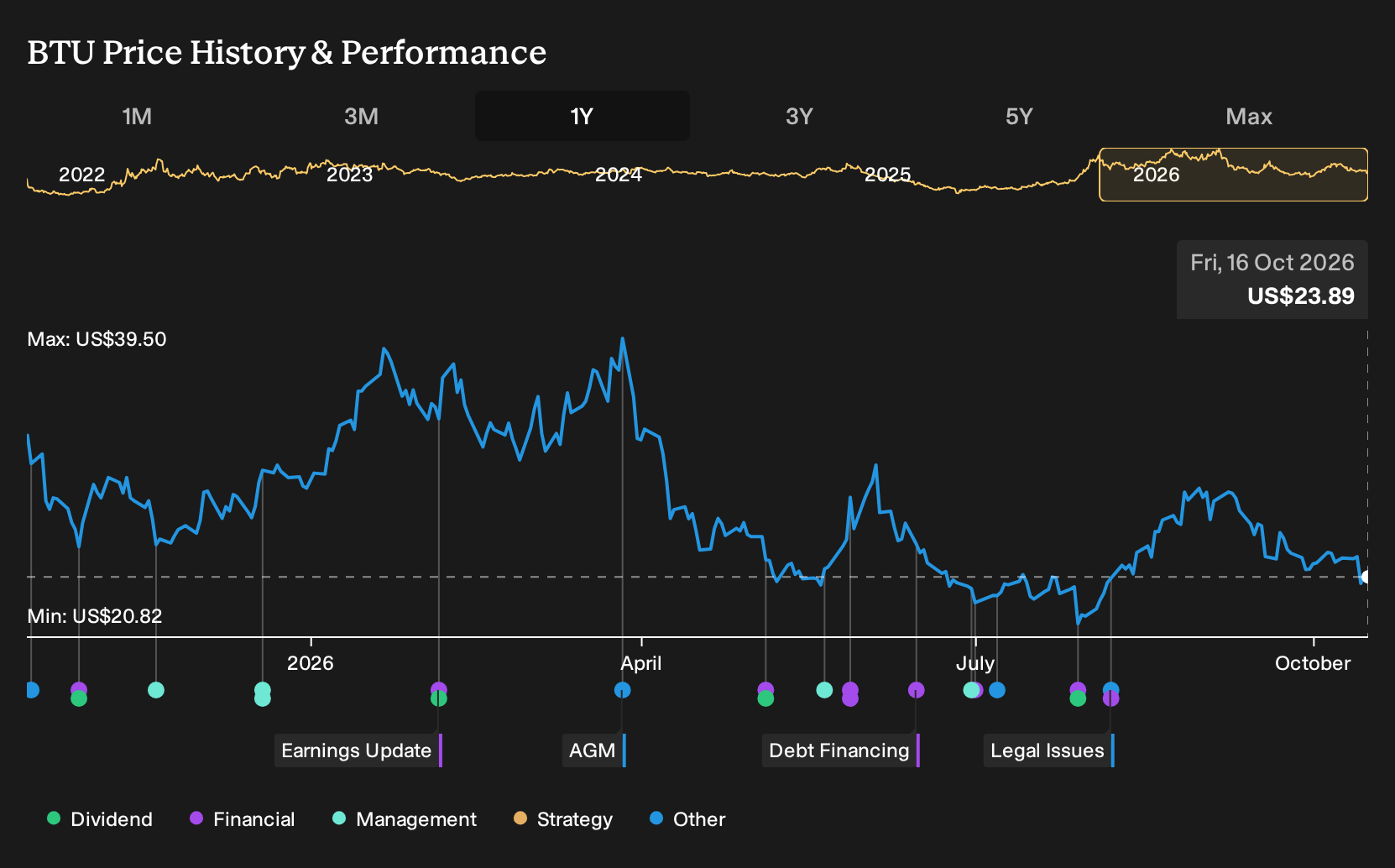
Peabody Energy asks investors to believe that coal cash flows can fund a difficult transition period while operational fixes restore profitability. The near term story hinges on whether management can pull production costs closer to guidance and stabilise the shrinking EBITDA margin. That is what keeps the current loss making position and recent sales softness from becoming a longer lasting drag on the thesis.
The biggest near term catalyst is cleaner execution at key mines, especially Centurion, which would feed into better unit economics and a healthier margin profile. The main risk is that high production costs and weak market connection persist, which would keep EBITDA under pressure and limit the benefit of any supportive coal pricing or policy tailwinds.
Centurion remains the most important project in this context, even without a fresh announcement. Commissioning and geotechnical issues have already cut 2026 sales guidance from 3.5 million tons to 2.5 million tons and lifted seaborne metallurgical cash cost guidance to US$123 to US$133 per ton. That sits awkwardly beside the original expectation for a low cost, first quartile asset.
If Centurion production and costs do not move closer to the targeted 4.7 million tons per year at about US$105 per ton, the planned shift toward higher margin metallurgical coal stays delayed. That would leave Peabody Energy more exposed to thermal coal trends, keep consolidated margins weaker and reduce the flexibility to keep funding buybacks, dividends and new critical minerals options from internal cash generation.
Peabody Energy's current analyst narrative assumes revenue will grow by 6.5% per year, with earnings moving from a loss of $182.7 million today to $701.1 million by 2029, a swing of about $884 million. To reach that 2029 profile, forecasts point to about $4.8 billion of revenue and $701.1 million of earnings in that year.
Uncover why Peabody Energy's fair value points to a 32% potential upside to its current price. This upside could narrow quickly if sentiment turns.
Exploring Other Perspectives
For a contrasting angle, consider the bullish Centurion catalyst. The most optimistic analysts were projecting $5.0b of revenue and $846.7m of earnings by 2029 for Peabody Energy before this news, compared with the baseline view of $4.8b and $701.1m. That spread highlights how widely opinions differ, so treat this update as an opportunity to compare those narratives yourself.
Explore 5 other Peabody Energy fair value estimates, including one that suggests as much as 176% potential increase from the current price.
The Verdict Is Yours
Disagree with existing narratives? Extraordinary investment returns rarely come from following the herd, so consider conducting your own analysis.
- A great starting point for your Peabody Energy research is our analysis highlighting 3 key rewards that could impact your investment decision.
- See our latest analysis for Peabody Energy. The report includes a comprehensive fundamental analysis summarized in a single visual, the Snowflake, making it easy to evaluate Peabody Energy's overall financial health at a glance.
Looking for more Peabody Energy style investment ideas?
If the Peabody Energy story has you rethinking how you balance risk, income and balance sheet strength, you can cast the net wider using the Simply Wall St Screener to see how other businesses stack up against your criteria.
- For investors who want potential upside with a strict focus on fundamentals, you can scan a curated set of value opportunities through the 33 high quality undervalued stocks.
- If capital preservation matters just as much as return potential, you can narrow your search to companies screened for resilience and stability using the 32 resilient stocks with low risk scores.
- For those hunting for under-followed ideas before they hit the spotlight, you can look across a hand picked pool of under the radar prospects via the 20 high quality undiscovered gems.
This article by Simply Wall St is general in nature. We provide commentary based on historical data and analyst forecasts only using an unbiased methodology and our articles are not intended to be financial advice. It does not constitute a recommendation to buy or sell any stock, and does not take account of your objectives, or your financial situation. We aim to bring you long-term focused analysis driven by fundamental data. Note that our analysis may not factor in the latest price-sensitive company announcements or qualitative material. Simply Wall St has no position in any stocks mentioned.
Have feedback on this article? Concerned about the content? Get in touch with us directly. Alternatively, email editorial-team@simplywallst.com