
- PRICING
- LIVE QUOTES
- LEARN
- HELP


EN
Missed Bossard's Run? What Holders Had To Believe
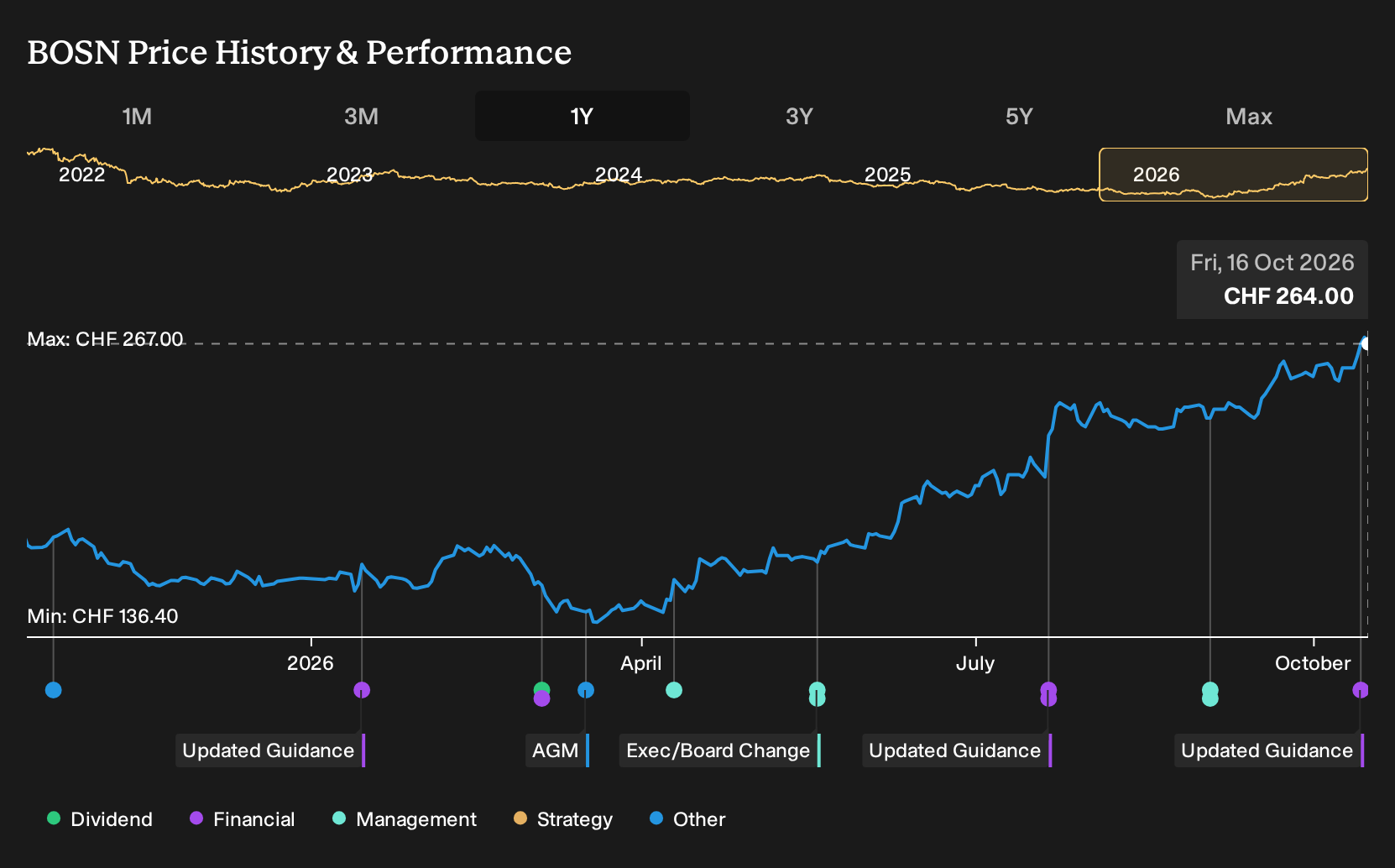
Bossard’s recent half year report put a spotlight on one tangible shift: net income excluding extra items reached CHF 53.391 million on CHF 575.719 million of revenue in H1 2026, with net margin at 9.3%. For Bossard shareholders, the return over the past year was 58.9%, including dividends. If you were deciding back on 16 October 2025, what did you need to believe about tariffs, ERP rollout and Asia exposure to buy in with confidence?
On Simply Wall St, a Narrative is an investor's thesis written down: the reasoning, plus the numbers it rests on. Run those numbers and you get an estimated Fair Value.
If the move has made Bossard harder to judge, start where the gap is still open and scan 186 high quality undervalued stocks.
Two Competing Stories Bossard Investors Faced
The shares cost CHF172 at the start of the period. Anyone looking at Bossard then had to decide whether strong digital execution and supply chain trends would justify paying up, or whether tariffs and extra costs would eat into the upside.
The bullish narrative put fair value at CHF247. It leaned on Microsoft Dynamics 365 and AI integration across much of the business, as well as faster synergy from deals like Ferdinand Gross and Aero Negoce supporting higher margins.
The bearish view set fair value at CHF160. That camp focused on US and EU tariffs, rising ESG compliance expenses, and net debt to EBITDA at 2.8 times, which increased balance sheet risk and pressured profitability.
What The Bossard Results Actually Tested
Bossard’s H1 2026 report gave the clearest signal. Revenue was CHF 575.719 million and net income excluding extra items was CHF 53.391 million, up from CHF 546.721 million and CHF 37.372 million in H1 2025, with net margin moving from 6.8% to 9.3%. That outcome leaned toward the optimistic case on efficiency and margins, although tariff and debt worries were not settled.
The takeaway for any other stock is simple. When a story leans on systems upgrades or integration, track whether net margin and absolute profit move together, not just whether sales inch higher.
What Bossard’s Price Seems To Be Assuming Now
Bossard now trades around CHF264. Over the same period that the share price moved, revenue went from CHF 546.721 million in H1 2025 to CHF 575.719 million in H1 2026 and net margin rose from 6.8% to 9.3%.
The question today is whether that margin step and profit lift justify the higher multiple investors are implicitly paying for the business. A valuation check can test how much lasting improvement in profitability you are assuming.
The return is settled. The valuation question is not. Pinpoint what our model says Bossard is worth.
Find Your Own Contrarian Opportunity
What if your next investment idea came before the headlines? Go straight to the companies whose prices and our estimates still disagree. Three places to start, with the names waiting behind the link.
- Company 1 - 32% below our estimate - targets promotion heavy shoppers through omnichannel electronics and appliance upgrade formats.
- Company 2 - 46% below our estimate - ramps advanced networking hardware programs that plug into hyperscalers' AI infrastructure buildouts.
- Company 3 - 42% below our estimate - wins technical consulting briefs when regulators and courts require independent AI safety expertise.
Three companies from the same screener. Open all 204 companies with the balance sheet to back it up →
This article by Simply Wall St is general in nature. We provide commentary based on historical data and analyst forecasts only using an unbiased methodology and our articles are not intended to be financial advice. It does not constitute a recommendation to buy or sell any stock, and does not take account of your objectives, or your financial situation. We aim to bring you long-term focused analysis driven by fundamental data. Note that our analysis may not factor in the latest price-sensitive company announcements or qualitative material. Simply Wall St has no position in any stocks mentioned.
Have feedback on this article? Concerned about the content? Get in touch with us directly. Alternatively, email editorial-team@simplywallst.com