
- PRICING
- LIVE QUOTES
- LEARN
- HELP


EN
Should New Defense Contracts Require Action From Leonardo DRS Stock Investors?
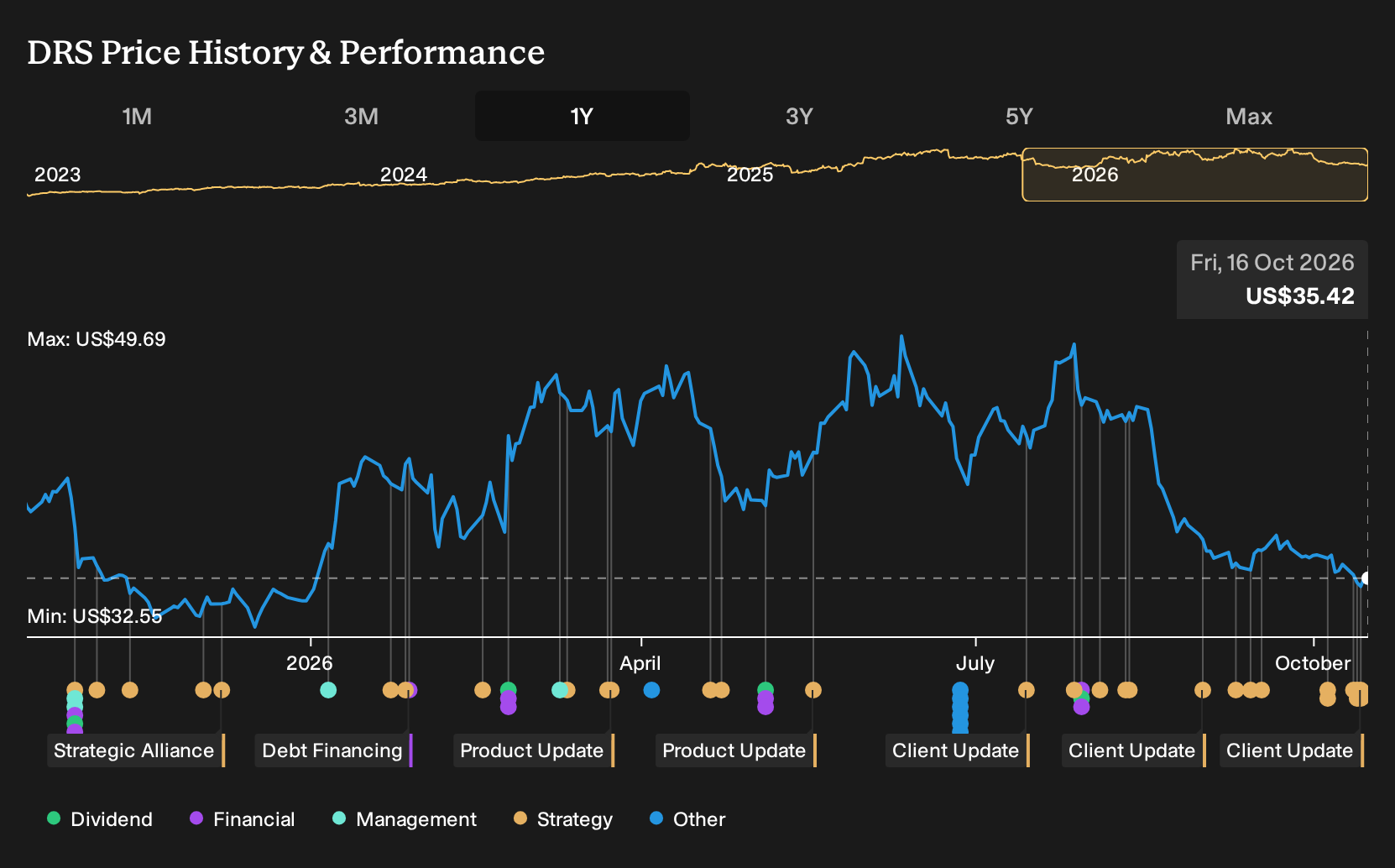
- Leonardo DRS recently reported a 10 year NASA SEWP VI prime contract, a $500 million Counter UAS IDIQ, new U.S. Army awards, a cxMHR radar production launch and a UK radar manufacturing hub, all tied directly to its defense electronics portfolio.
- The cluster of long duration government contracts and fresh product launches provides Leonardo DRS with additional visibility into demand for its sensing, radar and thermal imaging franchises across U.S. and allied customers.
- We will now look at how Leonardo DRS's extended NASA SEWP VI contract could influence the existing investment narrative around backlog and execution.
Scan how defense electronics momentum at Leonardo DRS compares with other contractors by reviewing a curated list of 41 power grid technology and infrastructure stocks aligned with radar, sensing and mission-critical infrastructure demand.
Leonardo DRS Investment Narrative Recap
To own Leonardo DRS, you need to believe its focus on defense electronics, sensors and computing can translate higher R&D and capital spending into a thicker, more durable backlog. The most important short term catalyst is simple execution on these new contracts and programs so funded orders convert into steady, higher margin work rather than sporadic wins.
The biggest near term risk is that recent contract momentum does not offset past patterns of modest revenue growth, softer backlog and pressure on returns. If SEWP VI and the fresh radar and thermal awards do not scale into larger task orders, cash flow and earnings could feel the weight of ongoing investment.
The 10 year NASA SEWP VI prime award looks most relevant because it directly affects how Leonardo DRS sells a broad slice of its catalog into U.S. federal customers. This is essentially a distribution and contracting channel that can influence how quickly newer radar, sensing and computing products move from catalog items into funded task orders.
For investors tracking catalysts, SEWP VI ties directly into the existing concern that higher R&D and capital spending must show up in real demand. Strong execution on this vehicle, through consistent task order wins and smooth delivery, would address that question in a concrete way. Weak follow through would keep the focus on backlog quality and execution risk.
Leonardo DRS' current analyst storyline points to revenues of $4.6b and earnings of $458.3m by 2029, which is based on a 7.1% yearly revenue growth assumption and an earnings increase of about $136m from the $322.0m booked today.
Uncover why Leonardo DRS' fair value indicates a 52% potential upside to its current price, which could narrow quickly if sentiment catches up.
Exploring Other Perspectives
Some of the most optimistic analysts focus on Counter UAS demand rather than SEWP VI. They were already modeling revenue of about $4.9b and earnings near $479.0m by 2029, before this Leonardo DRS contract news hit. That view leans on stronger C UAS and radar orders and shows how far opinions can differ, so it is important to explore both narratives carefully.
Explore 4 other Leonardo DRS fair value estimates, including one that suggests as much as 67% upside from the current price.
Form Your Own Verdict
Don't just follow the ticker. Dig into the data and build a conviction that's truly your own.
- A great starting point for your Leonardo DRS research is our analysis highlighting 4 key rewards that could impact your investment decision.
- See our latest analysis for Leonardo DRS. The report includes a comprehensive fundamental analysis summarized in a single visual, the Snowflake, making it easy to evaluate Leonardo DRS' overall financial health at a glance.
Looking for more investment ideas beyond Leonardo DRS?
If the Leonardo DRS story has sharpened your view on defense electronics, you can use that same lens to scan a wider field of opportunities with the Simply Wall St Screener.
- If you are hunting for steady income and resilience, you can start with dividend payers that aim for both yield and staying power through our 8 dividend fortresses.
- For readers who care most about balance sheet strength, you can filter for companies with solid finances and clean fundamentals using this list of solid balance sheet and fundamentals (25 results).
- If you prefer to look where fewer people are paying attention, you can widen your research to smaller, under followed companies with strong metrics by using the 20 high quality undiscovered gems.
This article by Simply Wall St is general in nature. We provide commentary based on historical data and analyst forecasts only using an unbiased methodology and our articles are not intended to be financial advice. It does not constitute a recommendation to buy or sell any stock, and does not take account of your objectives, or your financial situation. We aim to bring you long-term focused analysis driven by fundamental data. Note that our analysis may not factor in the latest price-sensitive company announcements or qualitative material. Simply Wall St has no position in any stocks mentioned.
Have feedback on this article? Concerned about the content? Get in touch with us directly. Alternatively, email editorial-team@simplywallst.com