
- PRICING
- LIVE QUOTES
- LEARN
- HELP


EN
Did Cancer Drug Partnership Just Shift Gilead's (GILD) Investment Narrative?
- Gilead Sciences recently announced a collaboration and license agreement with Vir Biotechnology to develop dual masked T cell engager drugs targeting solid tumors, adding three potential oncology candidates that use Vir’s PRO XTEN technology.
- The deal points to Gilead Sciences leaning harder into oncology research to diversify beyond its HIV franchise, while using external technology partnerships instead of large acquisitions to expand its pipeline and manage development risk and upfront cost.
- We will now look at how Gilead Sciences' Vir T cell engager deal could influence the broader investment narrative around diversification.
Compare Gilead Sciences' oncology pivot with other potential breakout opportunities by scanning our hand-picked list of 20 high quality undiscovered gems across global markets.
Gilead Sciences Investment Narrative Recap
To own Gilead Sciences, you have to believe the HIV prevention and treatment engine can stay resilient while newer oncology and immunology efforts eventually matter more to the income statement. Recent performance has come with pressure. Revenue growth over the last five years has lagged peers, margins have compressed and the company is currently loss making.
That backdrop makes near term execution on existing franchises the key catalyst, with HIV and COVID therapies still paying the bills. The biggest risk is that pricing and competition in HIV and hepatitis offset any progress in cancer, leaving earnings and cash flow under strain despite the Vir partnership headlines.
The Vir Biotechnology T cell engager deal sits squarely in that oncology diversification theme. It adds three early candidates that, if they move through development, could support Gilead Sciences’ goal of building a second major pillar alongside virology. For now, the agreement is more about future optionality than near term revenue.
Attention around the upcoming third quarter 2026 earnings release on October 29 will likely stay on HIV PrEP uptake, HIV treatment resilience and COVID therapy demand. The Vir alliance feeds into the medium term story of expanding the oncology pipeline. The core operational catalyst in the short run remains whether the existing portfolio trends can support a return to profitability and help cover a dividend that is not well supported by current earnings.
What The Vir Deal Means Against Gilead Sciences' Current Assumptions
On the numbers, Gilead Sciences is now framed as a turnaround in progress rather than a steady compounder. Analysts are building in revenue growth of 5.3% a year over the next three years, so any real contribution from the Vir T cell engager tie up would be layered on top of that existing expectation rather than rescuing a weak top line. The story investors are being asked to buy is that a business reporting a loss of US$3.2b today can move to earnings of US$11.5b by 2029 as margins shift from a loss making 10.6% level to 32.4% profit, supported over time by oncology efforts like the Vir collaboration if they progress.
Gilead Sciences' narrative projects US$35.5b revenue and US$11.5b earnings by 2029. This assumes 5.3% yearly revenue growth and an earnings increase of about US$14.7b from current earnings of a US$3.2b loss.
For an investor weighing the Vir partnership, the scale of that earnings shift matters more than any single early stage asset. Moving from a US$3.2b loss to US$11.5b in profit implies the oncology and immunology build out, including T cell engagers and other external collaborations, eventually need to support the kind of margin structure implied by a 32.4% profit level. That places execution risk front and center. The Vir assets are still potential options, not line items in a near term model. The key question is whether Gilead Sciences can keep HIV and COVID cash flows steady enough to fund this push without stretching the balance sheet or the dividend.
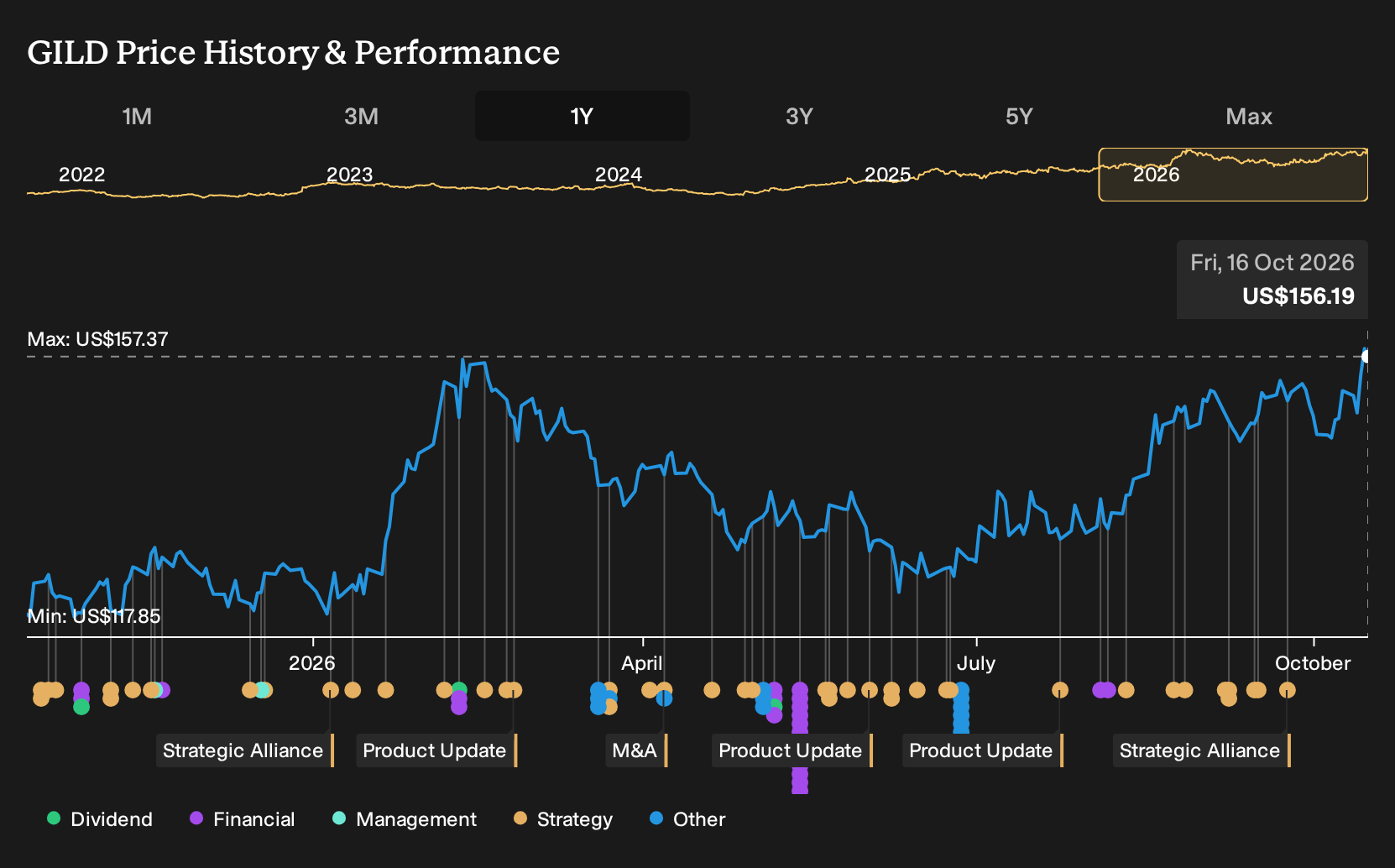
Valuation assumptions underline how much of that optimism is already in the price. To line up with the analyst consensus, you would be treating US$35.5b of revenue and US$11.5b of earnings in 2029 as achievable and accepting a P/E of 21.3x on those forecast profits, using a 7.7% discount rate. With the stock at US$151.28 against an average target of US$158.65, the implied 4.6% upside indicates that analysts, on balance, see Gilead Sciences as roughly fairly valued on those forecasts. In that context, the Vir Biotechnology deal reads less like a surprise re rating catalyst and more like one building block that needs to work alongside HIV PrEP growth, cell therapy and antibody drug conjugates to keep that consensus narrative intact.
Uncover why Gilead Sciences' fair value is assessed as being in line with its current price.
Exploring Other Perspectives
Pessimistic analysts focus less on the Vir T cell engager news and more on policy risk around Gilead Sciences’ HIV drugs. Before this deal, the lowest forecasts already penciled in about US$33.5b of 2029 revenue and US$12.1b of earnings, yet still argued for a much lower price. That gap shows how sharply opinions can differ, so it makes sense to explore several viewpoints before deciding how this new partnership might shift the story.
Explore 4 other Gilead Sciences fair value estimates, including one that suggests as much as 18% downside from the current price.
Form Your Own Verdict
Disagree with existing narratives? Extraordinary investment returns rarely come from following the herd, so consider forming your own view.
- A great starting point for your Gilead Sciences research is our analysis highlighting 3 key rewards and 2 important warning signs that could impact your investment decision.
- See our latest analysis for Gilead Sciences. The report includes a comprehensive fundamental analysis summarized in a single visual, the Snowflake, making it easy to evaluate Gilead Sciences' overall financial health at a glance.
Looking For More Gilead Sciences-Sized Investment Ideas?
If the Gilead Sciences story has you thinking about portfolio gaps, it can help to line it up against other opportunities that share similar qualities or offer something completely different. The Simply Wall St Screener is a quick way to surface stocks that match the kind of risk, income profile or balance sheet strength you want to focus on next.
- For investors who care most about financial resilience, run a filter built around a list of solid balance sheet and fundamentals (25 results) and compare how those businesses stack up against Gilead Sciences on strength and flexibility.
- If capital preservation sits higher on your list than chasing every headline, consider starting with a 32 resilient stocks with low risk scores that screens for steadier earnings patterns and more measured volatility.
- When you want to look beyond well covered tickers like Gilead Sciences, widen the search with a 20 high quality undiscovered gems that flags under-the-radar businesses with stronger fundamentals than their visibility suggests.
This article by Simply Wall St is general in nature. We provide commentary based on historical data and analyst forecasts only using an unbiased methodology and our articles are not intended to be financial advice. It does not constitute a recommendation to buy or sell any stock, and does not take account of your objectives, or your financial situation. We aim to bring you long-term focused analysis driven by fundamental data. Note that our analysis may not factor in the latest price-sensitive company announcements or qualitative material. Simply Wall St has no position in any stocks mentioned.
Have feedback on this article? Concerned about the content? Get in touch with us directly. Alternatively, email editorial-team@simplywallst.com