
- PRICING
- LIVE QUOTES
- LEARN
- HELP


EN
How Loan Sales Will Impact Truist Stock Investors
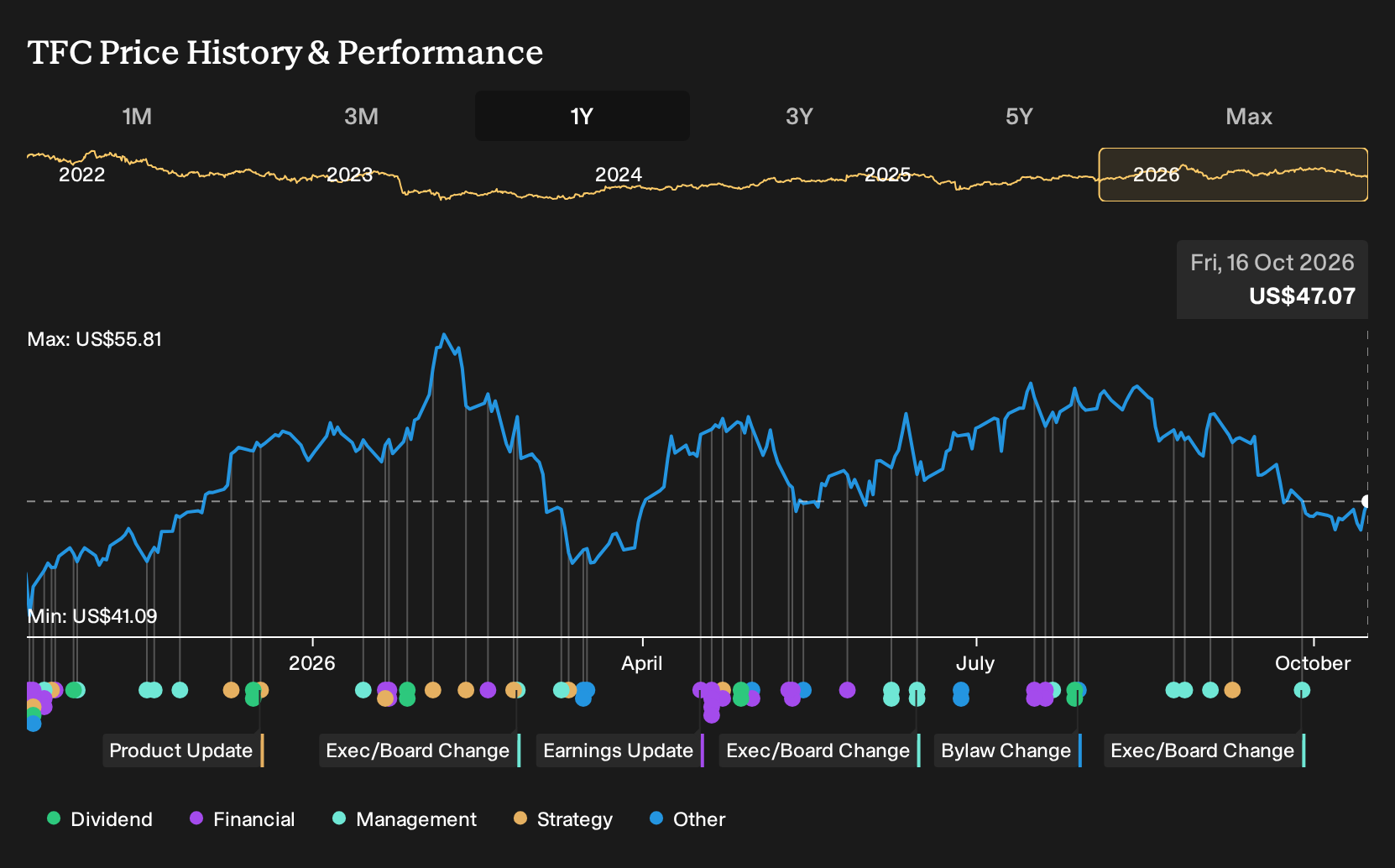
- Truist Financial reported third quarter 2026 results that included US$5.19b in revenue, adjusted EPS of US$1.16, higher net charge-offs, and securities and loan portfolio repositioning, while also providing fourth quarter revenue guidance of about US$5.35b.
- The bank coupled these earnings with a sale of non core consumer loan portfolios, US$1.2b of buybacks, leadership reshuffles, and a continued focus on dividends, signaling an effort to simplify operations and concentrate capital on relationship based banking.
- We will now look at how Truist Financial's sale of non core loan portfolios may influence its longer term investment narrative.
Truist Financial Investment Narrative Recap
To own Truist Financial, you need to be comfortable with a regional bank that is reshaping itself around relationship banking, digital usage and steadier fee income, while still carrying the realities of higher credit costs and a large branch footprint. The near term swing factor is whether the core deposit and lending franchises can offset repositioning hits and higher net charge offs.
Right now, the biggest operational risk is credit quality. Net charge offs of US$629 million for the quarter, compared with US$385 million a year ago, show that credit costs are already biting into earnings. Recent portfolio sales simplify the balance sheet, but they do not fully resolve exposure to commercial real estate or the cost of Truist Financial's physical network.
One announcement that ties this together is Truist Financial's plan to sell LightStream and US$7.7b of unsecured consumer loans, alongside the earlier US$5.5b RAC auto loan sale. These moves pull Truist away from more volatile unsecured and indirect lending and concentrate attention on core consumer, small business and wholesale relationships.
For you as a shareholder, that creates a very clear execution test. The short term catalyst is whether Truist can replace sold loan balances with higher quality, relationship driven lending, while keeping revenue around the guided US$5.35b in the fourth quarter. The risk is that elevated credit costs and heavy tech and talent spending outweigh efficiency gains before those refocused franchises fully contribute.
Truist Financial's current analyst narrative points to US$23.7b in revenue and US$6.1b in earnings by 2029, based on an assumed 7.6% yearly revenue growth rate and an earnings increase of about US$0.6b from US$5.5b today.
Discover how Truist Financial's fair value indicates a 16% potential upside to its current price, representing a discount that may not last much longer.
Exploring Other Perspectives
Two fair value estimates from the Simply Wall St Community cluster between about US$54.6 and US$72.3, which already shows how far retail views on Truist Financial can stretch. Consider that in the context of rising net charge-offs, new leadership in consumer and small business banking, and your own view on whether the repositioning plan really earns its keep. Investor opinions can differ widely, so it pays to explore several of these alternative viewpoints before you commit fresh capital.
Explore another Truist Financial fair value estimate, including one that suggests it could be worth just $54.59.
Form Your Own Verdict
Disagree with existing narratives? Extraordinary investment returns rarely come from following the herd, so consider forming your own view.
- A great starting point for your Truist Financial research is our analysis highlighting 4 key rewards and 1 important warning sign that could impact your investment decision.
- See our latest analysis for Truist Financial. The report includes a comprehensive fundamental analysis summarized in a single visual, the Snowflake, making it easy to evaluate Truist Financial's overall financial health at a glance.
Looking for more investment ideas beyond Truist Financial?
Once you have a view on Truist Financial, it can help to compare it with a few very different opportunities so you see how return potential, balance sheet strength and income profiles stack up across your watchlist.
- If you want to focus on financial resilience first, scan a curated 32 resilient stocks with low risk scores that aims to keep risk scores in check while still offering exposure to equity upside.
- For investors who care most about valuation, compare Truist Financial with a hand picked 33 high quality undervalued stocks that pairs solid fundamentals with market prices that may not fully reflect them yet.
- If income is your priority, build a shortlist from a 8 dividend fortresses that combines yields above 5% with an emphasis on stability and staying power.
This article by Simply Wall St is general in nature. We provide commentary based on historical data and analyst forecasts only using an unbiased methodology and our articles are not intended to be financial advice. It does not constitute a recommendation to buy or sell any stock, and does not take account of your objectives, or your financial situation. We aim to bring you long-term focused analysis driven by fundamental data. Note that our analysis may not factor in the latest price-sensitive company announcements or qualitative material. Simply Wall St has no position in any stocks mentioned.
Have feedback on this article? Concerned about the content? Get in touch with us directly. Alternatively, email editorial-team@simplywallst.com