
- PRICING
- LIVE QUOTES
- LEARN
- HELP


EN
How Bullish Earnings Expectations At Amex Have Changed Its Investment Story
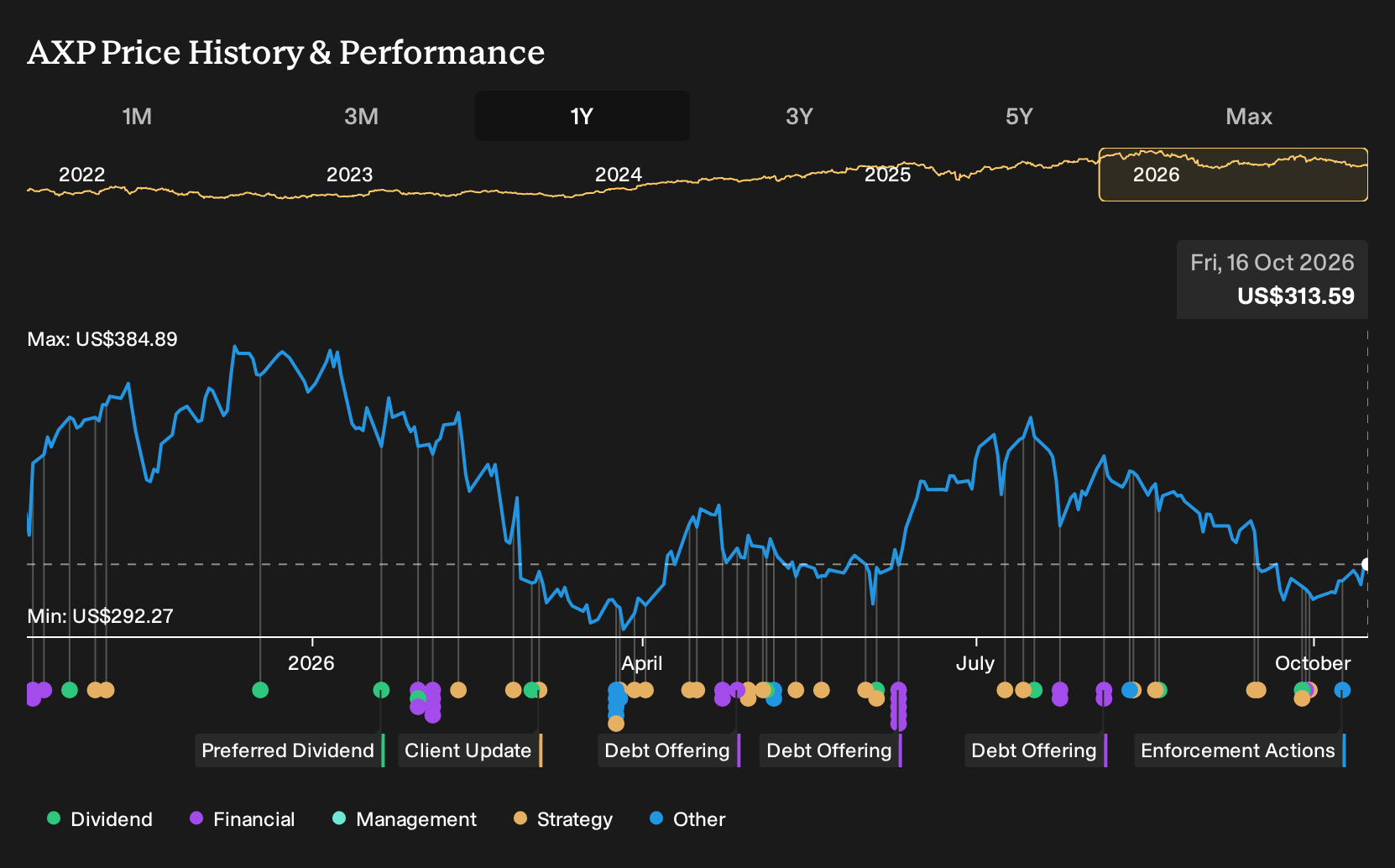
- American Express recently faced enforcement actions from the Federal Reserve and the OCC over weaknesses in detecting and reporting suspicious activity in its anti money laundering program, with regulators requiring fixes across the group and its subsidiary national bank.
- At the same time, the American Express closed loop payments model, premium customer focus and strong credit quality continue to underpin positive fund commentary and analyst expectations for changes in earnings and revenue in the upcoming quarter.
- We will now look at how American Express's investment narrative could be affected by the regulatory enforcement actions around its anti money laundering controls.
Compare how American Express manages risk and growth with a curated 32 resilient stocks with low risk scores that aims to balance regulatory resilience with upside potential.
American Express Investment Narrative Recap
To own American Express, you need to believe the premium, closed loop model continues to attract affluent and younger cardmembers, while credit quality remains disciplined and rewards spending remains productive. In the short term, a key swing factor is execution in upcoming earnings, particularly how billed business and fee income offset headwinds from portfolio transfers and higher operating costs.
The new anti money laundering enforcement actions add compliance and technology workload, but they do not directly alter the core spending, lending, and fee engine. The bigger near term risk remains rewards and customer engagement costs running ahead of revenue, which could compress margins if marketing, servicing, and risk spending are not tightly managed.
The most relevant recent development is the Federal Reserve and OCC actions around American Express anti money laundering controls. This affects governance, data quality, and monitoring across the network, which is typically where the closed loop model provides operational visibility and control, so remediation quality will be watched closely by regulators and investors.
How the group handles this remediation could intersect with the key catalyst, which is continued expansion in premium card fees, Millennial and Gen Z adoption, and international billed business. If compliance upgrades absorb too many resources or create friction for new account growth, the revenue trajectory and expense ratio could be less attractive in the near term.
American Express' current analyst narrative points to US$98.3b in revenue and US$15.4b in earnings by 2029. This path assumes 11.5% yearly revenue growth and an earnings increase of about US$4.1b from US$11.3b today.
Discover how American Express' fair value indicates an 18% potential upside to its current price that may not last much longer.
Exploring Other Perspectives
One alternate view treats the new enforcement actions as a direct threat to American Express earning the richer outcomes some analysts anticipated before the news. That more optimistic camp was modeling revenue of about US$102.7b and earnings near US$16.7b by 2029. Those forecasts were set before this regulatory twist, so opinions are likely to shift. It may be useful to explore several angles yourself.
Explore 7 other American Express fair value estimates, including one that suggests up to 40% potential upside from the current price.
Form Your Own Verdict
Disagree with existing narratives? Extraordinary investment returns rarely come from following the herd, so trust your own research and judgment.
- A great starting point for your American Express research is our analysis highlighting 3 key rewards and 1 important warning sign that could impact your investment decision.
- See our latest analysis for American Express. The report includes a comprehensive fundamental analysis summarized in a single visual, the Snowflake, making it easy to evaluate American Express' overall financial health at a glance.
Looking for more investment ideas beyond American Express?
Once you have formed a view on American Express, it can help to set it alongside other opportunities that fit different risk and income profiles. The Simply Wall St Screener gives you ready made sets of stocks so you can compare quality, balance sheet strength, and potential returns in a consistent framework.
- If you want balance sheet resilience front and center, start with a list of solid balance sheet and fundamentals (25 results) that screens for companies with robust financial footing and fewer funding surprises.
- For investors hunting for mispriced quality, weigh American Express against a 33 high quality undervalued stocks that focuses on businesses with strong fundamentals trading below analyst estimates of fair value.
- Income focused readers who care about reliability over excitement can review a 8 dividend fortresses built around higher yielding payout profiles that aim to combine durability with regular cash returns.
This article by Simply Wall St is general in nature. We provide commentary based on historical data and analyst forecasts only using an unbiased methodology and our articles are not intended to be financial advice. It does not constitute a recommendation to buy or sell any stock, and does not take account of your objectives, or your financial situation. We aim to bring you long-term focused analysis driven by fundamental data. Note that our analysis may not factor in the latest price-sensitive company announcements or qualitative material. Simply Wall St has no position in any stocks mentioned.
Have feedback on this article? Concerned about the content? Get in touch with us directly. Alternatively, email editorial-team@simplywallst.com