
- PRICING
- LIVE QUOTES
- LEARN
- HELP


EN
Will Atlanta Express Lanes Win Change Ferrovial's (BME:FER) Narrative
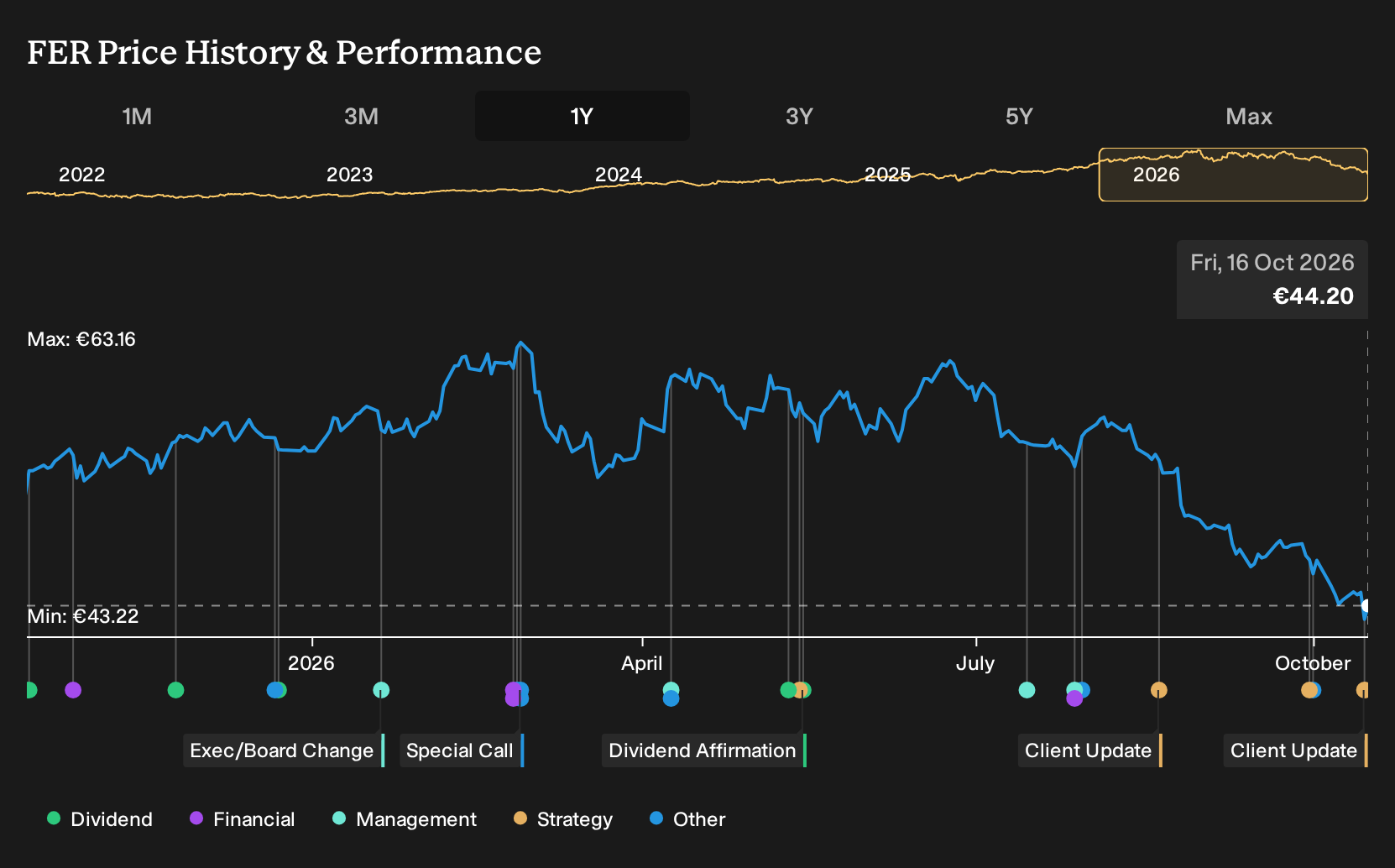
- On 15 October 2026, Ferrovial N.V. reported that its consortium, Top End Mobility Group, had been chosen by Georgia’s transport authorities to finance, design, build, operate, and maintain Phase 1 of the I-285 East Express Lanes around Atlanta, a public private partnership with an estimated construction value of US$8.9b.
- The I-285 award deepens Ferrovial’s exposure to long-duration US managed lanes concessions and will test its ability to control construction risk, funding costs, and long term operating performance on a multi phase project that could ultimately span about 37.5 miles of express lanes.
- We will now see how Ferrovial’s investment narrative could be affected by this large I-285 express lanes public private partnership.
Scan other long-term toll road and infrastructure operators facing similar contract and construction trade offs through our curated list of list of solid balance sheet and fundamentals (203 results)
Ferrovial Investment Narrative Recap
To own Ferrovial, you need to be comfortable with a tolled infrastructure group that leans heavily on North American concessions, uses an asset light model, and accepts sizeable construction and financing commitments in return for long dated contracts. The I 285 win reinforces that profile but does not change the near term story, which still hinges on execution in existing highways and airports.
The key short term swing factor remains how Ferrovial manages debt, project funding costs, and profit margins after a year where net margin sat at 6%, well below the prior year. The biggest risk is that high leverage and complex US PPPs amplify any cost overruns, traffic softness, or pricing pushback in its core toll road portfolio.
The I 285 decision ties directly into one long running catalyst for Ferrovial: its ambition to keep winning large US public private partnerships and recycle capital from mature assets into earlier stage concessions. Analysts already flag expectations for earnings growth of about 14.1% a year, helped by this tilt toward higher returning projects.
That same tilt raises execution and funding questions. Ferrovial carries a high level of debt and relies entirely on borrowing rather than deposits, so a US$8.9b construction program, even within a consortium, increases sensitivity to financing costs and bid discipline. For you as an investor, the operational test is whether these mega projects support returns without putting more pressure on already compressed margins or the P/E multiple of 53.8x.
Ferrovial's narrative reflects analyst expectations for revenue of €11.4b and earnings of €980.6m by 2029, based on assumed yearly top line growth of 5.0%. That outlook implies earnings rising by €388.6m from €592.0m today to the 2029 consensus level.
Uncover why Ferrovial's fair value indicates a 36% potential upside to its current price, before the market moves to close that gap.
Exploring Other Perspectives
Some of the most optimistic analysts focus on Ferrovial’s North American project pipeline as a catalyst. Before this I 285 decision, the bullish group was already working off forecasts of €12.4b in 2029 revenue and €1.1b in earnings. You can compare that to the consensus €11.4b and €980.6m and decide which story feels more realistic, knowing this new project could still shift both views.
Explore 3 other Ferrovial fair value estimates, including one that suggests as much as 68% upside from the current price.
Decide For Yourself
Don't just follow the ticker. Dig into the data and build a conviction that's truly your own.
- A great starting point for your Ferrovial research is our analysis highlighting 3 key rewards and 3 important warning signs that could impact your investment decision.
- See our latest analysis for Ferrovial. The report includes a comprehensive fundamental analysis summarized in a single visual, the Snowflake, making it easy to evaluate Ferrovial's overall financial health at a glance.
Looking For More Investment Ideas Beyond Ferrovial?
Once you have formed a view on Ferrovial, it can help to compare the opportunity with other businesses that have different risk and return profiles, using the Simply Wall St Screener as a starting point.
- If you want potential mispriced opportunities with strong fundamentals, start by reviewing 191 high quality undervalued stocks that combine quality metrics with attractive pricing signals.
- For readers who care most about resilience, filter for 233 resilient stocks with low risk scores that may offer steadier profiles and fewer red flags.
- If your focus is on dependable income, scan through 214 dividend fortresses that pair yields above 5% with an emphasis on durability.
This article by Simply Wall St is general in nature. We provide commentary based on historical data and analyst forecasts only using an unbiased methodology and our articles are not intended to be financial advice. It does not constitute a recommendation to buy or sell any stock, and does not take account of your objectives, or your financial situation. We aim to bring you long-term focused analysis driven by fundamental data. Note that our analysis may not factor in the latest price-sensitive company announcements or qualitative material. Simply Wall St has no position in any stocks mentioned.
Have feedback on this article? Concerned about the content? Get in touch with us directly. Alternatively, email editorial-team@simplywallst.com