
- PRICING
- LIVE QUOTES
- LEARN
- HELP


EN
Will Consumer Stock Stress Change Harley Davidson's (HOG) Narrative
- Harley-Davidson has come under fresh scrutiny after commentary from Wall Street veteran Larry McDonald highlighted how consumer-facing groups such as the motorcycle maker have faced sharp internal pressure, even while the S&P 500 recently reached record highs.
- The remarks point to a possible mismatch between Harley-Davidson’s day-to-day demand realities and the way broad passive index flows treat the stock as part of a surging market headline.
- We will now assess how Harley-Davidson's investment narrative could be affected by this internal market stress on consumer-focused shares.
Scan beyond Harley-Davidson and pressure-hit consumer stocks to see which resilient retailers and manufacturers are already attracting fresh interest in the 32 resilient stocks with low risk scores.
Harley-Davidson Investment Narrative Recap
To own Harley-Davidson, you need to believe the business can keep demand for its affordable, customizable bikes healthy enough to offset tariff costs and a softer backdrop for consumer stocks. The key short term swing factor is execution on the Back to the Bricks plan and dealer health, which aims to support volumes, pricing and Parts & Accessories sales.
McDonald’s comments about an internal market crash in consumer names mainly affect sentiment, not the fundamentals of Harley-Davidson’s cost and product reset. The bigger risk still sits with tariffs and margin pressure, including the guided US$75 million to US$90 million in incremental 2026 costs and mid single digit EBITDA expectations.
With no fresh company announcements tied directly to this market commentary, the most relevant existing development is the shift in Harley-Davidson Financial Services toward a capital light, fee focused model. That move, together with total debt plus deposits stepping down from US$7.4b to US$2.8b, leaves HDMC in a net cash position.
For you as a shareholder, that financial repositioning matters because it supports reinvestment, cost programs like Back to the Bricks and potential buybacks, even while consumer stocks are under pressure. The catalyst to watch is whether this leaner balance sheet and fee based HDFS model translate into steadier earnings quality as tariff and input headwinds continue.
Analysts see Harley-Davidson reaching about US$4.0b in revenue and US$259.6m in earnings by 2029, based on an assumed yearly revenue decline of 1.9% and an increase in profit from US$202.6m today. This implies an earnings rise of roughly US$57m by the same 2029 forecast year.
Uncover how Harley-Davidson's fair value indicates a 5% potential upside to its current price before this discount starts to close.
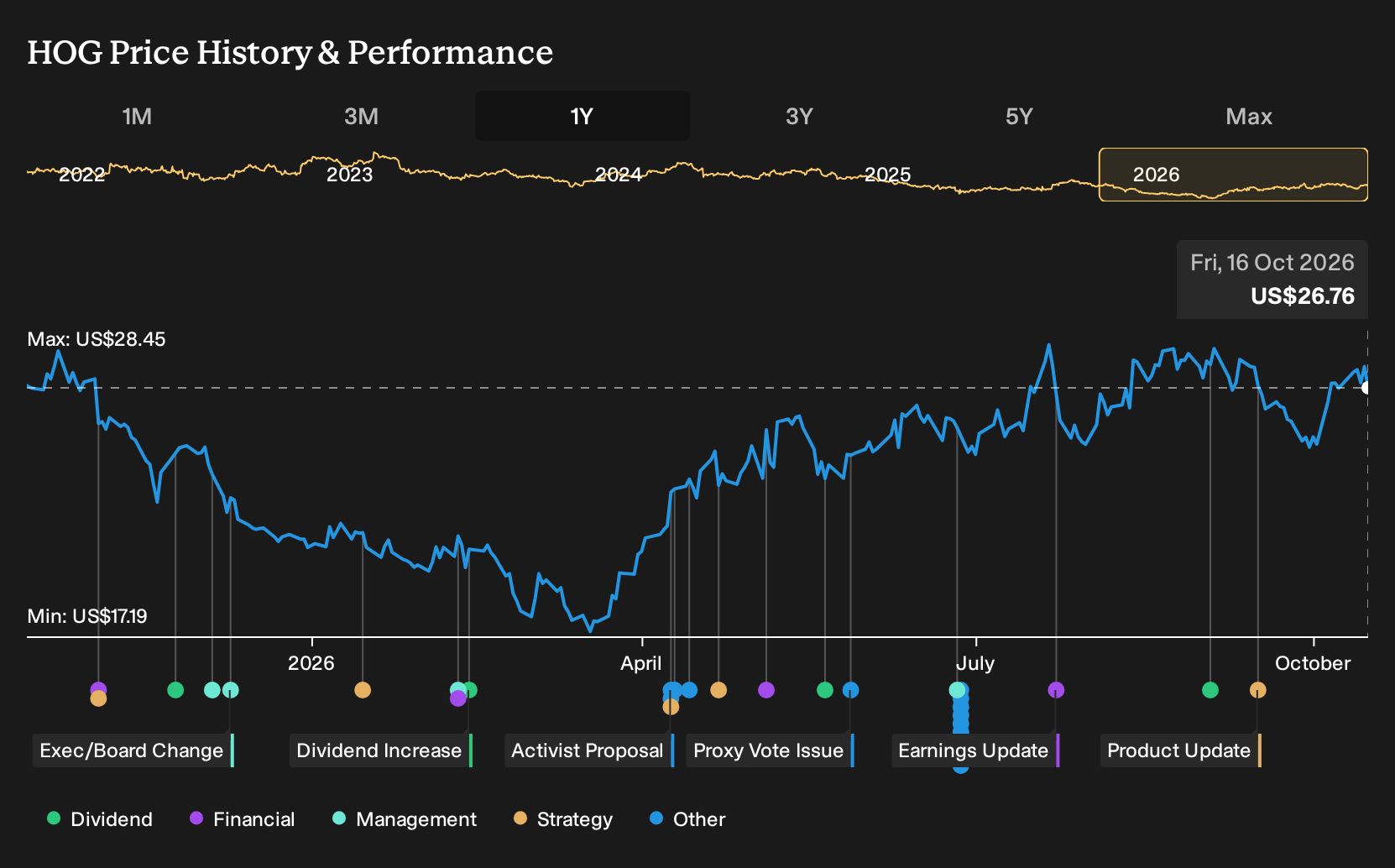
Exploring Other Perspectives
Some of the most optimistic analysts focus on Harley-Davidson’s affordability push as a potential catalyst, arguing that lower entry prices and financing could support their projections of about US$3.9b in revenue and US$338.5m in earnings by 2028. You can treat McDonald’s comments as a prompt to revisit these pre news assumptions and compare several viewpoints.
Explore 3 other Harley-Davidson fair value estimates, including one that suggests as much as 20% upside from the current price.
Reach Your Own Conclusion
Don't just follow the ticker; dig into the data and build a conviction that's truly your own.
- A great starting point for your Harley-Davidson research is our analysis highlighting 2 key rewards and 1 important warning sign that could impact your investment decision.
- See our latest analysis for Harley-Davidson. The report includes a comprehensive fundamental analysis summarized in a single visual, the Snowflake, making it easy to evaluate Harley-Davidson's overall financial health at a glance.
Looking for more Harley-Davidson style investment ideas?
If this Harley-Davidson story has you thinking about portfolio balance, use the Simply Wall St Screener to line up other candidates that match the kind of risk, quality and income profile you want.
- For investors who want potential value with quality fundamentals, scan through a curated 33 high quality undervalued stocks that already clear strict financial checks.
- If income is your focus, filter for companies in the 8 dividend fortresses that pair higher yields with resilient balance sheets.
- To keep risk in check while still hunting for opportunity, start with a list of solid balance sheet and fundamentals (25 results) that can handle tougher conditions.
This article by Simply Wall St is general in nature. We provide commentary based on historical data and analyst forecasts only using an unbiased methodology and our articles are not intended to be financial advice. It does not constitute a recommendation to buy or sell any stock, and does not take account of your objectives, or your financial situation. We aim to bring you long-term focused analysis driven by fundamental data. Note that our analysis may not factor in the latest price-sensitive company announcements or qualitative material. Simply Wall St has no position in any stocks mentioned.
Have feedback on this article? Concerned about the content? Get in touch with us directly. Alternatively, email editorial-team@simplywallst.com