
- PRICING
- LIVE QUOTES
- LEARN
- HELP


EN
Could NVIDIA AI Acceleration Change The Bull Case For Adobe Stock (ADBE)?
- On 15 October 2026, Adobe and NVIDIA reported an expanded partnership that applies NVIDIA RTX Spark and Nemotron models across Photoshop, Premiere, Substance 3D, Frame.io and Brand Concierge to speed AI workflows and enterprise personalization.
- The collaboration focuses on GPU acceleration, unified memory and open models, which relates directly to Adobe’s cost of compute, user productivity and enterprise AI adoption.
- We will now look at how Adobe's NVIDIA accelerated AI workflows may reshape the existing investment narrative around AI driven subscriptions.
Adobe Investment Narrative Recap
To own Adobe, you need to believe its AI-first tools, freemium funnel and enterprise platforms can keep turning usage into durable subscription cash flows. The biggest near-term swing factor is whether AI features across Photoshop, Premiere and Firefly translate into stronger paid adoption that stabilises net new ARR after recent softness.
The main risk is still competitive pressure and possible freemium fatigue, especially as new AI content tools compete hard on price and features. The expanded NVIDIA deal looks helpful for product speed and cost of compute, but on its own it does not significantly change the key risk-reward debate yet.
The Heathrow partnership is the clearest operational bridge between Adobe’s creator-focused AI work with NVIDIA and its customer experience catalyst. Heathrow plans to use Adobe CX Enterprise and Brand Visibility to personalise content across web and AI assistants at scale. That speaks directly to the AI MarTech opportunity analysts already highlight.
For you as an investor, this matters because large reference clients in CX Enterprise can support the thesis that Adobe’s AI platforms are relevant beyond creative pros. Execution still has to prove that these deployments turn into long-running contracts and healthy margins, which would help offset worries about slower ARR and heavy competition.
How NVIDIA Acceleration Feeds Into Adobe’s AI Economics
Adobe's narrative projects US$33.4b revenue and US$9.5b earnings by 2029. This rests on analysts baking in 8.7% yearly revenue growth and an earnings increase of about US$2.2b from current earnings of US$7.3b.
AI workloads are expensive to run, so any improvement in GPU efficiency matters. The expanded use of NVIDIA RTX Spark and Nemotron in Photoshop, Premiere, Substance 3D and the rest of Adobe's stack speaks directly to that cost of compute line item. If GPU acceleration and unified memory let the firm push more generative and agentic features through the same or lower infrastructure spend, the path from usage to earnings looks easier to support.
The analyst framework already pins a clear destination. Revenue is projected to reach about US$33.4b and earnings US$9.5b by 2029, from US$7.3b of profit today, which is roughly a US$2.2b step up. That path assumes revenue growth of 8.7% a year, profit margins edging from 28.0% to 28.5% over three years and a P/E compression from 12.5x today to 11.7x on those 2029 earnings, well below the current 29.7x for the US software group.
Where NVIDIA fits in is less about the headline and more about the plumbing. Faster GPUs and smarter memory use can let Adobe ship richer AI features while keeping latency acceptable for working creatives and enterprise users. If customers can generate video edits, 3D assets or marketing content more quickly without the tools feeling sluggish, that supports daily engagement and reduces the risk that cheaper AI point tools pull users away.
The revenue opportunity in that analyst model still relies heavily on conversion rather than pure user growth. Management has more than 1 billion monthly active users and over 100 million creative freemium users to work with. The NVIDIA accelerated features inside Photoshop or Premiere give Adobe more reasons to nudge those users into paid plans or higher tiers, which is where the subscription economics start to match the US$9.5b earnings consensus.
Enterprise buyers care less about a single AI feature and more about predictable performance at scale. The Heathrow use case, combined with NVIDIA powered workflows, shows how Adobe can pitch CX Enterprise, Brand Visibility and GenStudio as a full stack for AI driven content and customer experiences. For investors, that ties AI infrastructure directly to the forecast revenue of US$33.4b, since large CX deals tend to be multi year, subscription heavy and aligned with the margin uplift analysts are modeling.
Risk sits in the gap between this AI tooling and actual monetisation. Freemium fatigue, aggressive pricing from rival AI platforms and the drag from a leadership transition could all make the 8.7% growth assumption harder to hit. If AI usage skews toward free tiers or discounted bundles, the NVIDIA gains on performance and cost may protect profitability at the margin, but the jump from US$7.3b to US$9.5b of earnings becomes tougher.
The valuation setup anchors on that earnings bridge. To line up with the consensus target, investors would need to be comfortable with Adobe trading at roughly 11.7x those 2029 earnings instead of its current 12.5x multiple, and well below the broader software sector. That leaves the NVIDIA partnership as one more real world proof point that Adobe is investing in the infrastructure needed to support AI heavy subscriptions at scale, even if the final revenue mix and customer adoption patterns still need to play out over the next few years.
Uncover why Adobe's fair value indicates a 12% potential upside to its current price, which could narrow quickly.
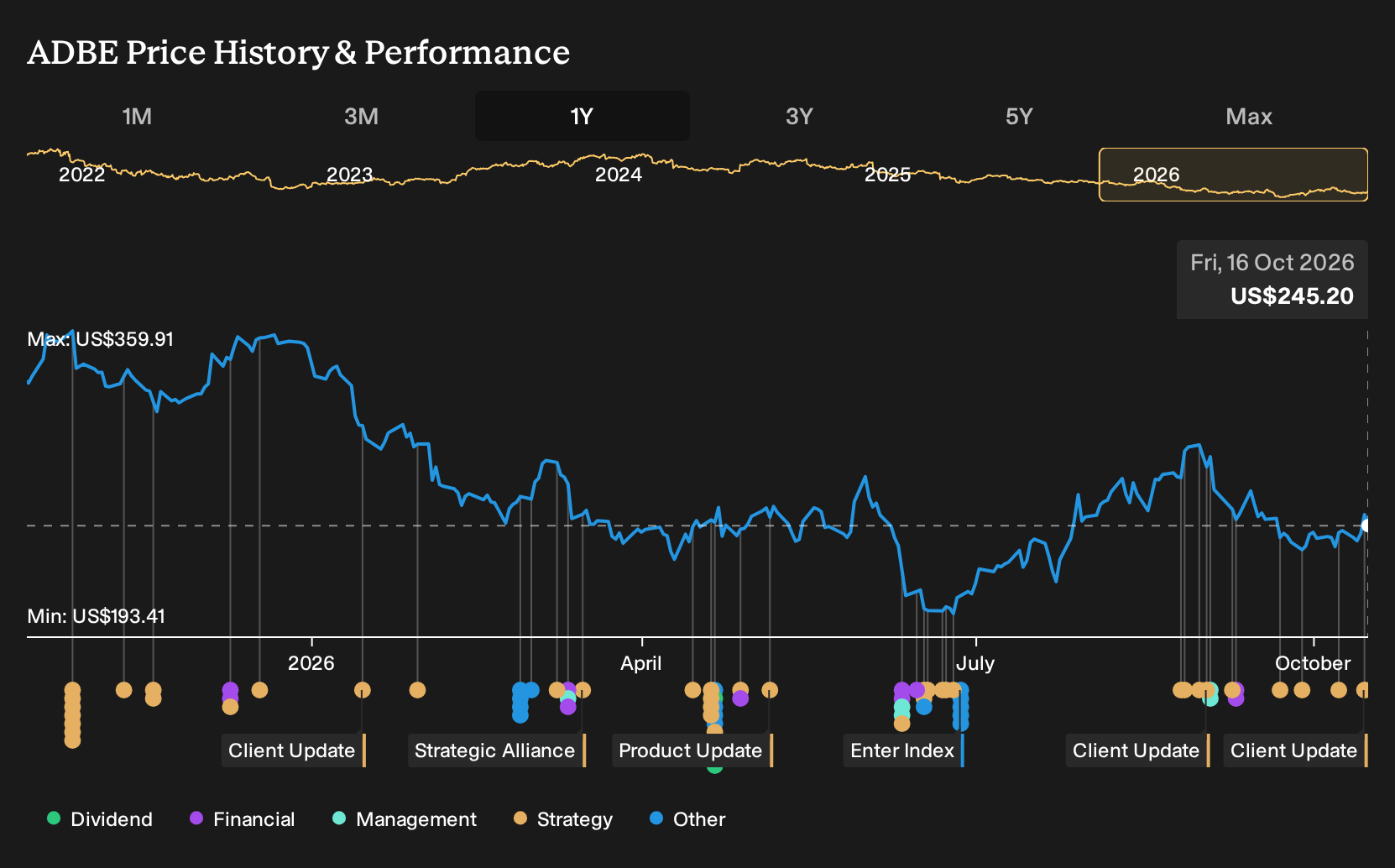
Exploring Other Perspectives
One alternate, more optimistic view places freemium conversion at the center of the Adobe story. The most bullish analysts were penciling in US$35.5b of revenue and US$10.7b of earnings by 2029, well above consensus. If you think NVIDIA accelerated AI tools make paid tiers more compelling, that narrative might strengthen. Opinions differ widely, so treat this as one lens and explore a range of forecasts before deciding what fits your own expectations.
Explore 37 other Adobe fair value estimates, including one that suggests as much as 153% upside from the current price!
Form Your Own Verdict
Don't just follow the ticker; dig into the data and build a conviction that's truly your own.
- A great starting point for your Adobe research is our analysis highlighting 4 key rewards and 1 important warning sign that could impact your investment decision.
- See our latest analysis for Adobe. The report includes a comprehensive fundamental analysis summarized in a single visual, the Snowflake, making it easy to evaluate Adobe's overall financial health at a glance.
Looking for more Adobe style investment ideas?
If you want to put Adobe in context and round out your watchlist, it can help to compare it with other businesses that share similar quality traits or income profiles. The Simply Wall St Screener lets you line up different types of opportunities side by side so your next move is grounded in data, not noise.
- For investor-grade quality at a discount, start with companies that pair solid fundamentals with appealing valuations using the 33 high quality undervalued stocks.
- If capital preservation and balance sheet strength matter most to you, filter for businesses with robust financial positions through the list of solid balance sheet and fundamentals (25 results).
- For those hunting beyond the usual tickers, surface lesser known opportunities with strong metrics by checking the 20 high quality undiscovered gems.
This article by Simply Wall St is general in nature. We provide commentary based on historical data and analyst forecasts only using an unbiased methodology and our articles are not intended to be financial advice. It does not constitute a recommendation to buy or sell any stock, and does not take account of your objectives, or your financial situation. We aim to bring you long-term focused analysis driven by fundamental data. Note that our analysis may not factor in the latest price-sensitive company announcements or qualitative material. Simply Wall St has no position in any stocks mentioned.
Have feedback on this article? Concerned about the content? Get in touch with us directly. Alternatively, email editorial-team@simplywallst.com