
- PRICING
- LIVE QUOTES
- LEARN
- HELP


EN
Is Valaris (VAL) Fully Valued Following $220 Million In New Offshore Contracts?
Valaris (VAL) is back in focus after the offshore driller disclosed about US$220 million in new contracts and extensions, a batch of deals that reshapes its contracted revenue backlog across several key regions.
Investors have already been responding to this stream of new work, with Valaris trading at US$85.32 and logging a 63.61% year-to-date share price return. Its 76.54% one-year total shareholder return signals momentum that has been building rather than fading.
Spot other offshore drillers with similar contract momentum by scanning our hand-picked 41 power grid technology and infrastructure stocks.Valaris now trades well above the average analyst target, yet its own intrinsic value estimate still indicates a large discount. Is the market being too cautious, or are those valuation gaps serving as useful risk buffers for you?
Most Popular Narrative: 26.5% Overvalued
Valaris closed at $85.32 while the most followed narrative anchors fair value at $67.43. This frames the current share price as rich relative to that estimate and heavily tied to expectations around the Transocean merger actually delivering.
The all stock merger with Transocean is being sold as transformational, with more than US$200 million of annual cost synergies, a pro forma backlog above US$10b and a targeted leverage ratio of about 1.5x within 24 months of closing. However, the stock already prices in substantial value from those integration benefits that are still to be realised in future margins, earnings and cash flow.
See why 30 investors see Valaris as 27% overvalued.
Result: Fair Value of $67.43 (OVERVALUED)
Still, the thesis can break if offshore demand holds up better than expected, or if the Transocean merger synergies and backlog prove more durable catalysts.
Find out about the key risks to this Valaris narrative.
Another View: Cash Flows Paint Valaris Very Differently
While the popular narrative calls Valaris 26.5% overvalued versus a $67.43 fair value, our DCF model points the other way. On that framework, VAL at $85.32 trades well below an estimated future cash flow value of $314.95, which frames current pricing as cautious rather than euphoric. Which story aligns more closely with how you think offshore earnings and cash generation will really play out?
Look into how the SWS DCF model arrives at its fair value.
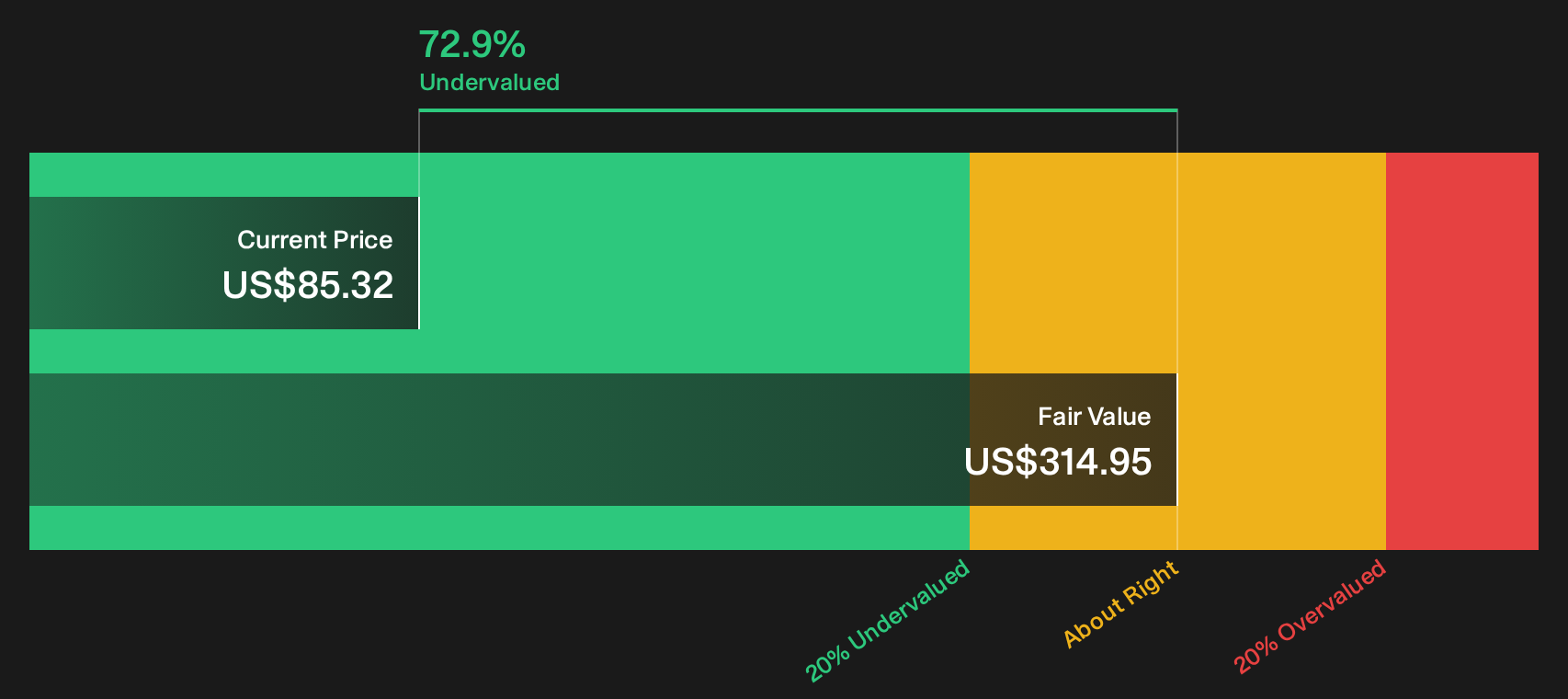
Simply Wall St performs a discounted cash flow (DCF) on every stock in the world every day (check out Valaris for example). We show the entire calculation in full. You can track the result in your watchlist or portfolio and be alerted when this changes, or use our stock screener to discover 33 high quality undervalued stocks. If you save a screener we even alert you when new companies match - so you never miss a potential opportunity.
Next Steps
Mixed messages on Valaris so far, or a clear tilt in one direction. Either way, now is the moment to check the numbers yourself, weigh both sides of the story and see the 2 key rewards and 2 important warning signs.
Looking for more investment ideas beyond Valaris?
If Valaris has your attention, do not stop there. Broaden your watchlist now so you are not chasing opportunities after they are obvious.
- Hunt for potential mispricing by scanning companies that screen as high quality yet possibly overlooked via the 20 high quality undiscovered gems.
- Prioritise resilience by reviewing a curated 32 resilient stocks with low risk scores that can help you focus on businesses with steadier risk profiles.
- Target financial strength by filtering for a list of solid balance sheet and fundamentals (25 results) that can support operations through tougher cycles.
This article by Simply Wall St is general in nature. We provide commentary based on historical data and analyst forecasts only using an unbiased methodology and our articles are not intended to be financial advice. It does not constitute a recommendation to buy or sell any stock, and does not take account of your objectives, or your financial situation. We aim to bring you long-term focused analysis driven by fundamental data. Note that our analysis may not factor in the latest price-sensitive company announcements or qualitative material. Simply Wall St has no position in any stocks mentioned.
Have feedback on this article? Concerned about the content? Get in touch with us directly. Alternatively, email editorial-team@simplywallst.com