
- PRICING
- LIVE QUOTES
- LEARN
- HELP


EN
Par Pacific Is Up 136%, But The Story Isn't Finished
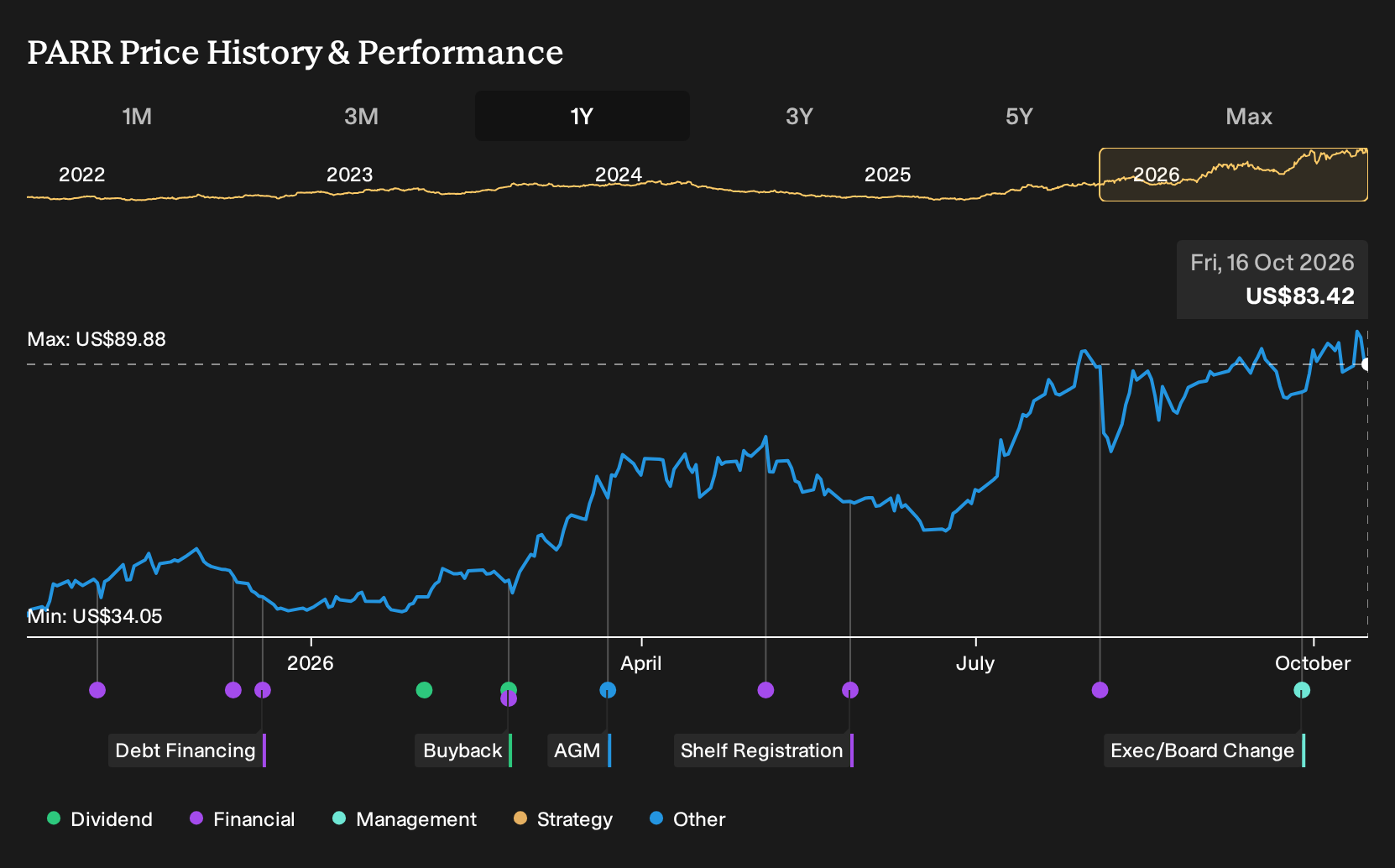
If Par Pacific sat on a watchlist instead of in a portfolio, the recent surge might feel expensive in hindsight. Investors who held Par Pacific over the past year are up 136.3%, including dividends. That jump invites a harder question. What clues were already on the table in October 2025 that might have helped you frame this as more than a regional refiner, particularly the assumption that tight global capacity could support premium refining margins in Hawaii and the Rockies?
The useful thing about a Narrative is that the reasoning is checkable: the assumptions sit beside the argument, and together they imply an estimated Fair Value you can disagree with.
If the move has made Par Pacific harder to judge, start where the gap is still open and scan 33 high quality undervalued stocks.
The Two Par Pacific Stories Investors Had To Weigh
The shares cost US$34.05 at the start of the period, and Par Pacific came with two very different stories attached.
The bullish narrative pinned fair value at US$38. It leaned on Hawaii SAF with Mitsubishi and ENEOS, assuming new international feedstock channels and markets could meaningfully lift refining margins.
The bearish view argued for a fair value of US$23. It focused on faster electric vehicle adoption and tighter emissions rules as serious threats to fuel demand and long term profitability.
What The Results Changed For The Par Pacific Story
The record Q2 2026 result for Par Pacific, with revenue moving from US$1,893.4 million in Q2 2025 to US$2,968.9 million and net income rising from US$59.5 million to US$462.1 million, clearly leaned toward the optimistic case that tight capacity could support premium margins. Net margin shifted from 3.1% to 15.6%. The Q1 2026 earnings miss and share-price drop cut the other way, so overall the evidence cut both ways.
The key lesson is simple. When a thesis rests on stronger refining economics, track net margin and segment throughput in each report and compare them with the original margin assumptions, not just with the latest headline earnings surprise.
What Par Pacific's Run Leaves You Paying For Today
Par Pacific now trades at US$83.42, and this Narrative’s Fair Value sits above the current price based on its own assessment rather than any certainty. It leans heavily on the idea that strong refining reliability, Montana capture and Hawaii Renewables output can keep the recent earnings power intact.
The argument is that today’s price still does not fully credit the cash generation already visible from current operations and projects, after you factor in the risks around Hawaii pricing, crude differentials and shrinking tax shields.
"The numbers on recent EBITDA, per share earnings and balance sheet capacity imply a share price that does not fully reflect the cash the business is already producing or the potential of its current project and capital allocation pipeline."
The price and this Narrative do not agree. → Uncover what this Narrative says Par Pacific is actually worth
Find Your Own Contrarian Opportunity
The story behind this run has already been told. The next one could be taking shape somewhere else. Where could you start looking before it becomes the headline?
- Company 1 - 47% below our estimate - uses proprietary betting tech and tighter marketing to convert digital gamblers more efficiently.
- Company 2 - 33% below our estimate - wins subsea work as faster brownfield tiebacks steer projects toward integrated contracts.
- Company 3 - 32% below our estimate - sells GPU platforms customers depend on for AI data centres facing power constraints.
That is three of the list. See every one of the 25 solid balance sheet companies →
This article by Simply Wall St is general in nature. We provide commentary based on historical data and analyst forecasts only using an unbiased methodology and our articles are not intended to be financial advice. It does not constitute a recommendation to buy or sell any stock, and does not take account of your objectives, or your financial situation. We aim to bring you long-term focused analysis driven by fundamental data. Note that our analysis may not factor in the latest price-sensitive company announcements or qualitative material. Simply Wall St has no position in any stocks mentioned.
Have feedback on this article? Concerned about the content? Get in touch with us directly. Alternatively, email editorial-team@simplywallst.com