
- PRICING
- LIVE QUOTES
- LEARN
- HELP


EN
Mastercard (MA) Launches Global Money Platform As Undervalued Narrative Faces A P/E Test
Mastercard (MA) just teamed up with BVNK to launch the Mastercard Global Money Platform, a single API that lets banks and fintechs handle multi currency accounts spanning both fiat and stablecoins.
The recent launch of Global Money Platform comes on the heels of several crypto and AI partnerships, including a SoFi backed crypto card program in Mexico and a reseller deal with Rezolve AI, which together keep Mastercard visible in high growth payment niches. The stock has strong momentum, with a 7 day share price return of 4.8% and a 30 day move of 8.75%. The 1 year total shareholder return of 10.77% and 5 year total shareholder return of 77.35% point to a longer record of value creation.
Compare Mastercard’s crypto and AI payment momentum with other potential breakouts by focusing on curated 39 profitable AI stocks that aren't just burning cash that feature real businesses behind the buzz.
After Mastercard’s sharp run on the latest crypto and AI news, the real fork in the road is simple: pay up after this move, or wait and risk watching it keep running while the valuation case says otherwise?
Most Popular Narrative: 18% Undervalued
Mastercard last closed at $617.42, while the most followed narrative on the stock, according to Investingwilly, pegs fair value at $750. That gap frames the entire debate around whether the recent AI and crypto momentum justifies paying up or still leaves room on the table.
What it offers instead: a business that compounds safely, a payout growing at double-digit rates from a tiny base, and a price that doesn't currently reflect either of those things. Setups like that don't come around often, and the current pullback looks more like an entry point than a warning sign.
See why 148 investors see Mastercard as 18% undervalued.
According to Investingwilly's narrative, that $750 fair value implies Mastercard trades at an 18% discount, even after the recent run to the low $600s. The narrative uses a discount rate of 7.25% and assumes the business can support margins near 45.9%, which helps explain why the estimated value sits well above the current share price.
The same storyline leans heavily on compounding. Earnings have grown 13.8% per year over the past 5 years, with the most recent year at 19.7%, and are forecast to increase a further 11.22% per year. In that context, the long term total shareholder return of 77.35% over 5 years and 63.52% over 3 years shows how previous investors have been rewarded when the share price eventually caught up with the underlying results.
Critically, the narrative does not rely on aggressive top line assumptions. Reported revenue growth is 10.80% and the user narrative references currency neutral growth of roughly 15% for a recent quarter, which sits in the same ballpark as the provided annual revenue growth of 10.80%. That keeps the 7.25% discount rate and the $900.92 future cash flow value estimate in the statements data broadly aligned with the story that the stock is trading below intrinsic value.
There are clear counterpoints. Mastercard carries a high level of debt and relies entirely on higher risk sources of funding because it has no customer deposits. The reported Return on Equity of roughly 7x the 40% "outstanding" threshold is flagged as being heavily skewed by that leverage, which means the eye catching 289.99% figure needs to be treated with care.
Governance sits in the middle ground. The management team and board are considered experienced, with average tenures of 2.1 years and 7.8 years respectively, and 91% of directors are independent. At the same time, there have been no new directors in the last 3 years and there has been significant insider selling in the past quarter, which some investors might see as a yellow flag after a strong multi year run.
Performance against broader benchmarks is mixed. Mastercard's 1 year total return of 10.77% trails the wider US market at 14% yet still edges out the US Diversified Financial industry at 7%. Earnings growth over the past year of 19.7%, ahead of the industry's 9.6%, and an improvement in net profit margins from 44.9% to 46.3% reinforce the idea that operationally the business has been moving in the right direction while the share price has lagged the narrative fair value.
Future growth expectations sit in a moderate range. Revenue is forecast to expand 10.8% per year and earnings 11.2% per year, which is slower than the US market forecasts of 13.5% and 17.1% but still points to ongoing progress. The narrative effectively argues that a global network business growing at low double digit rates with high quality earnings and a 46.3% net margin can justify a fair value above today's price, even if it is not in a hyper growth phase.
The internal valuation tools behind the narrative reach a similar conclusion. Mastercard is described as trading at 31.5% below one estimate of fair worth and at a material discount to an estimated future cash flow value of $900.92, despite a value score of 3 out of 6. Those checks support the idea that sentiment, rather than fundamentals, is doing most of the work in keeping the stock below the narrative's $750 reference point.
Result: Fair Value of $750 (UNDERVALUED)
Still, Mastercard’s story can change quickly if stablecoin payment rails pull volume off its network, or if regulators clamp down harder on interchange economics.
Find out about the key risks to this Mastercard narrative.
Another View: Mastercard Through The P/E Lens
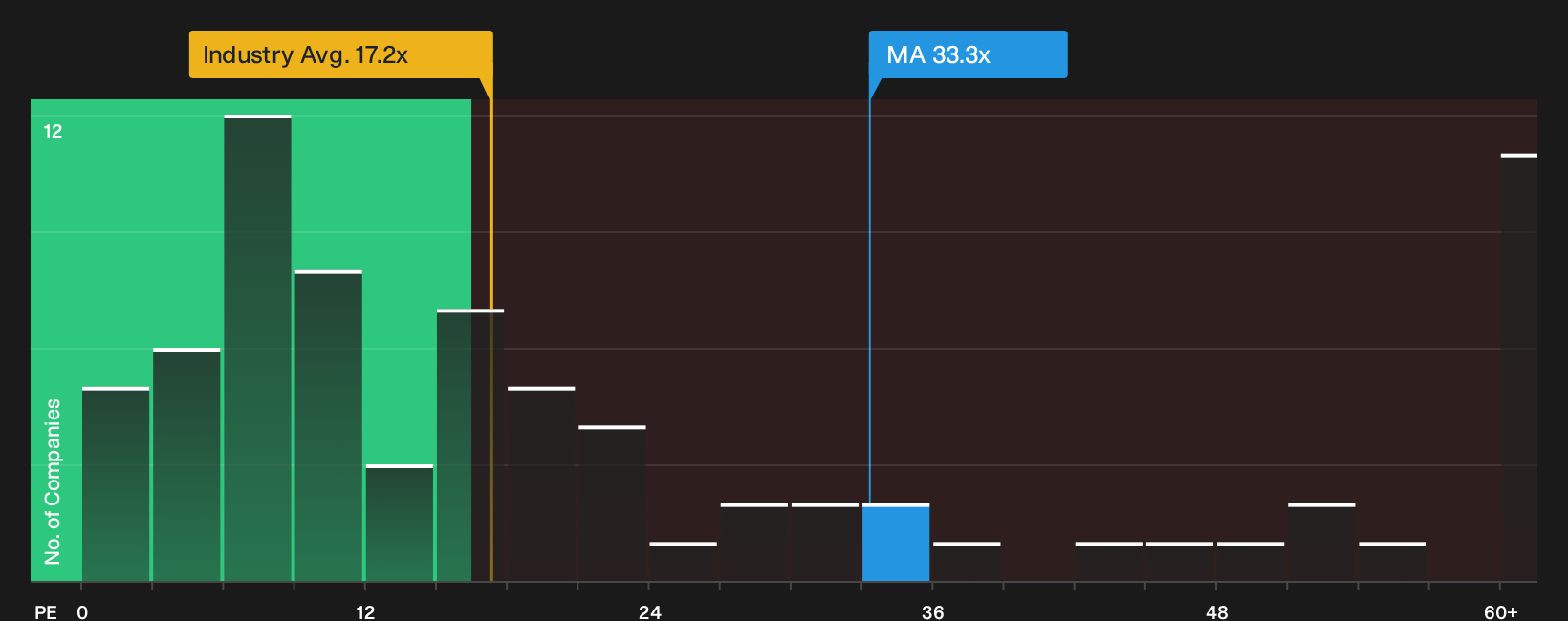
There is a catch to the undervalued storyline. On a P/E basis Mastercard trades at 33.3x, well above both the 19.4x fair ratio and the 17.2x industry average. That gap points to real multiple risk if sentiment cools, even if cash flow models say the stock is cheap. Which signal do you trust more?
For a closer look at what the current earnings multiple implies, and how it compares with peers, check the See what the numbers say about this price — find out in our valuation breakdown..
Next Steps
If the Mastercard story so far feels divided between optimism and caution, consider moving quickly and stress testing the numbers yourself using the 3 key rewards and 2 important warning signs.
Looking for more Mastercard investment ideas?
If Mastercard has you thinking harder about quality and price, now is the moment to widen your watchlist before the next wave of opportunities starts moving.
- Target strong upside potential by scanning a curated pool of quality companies that still look attractively priced using the 33 high quality undervalued stocks.
- Build a steadier portfolio by focusing on businesses with dependable payouts and higher yields through the 8 dividend fortresses.
- Sleep easier at night by concentrating on resilient companies with healthier risk profiles using the 32 resilient stocks with low risk scores.
This article by Simply Wall St is general in nature. We provide commentary based on historical data and analyst forecasts only using an unbiased methodology and our articles are not intended to be financial advice. It does not constitute a recommendation to buy or sell any stock, and does not take account of your objectives, or your financial situation. We aim to bring you long-term focused analysis driven by fundamental data. Note that our analysis may not factor in the latest price-sensitive company announcements or qualitative material. Simply Wall St has no position in any stocks mentioned.
Have feedback on this article? Concerned about the content? Get in touch with us directly. Alternatively, email editorial-team@simplywallst.com