
- PRICING
- LIVE QUOTES
- LEARN
- HELP


EN
Mercury NZ (NZSE:MCY) Could Be 6% Below Fair Value After Margin Growth
Mercury NZ (NZSE:MCY) has put its first quarter in focus after reporting a 19% rise in trading margin to NZ$445 million, supported by new wind capacity and reaffirmed earnings guidance.
At a share price of NZ$6.70, Mercury NZ has seen modest share price gains over 2026 year to date. The 1 year total shareholder return of 8.36% and 3 year total shareholder return of 31.10% point to steadier momentum, with the recent margin update and renewable build out helping frame that performance as investors reassess both growth prospects and risk around the portfolio build.
Scan beyond Mercury NZ and compare its renewable focused profile with our hand picked 41 power grid technology and infrastructure stocks building the infrastructure behind the energy transition.
Mercury NZ now trades at a discount to both analyst targets and some intrinsic value estimates, despite its recent margin update. Is that gap a genuine opportunity, or a warning that the market has this one right?
Most Popular Narrative: 6% Undervalued
On the latest figures, the most followed narrative pegs Mercury NZ's fair value at NZ$7.14 against a last close of NZ$6.70. This puts the current price below that narrative line and focuses attention squarely on how the business plans to grow into those expectations.
Ongoing and accelerated investment in new wind, geothermal, and battery storage projects, supported by a $1 billion capex pipeline and 3.5 TWh of new generation targeted by 2030, leverages the persistent decline in renewable technology costs, underpinning future earnings growth and generation margin expansion.
See why 25 investors see Mercury NZ as 6% undervalued.
The narrative uses a 7.41% discount rate to pull those future cash flows and project returns back into today's dollars, then lines that up against where Mercury NZ currently trades on the NZX. With that set of assumptions, the implied value of NZ$7.14 suggests a modest gap to the NZ$6.70 share price that leans toward the shares being undervalued on this framework.
For anyone weighing that gap, the key moving parts are the projected revenue growth of roughly 2.1% a year, an uplift in profit margin to about 10.4%, and the idea that the market could one day value those future earnings on a P/E multiple of around 33.9x. Those are precise inputs, not certainties, so they are best treated as a scenario to test against your own expectations for Mercury NZ's generation pipeline, hydrology risk and capital spending needs.
Result: Fair Value of NZ$7.14 (UNDERVALUED)
Still, Mercury NZ's heavy reliance on hydro inflows and rising capital demands for geothermal and grid projects could quickly challenge that 6% undervalued narrative.
Find out about the key risks to this Mercury NZ narrative.
Another View On Mercury NZ's Valuation
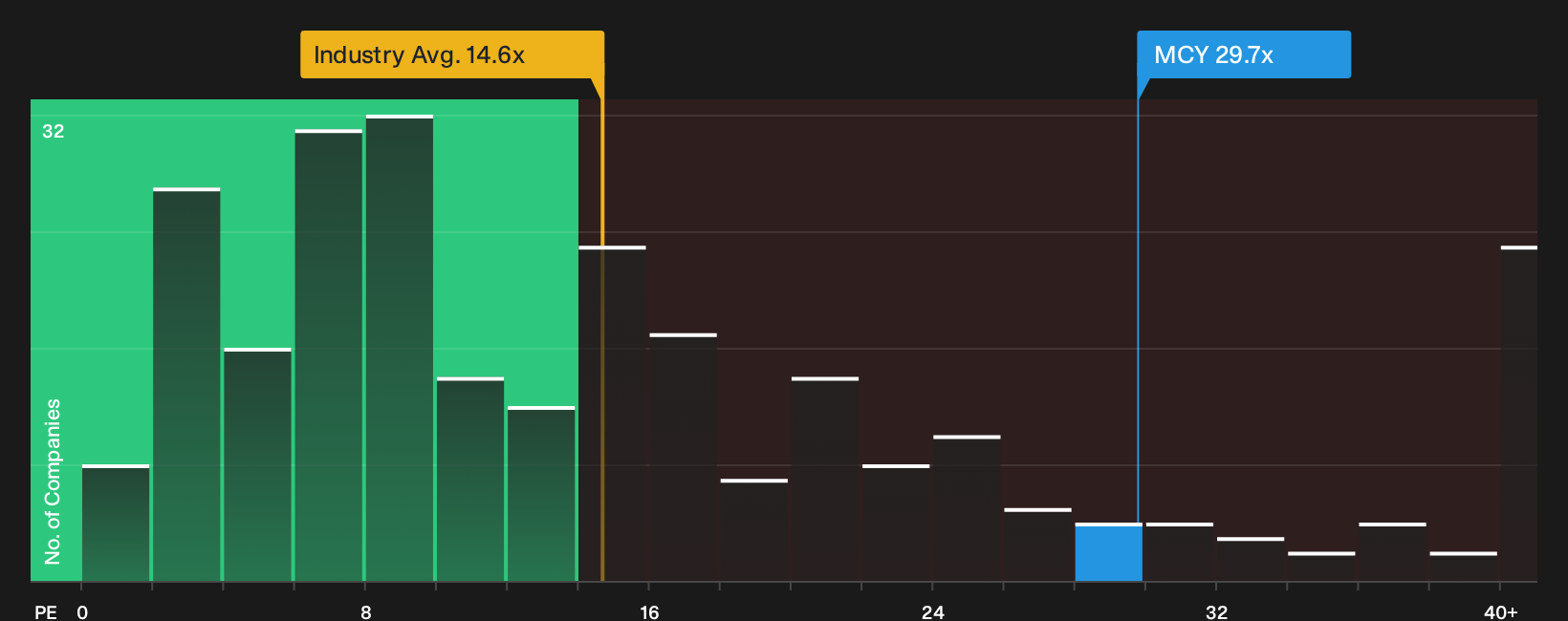
There is a twist when shifting from that narrative fair value to hard trading multiples. Mercury NZ changes hands on a P/E of 29.7x, which is roughly double the Global Electric Utilities average of 14.6x and above a fair ratio of 25.6x that our work suggests the market could lean toward over time.
That gap points to meaningful valuation risk if sentiment cools, even though the stock screens cheaper than its peer average P/E of 48.1x. The real question is which crowd you think will set the tone for returns from here.
See what the numbers say about this price — find out in our valuation breakdown.
Next Steps
Reading through Mercury NZ's story, you can see why opinions split between upside potential and portfolio risk. Move quickly, stress test the assumptions, and weigh the 2 key rewards and 2 important warning signs
Looking for more investment ideas beyond Mercury NZ?
If Mercury NZ has your attention, do not stop here. Broaden your opportunity set with focused stock ideas that match different risk and income goals.
- Target potential mispricing by scanning a curated set of 193 high quality undervalued stocks that combine strong fundamentals with attractive entry points.
- Strengthen portfolio resilience by filtering for companies with robust finances using our list of solid balance sheet and fundamentals (203 results).
- Hunt for future leaders early by reviewing a hand picked pool of 617 high quality undiscovered gems that many investors may be overlooking.
This article by Simply Wall St is general in nature. We provide commentary based on historical data and analyst forecasts only using an unbiased methodology and our articles are not intended to be financial advice. It does not constitute a recommendation to buy or sell any stock, and does not take account of your objectives, or your financial situation. We aim to bring you long-term focused analysis driven by fundamental data. Note that our analysis may not factor in the latest price-sensitive company announcements or qualitative material. Simply Wall St has no position in any stocks mentioned.
Have feedback on this article? Concerned about the content? Get in touch with us directly. Alternatively, email editorial-team@simplywallst.com