
- PRICING
- LIVE QUOTES
- LEARN
- HELP


EN
Pricing Downgrade Might Change The Case For Investing In Swiss Re Stock (SWX:SREN)
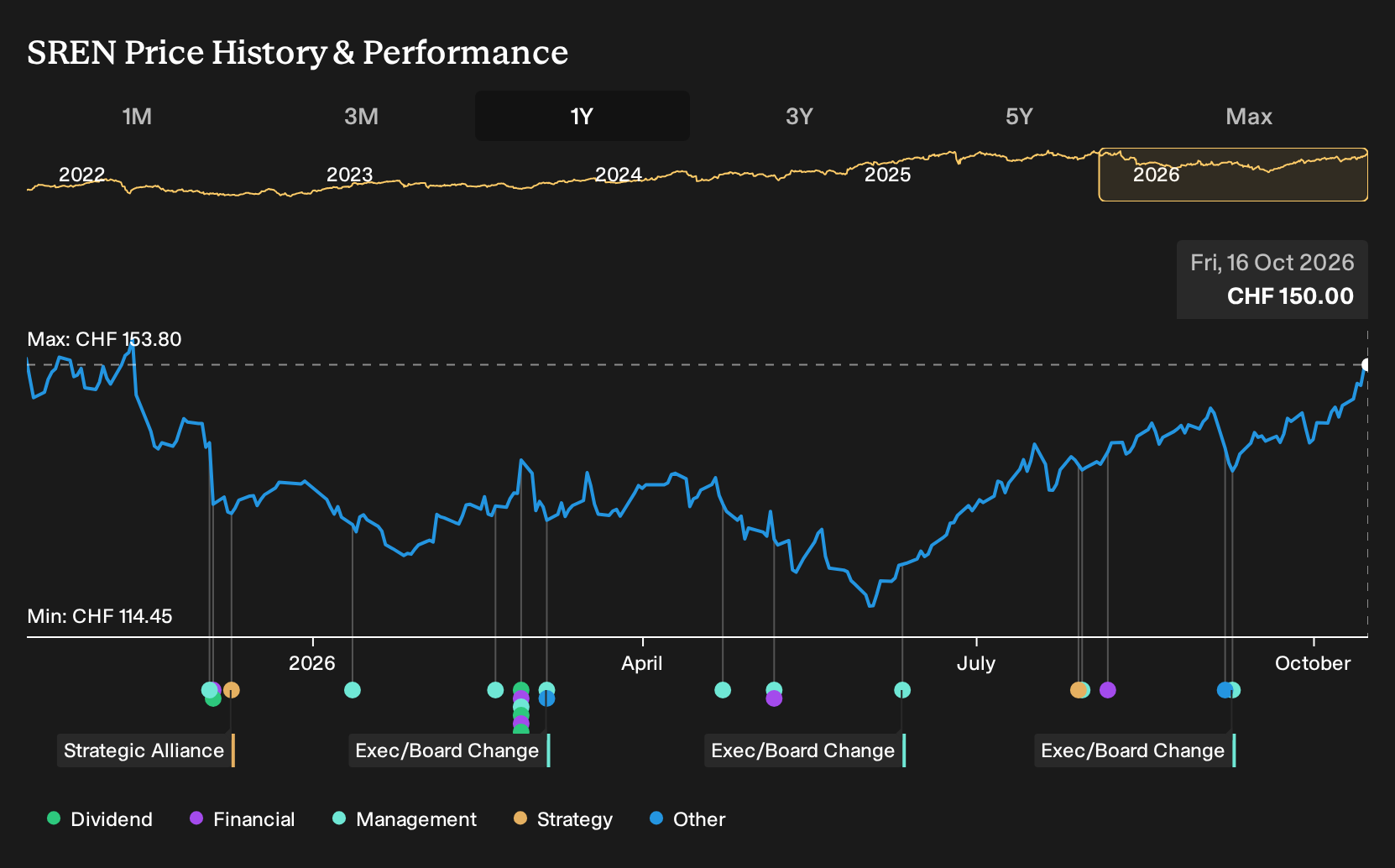
- Jefferies recently downgraded Swiss Re after pointing to softening reinsurance prices, which it believes are pressuring revenue and earnings forecasts out to 2028.
- The report spotlights a widening gap between Swiss Re's internal revenue expectations and more cautious external views on how weaker pricing affects future profitability.
- This raises questions about how Swiss Re's investment narrative could be influenced by accelerating reinsurance price softness highlighted in the Jefferies downgrade.
Pressure test Swiss Re's downgrade narrative by lining it up against hand-picked insurers and financials with stronger pricing support, using 233 resilient stocks with low risk scores as your comparison set.
Swiss Re Investment Narrative Recap
To own Swiss Re, you need to be comfortable with a reinsurance group that leans heavily on disciplined underwriting, catastrophe exposure and cost control to support earnings. The immediate catalyst is whether management can hold underwriting margins as real insurance pricing softens across key segments. Jefferies’ downgrade highlights that softer pricing is biting near term, although the core franchise and risk analytics focus remain the operational levers to watch.
The biggest near term risk is that pricing weakness proves more persistent or deeper than Swiss Re’s own planning assumes, which could strain combined ratios and earnings quality. On top of that, ongoing pruning in casualty lines and Life & Health assumption reviews already add volatility to results. If underlying real pricing continues to erode, the group’s slower expected earnings trajectory and already tightly covered dividend become more important for your risk tolerance.
There have been no fresh Swiss Re announcements listed around this downgrade, which puts the Jefferies report itself in the foreground as the key new datapoint. You are essentially comparing two views of the same business: one from the inside that assumes softer pricing can be managed, and one from outside that sees more pressure on revenue and profit over the next few years.
In that context, the earlier consensus expectations of 3.8% annual revenue growth and a 2.8% yearly decline in earnings take on a different color. Jefferies’ softer outlook on premiums aligns with those already cautious profit forecasts rather than contradicting them. For you as a shareholder or prospective investor, the practical question is how comfortable you are with a reinsurance group where earnings are expected to drift lower while pricing pressure, regulatory cost and capital needs all remain live operational constraints.
Swiss Re Forecasts Under the Microscope
Swiss Re's narrative projects $46.4b revenue and $4.8b earnings by 2029. This rests on 3.5% yearly revenue growth and a $0.1b earnings decline from $4.9b today.
Uncover why Swiss Re's fair value indicates a 13% potential downside to its current price, which leaves little room for error.
Exploring Other Perspectives
For Swiss Re, the alternate narrative leans on cost discipline as the swing factor. Bullish analysts saw room for margins to edge higher and expected earnings around $5.8b by 2029 on roughly $47.9b revenue, compared with the $4.8b earnings consensus. The Jefferies downgrade could prompt both camps to rethink those pre‑news assumptions.
Explore 2 other Swiss Re fair value estimates, including one that suggests up to 159% upside from the current price!
The Verdict Is Yours
Don't just follow the ticker; dig into the data and build a conviction that's truly your own.
- A great starting point for your Swiss Re research is our analysis highlighting 3 key rewards and 2 important warning signs that could impact your investment decision.
- See our latest analysis for Swiss Re. The report includes a comprehensive fundamental analysis summarized in a single visual, the Snowflake, making it easy to evaluate Swiss Re's overall financial health at a glance.
Looking for more Swiss Re sized investment ideas?
Once you have formed a view on Swiss Re, it can help to benchmark that conviction against a wider watchlist of opportunities that share similar quality traits or income profiles. The Simply Wall St Screener can surface a range of alternatives that fit different objectives, from defensive balance sheets to higher income potential.
- If capital preservation sits high on your list, start by comparing Swiss Re with a curated group of stocks that score well on resilience and risk using the 233 resilient stocks with low risk scores.
- For investors who want income to do more of the heavy lifting, line up Swiss Re against companies filtered for stronger yield support with the 212 dividend fortresses.
- When you are hunting for compelling fundamentals at a reasonable entry point, broaden the search beyond Swiss Re through the 193 high quality undervalued stocks.
This article by Simply Wall St is general in nature. We provide commentary based on historical data and analyst forecasts only using an unbiased methodology and our articles are not intended to be financial advice. It does not constitute a recommendation to buy or sell any stock, and does not take account of your objectives, or your financial situation. We aim to bring you long-term focused analysis driven by fundamental data. Note that our analysis may not factor in the latest price-sensitive company announcements or qualitative material. Simply Wall St has no position in any stocks mentioned.
Have feedback on this article? Concerned about the content? Get in touch with us directly. Alternatively, email editorial-team@simplywallst.com