
- PRICING
- LIVE QUOTES
- LEARN
- HELP


EN
The Sky Is Falling for Skydance Stock as Financial Concerns Mount. How to Play SKYD Here.
The long-running saga of Paramount Skydance acquiring Warner Bros. came to an end on Oct. 6. Streaming giant Netflix (NFLX) seemed to have the deal in the bag for quite some time. However, the David Ellison-led company continued to sweeten the deal for Warner Bros. shareholders to the point that Netflix's final offer of $27.75 for the former's studios and streaming assets was not enough, and it had to back out of the deal.
Yet, the show must go on, they say. And so it is.
SKYD Stock: Falling From the Sky
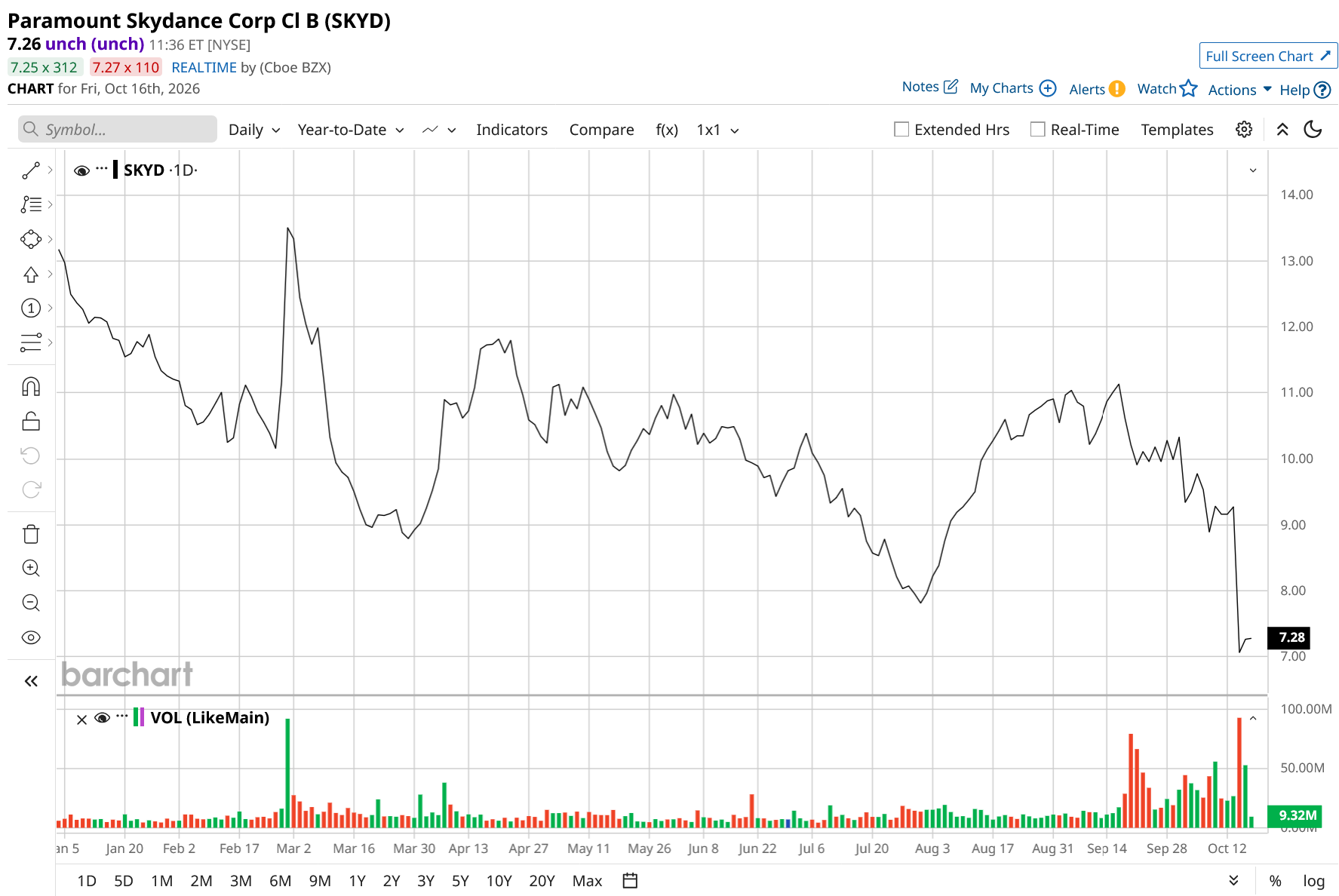
Post the merger, the Paramount-Warner Bros. combination has been rebranded as Skydance (SKYD). The Class B shares are now trading under the ticker SKYD and have been moved from Nasdaq to the New York Stock Exchange. However, they fell by a considerable 23.8% in Oct. 14's trading session. Why? Well, the deal to acquire Warner Bros. involved Paramount Skydance distributing warrants to eligible existing Class B shareholders in connection with the syndication of equity financing for the acquisition.
The company explained that eligible shareholders would receive one warrant per share held on the record date, subject to exclusions. The warrants were intended to allow eligible shareholders to participate in future appreciation on terms linked to the $12-per-share equity syndication price. Finally, about 470.7 million warrants were distributed on Oct. 13, 2026, following completion of the acquisition, with an initial exercise price of $12 per share and a ten-year term. Skydance potentially raised about $5.65 billion in gross proceeds from this exercise, although this led to the dramatic fall in the share price in Wednesday's trading session.
Size Matters
On paper, the combination of Paramount and Warner Bros. looks impressive. The resulting company brings together two major Hollywood studios, the Paramount+ and HBO Max streaming services, and a wide range of television, news, and sports brands, including CBS, CNN, HBO, Nickelodeon, and TNT Sports. Notably, the management expects the enlarged Skydance Corporation to generate close to $70 billion in annual revenue, with its content library including globally popular franchises such as Mission Impossible, Top Gun, Harry Potter, and the DC properties, which can be monetized through theatrical releases, streaming subscriptions, advertising, licensing deals, and live sports.
Moreover, the company is targeting at least $6 billion in annualized cost savings within three years. Most of those savings are expected to come from combining technology systems, streamlining purchasing, coordinating marketing efforts, and reducing real estate footprints. At the same time, leadership has committed to releasing at least 30 theatrical films and more than 180 television shows and series each year. If the plan works, the larger group should gain stronger negotiating power with distributors and advertisers, reach a wider audience with its content, and become a more serious competitor to Netflix (NFLX) and Disney (DIS).
The scale of the deal does carry real financial risk, however. Pro forma net debt stands at about $78.9 billion. Delivering the promised synergies and generating enough free cash flow will therefore be essential if the company is to bring that debt down and create value for shareholders.
In its latest quarterly results for the three months ended June 30, 2026, before the merger's completion, Paramount Skydance beat expectations on revenue but missed on earnings.
Total revenues rose by about 1% from the previous year to $6.9 billion, as the streaming and studios segment augmented growth by increasing by 9% and 16% in the same period to $2.5 billion and $1.3 billion, respectively. However, revenues for TV media fell by 9% YoY to $3.2 billion.
In terms of earnings, the same fell to $0.04 per share from $0.08 per share in the year-ago period, missing the consensus estimate of $0.11 per share.
Notably, the company remained cash flow positive amid all this upheaval, generating net cash from operating activities of $504 million for the six months ended June 30, 2026. This was $339 million in the comparable period a year ago. Overall, the company closed the June 2026 quarter with a cash balance of $1.63 billion, with no short-term debt on its books. However, the long-term debt had already ballooned to $14.5 billion by then.
Valued at a market cap of $7.9 billion, SKYD stock is down 46% on a year-to-date (YTD) basis, with the stock also offering a dividend yield of 2.75%. However, all this must be seen in the context of the merger and the ensuing value distortion. A clearer picture would emerge after at least a year of operations of the combined company.
Analyst Opinion on SKYD Stock
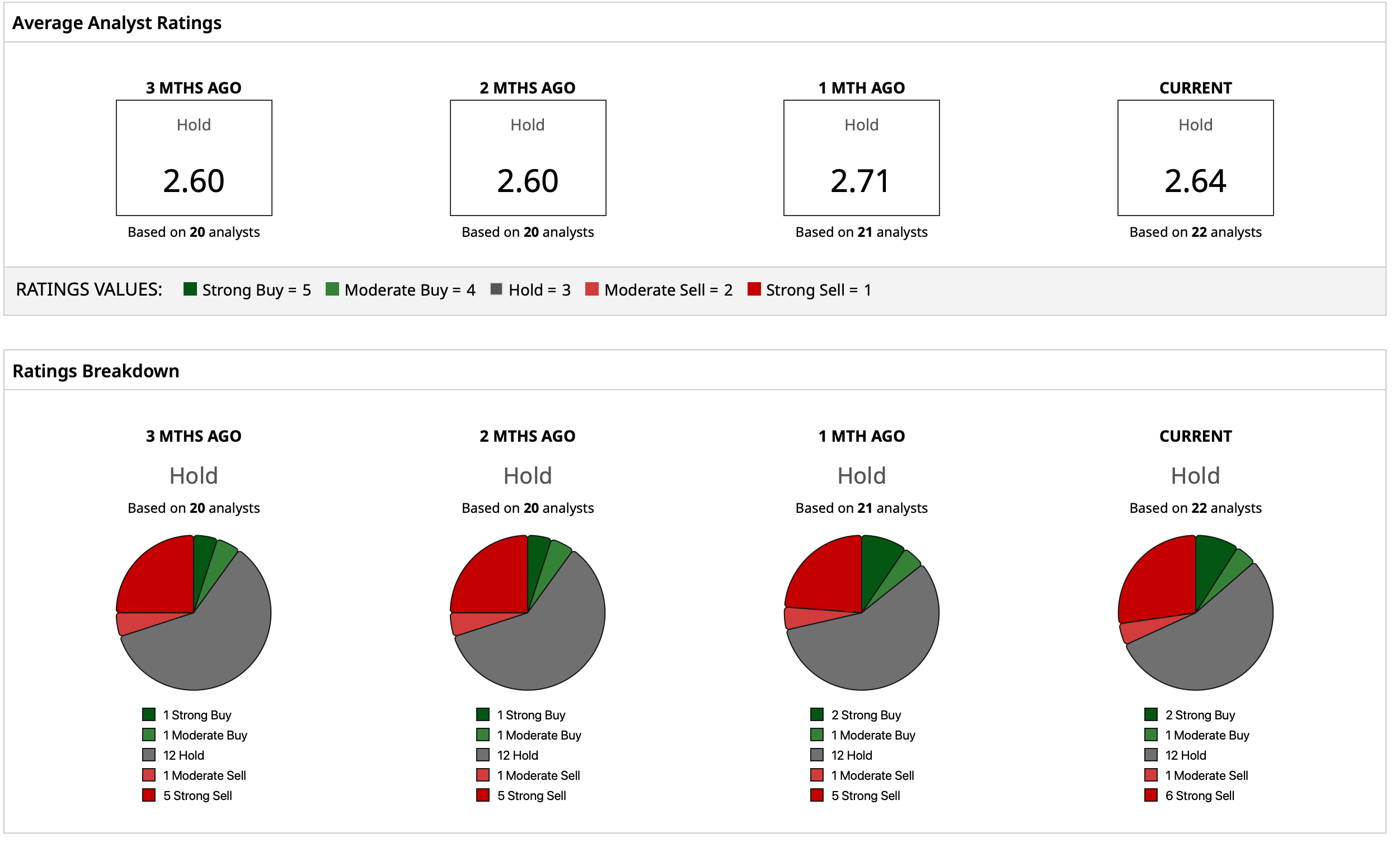
Considering this, analysts have deemed SKYD stock to be a consensus “Hold.” The mean target price of $10.09 denotes a potential upside of 39% from current levels. Out of 22 analysts covering the stock, two have a “Strong Buy” rating, one has a “Moderate Buy” rating, 12 have a “Hold” rating, one has a “Moderate Sell” rating, and six have a “Strong Sell” rating.
On the date of publication, Pathikrit Bose did not have (either directly or indirectly) positions in any of the securities mentioned in this article. All information and data in this article is solely for informational purposes. For more information please view the Barchart Disclosure Policy here.