
- PRICING
- LIVE QUOTES
- LEARN
- HELP


EN
What Happens to Software Stocks When Nobody Opens Apps Anymore? Microsoft Has a Head Start.
Bank of America has flagged a long-term risk for enterprise software companies. As AI assistants become the main way people work, users may stop opening individual apps altogether. Instead, they would simply ask a chatbot to get things done. BofA warned this could hurt even companies that own valuable data and workflows. It also said leading AI labs could eventually build competing apps of their own. Among the big names, though, BofA sees Microsoft (MSFT) as best positioned to own this new way of working, thanks to Office, Teams, Outlook, Windows, and its Copilot strategy.
Copilot Is Already Part of the Daily Routine
Microsoft’s latest numbers strengthen that view. Microsoft 365 Copilot passed 30 million paid seats last quarter, up from more than 20 million in April. More importantly, CEO Satya Nadella said Copilot usage is now as intense as Outlook and Teams, two of the most-used workplace tools in the world. I think that’s the detail worth paying attention to. If people use Copilot as often as their email, it’s already becoming the interface BofA is talking about. Microsoft is also turning Copilot into a single app that combines chat, task automation, and coding.
Microsoft has a backup plan too, if AI labs win more of the interface. Its Foundry platform now offers more than 11,000 models from OpenAI, Anthropic, xAI, and others, alongside its own. So even when customers choose another company’s AI, Microsoft can still earn by hosting it. As I recently covered, it’s also building cheap, fast models like Microsoft-Decision-1 to help AI agents make decisions at a lower cost.
About Microsoft Stock
Microsoft makes software and cloud services used by businesses and consumers worldwide, including Windows, Office, Teams, Azure, LinkedIn, and Xbox. Its Copilot AI assistant now sits inside many of those products, putting it at the center of how people may use software in the future. Founded in 1975, the company is headquartered in Redmond, Washington.
Over the last 12 months, Microsoft’s stock has gained only about 6%, well behind the S&P 500’s ($SPX) 16% rise. The picture changed after the company’s fiscal fourth-quarter report in late July, when shares jumped about 8% in a single day. The rally has continued since, and the stock recently hit an all-time high. It currently sits near that level.
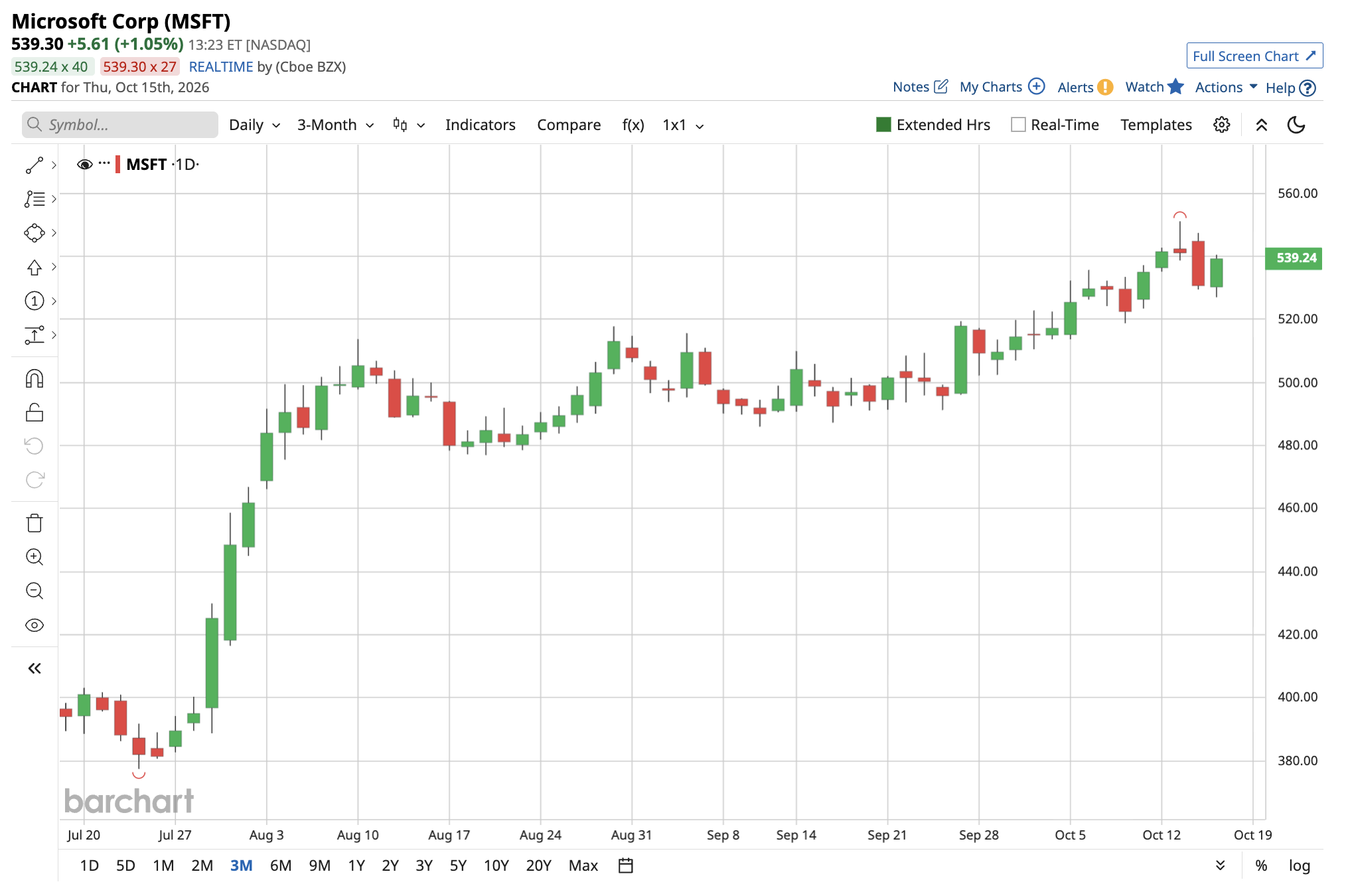
Microsoft’s valuation sits a little under its long-term average. The forward non-GAAP price-to-earnings (P/E) of 27.07x is roughly 11% below its 5-year average, and the forward price-to-sales (P/S) ratio of 10.15x is about 6% lower. Analysts expect earnings growth to improve from about 14% this fiscal year to around 20% next year. Based on fiscal 2028 estimates, the stock trades at about 23x earnings. The balance sheet is not much of a concern for a company worth trillions. Microsoft holds $76.84 billion in cash against $128.81 billion in debt and lease obligations. For investors, owning the place where people start their workday could prove more valuable than any single app, and I don't think today's price fully reflects that.
Azure Growth Is Expected to Speed Up Again
Microsoft reported its fourth-quarter fiscal 2026 results on July 29. Revenue grew 18% to $90 billion, beating the $87.6 billion analysts expected. Adjusted EPS of $4.74 also surpassed the $4.24 estimate. Azure was the standout, with growth accelerating to 43%. For the full year, Azure revenue passed $100 billion for the first time.
For the next quarter, management expects Azure growth to speed up again, to about 45% in constant currency. Spending will keep climbing too, with capital expenditures expected to exceed $50 billion this quarter alone. Investors will also get a clearer look at AI demand, since this will be the first quarter Microsoft reports Azure revenue in dollars. Together with Copilot’s progress, that should show how well Microsoft is turning AI into revenue. The company reports its fiscal first-quarter 2027 results on October 28.
What Do Analysts Expect for MSFT Stock?
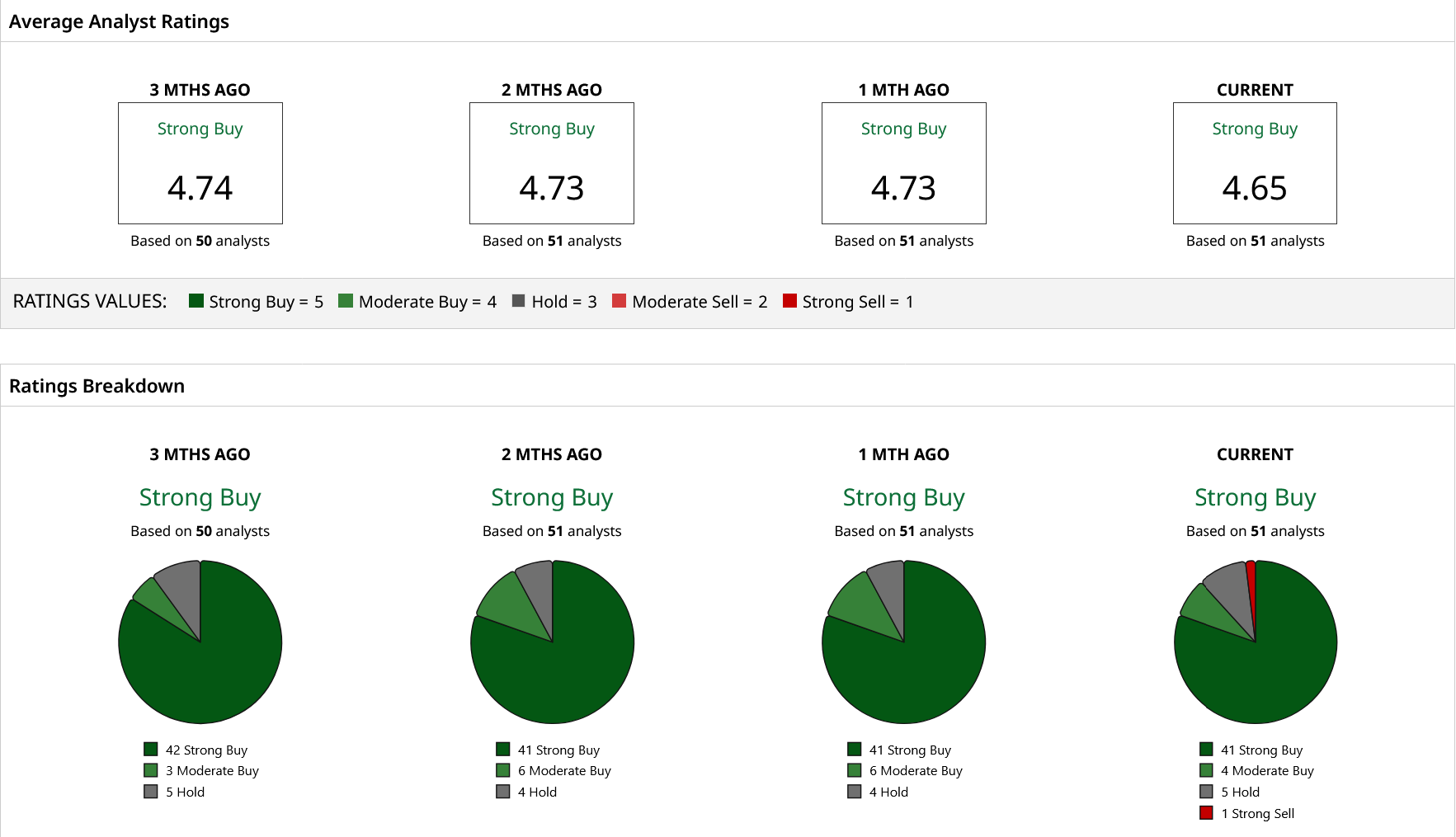
Based on 51 Wall Street analysts, MSFT stock holds a “Strong Buy” rating with a mean price target of $591.09, indicating 10% upside. The upside looks modest on paper. But with the stock already near its all-time high, analysts still expecting gains from here is more encouraging than it looks.
On the date of publication, Jabran Kundi did not have (either directly or indirectly) positions in any of the securities mentioned in this article. All information and data in this article is solely for informational purposes. For more information please view the Barchart Disclosure Policy here.