
- PRICING
- LIVE QUOTES
- LEARN
- HELP


EN
Elon Musk Has ‘No Idea How to Make Microchips’ But He’s Confident Tesla Could Supercharge the Chip Design Process
Elon Musk is making an increasingly ambitious bet on semiconductors, even as he openly admits that he currently has “no idea how to make microchips.” Speaking via livestream at the X Takeover event outside Tesla’s Gigafactory in Austin, Texas, Musk said he believes Tesla (TSLA) and SpaceX (SPCX) can eventually make chips better than established industry players by applying their expertise in building highly customized manufacturing equipment.
The comments highlight Musk’s broader vision for Terafab, the planned Texas semiconductor project being developed by Tesla and SpaceX with Intel (INTC) involved. The project is expected to require more than $15 billion in initial investment and is designed to give Musk’s companies greater control over the chips needed for Tesla’s artificial intelligence (AI) systems, Optimus robots, and SpaceX’s computing ambitions. Musk also wants to dramatically accelerate chip-design iterations, potentially turning faster experimentation and customized equipment into a competitive advantage.
Thus, investors will be eager to assess whether Musk can translate Tesla’s manufacturing expertise into a meaningful advantage in one of the world’s most technically demanding industries.
About Tesla Stock
Tesla is an automotive and clean energy company headquartered in Austin, Texas. Tesla designs, manufactures, and sells electric vehicles (EVs), alongside energy storage solutions such as Powerwall and Megapack, solar products, and related services.
Over the years, Tesla has expanded globally with a network of production facilities, showrooms, service centers, and Supercharger stations, and has increasingly emphasized advanced software and autonomous capabilities as part of its long-term strategy. Tesla is one of the world’s most valuable companies with a current market capitalization of $1.45 trillion.
Tesla shares have delivered a muted performance despite several positive developments around the company’s AI, autonomous-driving, and robotics ambitions. TSLA stock is down 17% over the past year and 19% year-to-date (YTD), while it remains 27% below its 52-week high of $498.83.
The weakness largely reflects concerns about Tesla’s core automotive business and profitability. Although third-quarter deliveries of 486,532 vehicles comfortably exceeded expectations, they were still down 2% year-over-year (YOY), suggesting that the delivery recovery remains relatively modest. Tesla also produced 464,391 vehicles during Q3, below deliveries, indicating that it was fulfilling some demand from previously accumulated inventory rather than relying entirely on current-quarter production.
Investors are also looking beyond delivery numbers toward margins and cash generation. Tesla is committing more than $25 billion to capital expenditures in 2026 as it expands spending on AI infrastructure, autonomous driving, robotics, and manufacturing. At the same time, Q2 operating income fell sharply even as revenue increased, highlighting the difficulty of funding these long-term initiatives while maintaining automotive profitability.
Meanwhile, Tesla continues to face intense competition in China, while the expiration of U.S. EV incentives has weakened the broader U.S. EV market, with U.S. EV sales down sharply in 2026. Tesla’s U.S. sales fell 14% in the first three quarters of the year, although the company has performed better than some traditional automakers.
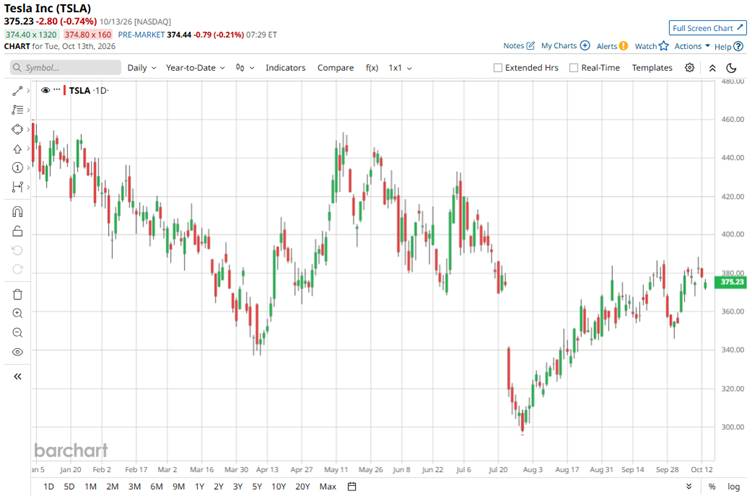
In terms of valuation, TSLA stock trades at a forward price-to-earnings (P/E) ratio of 542.1 times, which is well above the industry average. The stock also trades at 15.6 times sales, which is a premium compared to its peers.
Mixed Financial Performance
Tesla’s Q2 results, released on July 22, showed strong top-line growth and vehicle deliveries, but profitability remained under pressure as the company stepped up investments in AI, autonomy, and next-generation products.
Revenue climbed 26% YOY to $28.2 billion, helped by higher vehicle deliveries, growth in Services and Other, and stronger Energy Generation and Storage revenue. Automotive revenue increased 23% YOY to $20.5 billion, Energy Generation and Storage revenue rose 13% YOY to $3.1 billion, and Services and Other revenue surged 50% YOY to $4.6 billion.
Tesla’s vehicle business posted record quarterly deliveries as the company delivered 480,126 vehicles, up 25% YOY, while production increased 10% to 451,758 vehicles in Q2. Model 3/Y deliveries jumped 25% to 467,762 vehicles, while deliveries of other models rose 19% to 12,364. Energy storage deployments also increased 41% YOY to 13.5 gigawatt-hours. Meanwhile, active FSD subscriptions reached 1.48 million, up 56% YOY.
The stronger sales volumes, however, did not translate into higher operating profits. Gross profit rose 23% to $4.8 billion, but total gross margin declined to 16.8% from 17.2% a year earlier. Operating expenses jumped 47% YOY to $4.4 billion. As a result, operating income plunged 57% to $398 million, while operating margin fell to 1.4% from 4.1%. Adjusted EBITDA declined 4% to $3.3 billion, with the adjusted EBITDA margin dropping to 11.6% from 15.1%.
On the bottom line, non-GAAP net income fell 17% to $1.2 billion, while adjusted EPS dropped 18% to $0.33. Tesla’s results reflected the rising cost of its push into AI and other R&D initiatives, along with lower regulatory-credit revenue and lower vehicle average selling prices.
Cash flow also reflected Tesla’s aggressive investment cycle. Operating cash flow increased 85% YOY to $4.7 billion, but capex surged 142% YOY to $5.8 billion. That drove free cash flow to -$1.1 billion, compared with positive free cash flow of $146 million a year earlier. Tesla ended the quarter with $43.5 billion in cash, cash equivalents, and short-term investments.
Analysts expect EPS to decline 37% YOY for fiscal 2026 before rising 71% to $1.18 in fiscal 2027. For Q3, which will be reported on Oct. 21, the consensus EPS estimate is $0.21, indicating a decline of 43% YOY.
What Do Analysts Expect for Tesla Stock?
Barclays analyst Dan Levy recently maintained a “Hold” rating on Tesla with a $370 price target, signaling a relatively cautious view of TSLA stock at its current valuation. On Oct. 5, however, Deutsche Bank maintained a “Buy” rating with a $420 price target following Tesla’s better-than-expected Q3 deliveries.
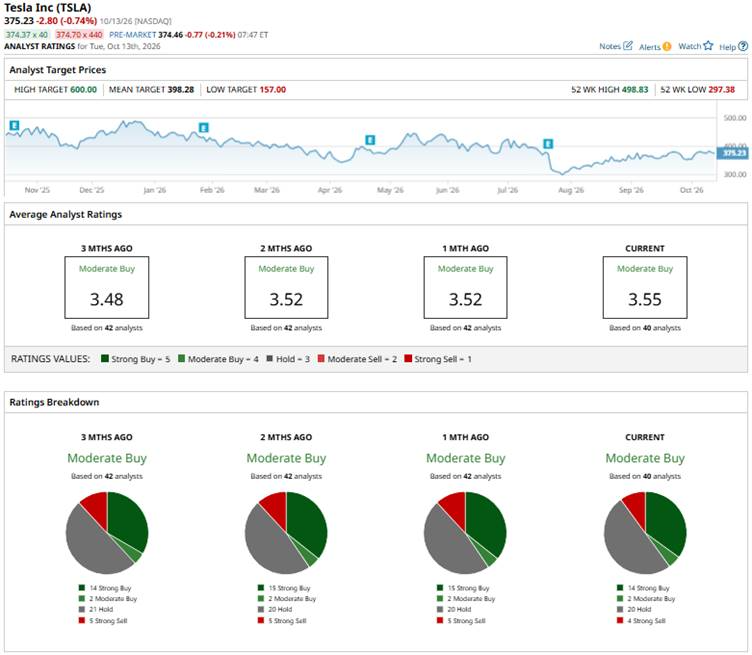
Overall, TSLA stock has a consensus “Moderate Buy” rating on Wall Street, indicating a cautiously bullish stance. Of the 40 analysts covering the stock, 14 advise a “Strong Buy,” two recommend a “Moderate Buy,” 20 analysts have a “Hold” rating, and four have a “Strong Sell" rating.
The average price target of $398.28 indicates potential upside of 10% from current levels. Meanwhile, the Street-high target price of $600 suggests the stock could rally as much as 66% from here.
On the date of publication, Subhasree Kar did not have (either directly or indirectly) positions in any of the securities mentioned in this article. All information and data in this article is solely for informational purposes. For more information please view the Barchart Disclosure Policy here.