
- PRICING
- LIVE QUOTES
- LEARN
- HELP


EN
Higher Earnings Estimates Might Change The Case For Investing In ANZ Shares (ASX:ANZ)
- ANZ Group Holdings received member resolutions under section 249N of the Corporations Act 2001 at its December 2026 AGM that proposed adding an advisory clause to the constitution, allowing shareholders to express views or request information on director powers where issues are materially relevant to the business and compliant with law.
- The push for an advisory resolution mechanism highlights growing investor focus on how ANZ Group Holdings’ board exercises its authority on operational priorities, capital allocation and risk controls, alongside recent earnings estimate upgrades that reflect changing external expectations for the bank’s performance.
- This analysis will examine how this governance-focused constitutional proposal and the recent earnings estimate revisions might influence ANZ Group Holdings’ broader investment narrative.
Scan how ANZ Group Holdings’ governance debate compares with other banks by reviewing the hand picked list of solid balance sheet and fundamentals (12 results) that may appeal to investors focused on board discipline and capital protection.
ANZ Group Holdings Investment Narrative Recap
To own ANZ Group Holdings, you need to be comfortable that management can keep reshaping a complex bank while juggling regulatory remediation, the ANZ Plus tech build and Suncorp Bank integration. Earnings forecasts point to growth, but the bigger story is whether cost programs and digital migration actually translate into a lower cost to income ratio.
The proposed advisory resolution on director powers does not directly change that operating equation in the short term. The immediate swing factors still look like execution on ANZ Plus, delivery of Suncorp synergies and keeping compliance and remediation spending from crowding out margin and earnings progress.
The AGM resolution to insert an advisory clause into ANZ Group Holdings’ constitution is the key governance announcement tying into this debate. It would formalise a mechanism for shareholders to express views or request information on how directors are using their powers where the issue is materially relevant and lawful, without binding the board.
For you, the interest is practical. Better disclosure and board accountability can make it easier to track progress on core catalysts such as the Suncorp integration timeline, the A$875m FY26 productivity program and regulatory remediation. It also sharpens focus on risk areas such as technology execution and the low allowance for bad loans at 49%.
Earnings Expectations Behind ANZ Group Holdings’ Governance Debate
ANZ Group Holdings sits in a tricky spot for investors, because the governance push around advisory resolutions is landing at the same time analysts have sketched out a fairly specific earnings and revenue profile out to 2029. Shareholders are not just asking how the board uses its powers in theory. They are weighing whether the current directors can actually deliver on the numbers now embedded in consensus models.
Forecasts in late 2026 outline a bank that is expected to lift revenue by 4.0% a year over the next three years while profit margins move from 27.4% to 33.4%. Earnings today are A$5.9b and analysts are looking for A$8.1b by 2029, which is an increase of about A$2.2b. That earnings path, combined with earnings per share assumptions of A$2.65 and modest share count growth of 1.06% per year, underpins the price targets currently being debated.
The analyst playbook has a clear valuation hook. To make the consensus target stack up, ANZ Group Holdings would need to trade on a P/E of 17.7x those A$8.1b earnings in 2029, down from 19.0x today but still above the broader New Zealand banks sector at 13.7x. That gap means the board is implicitly being asked to run a bank that justifies a richer multiple through execution on Suncorp Bank, the ANZ Plus platform and productivity programs, without simply relying on sector beta.
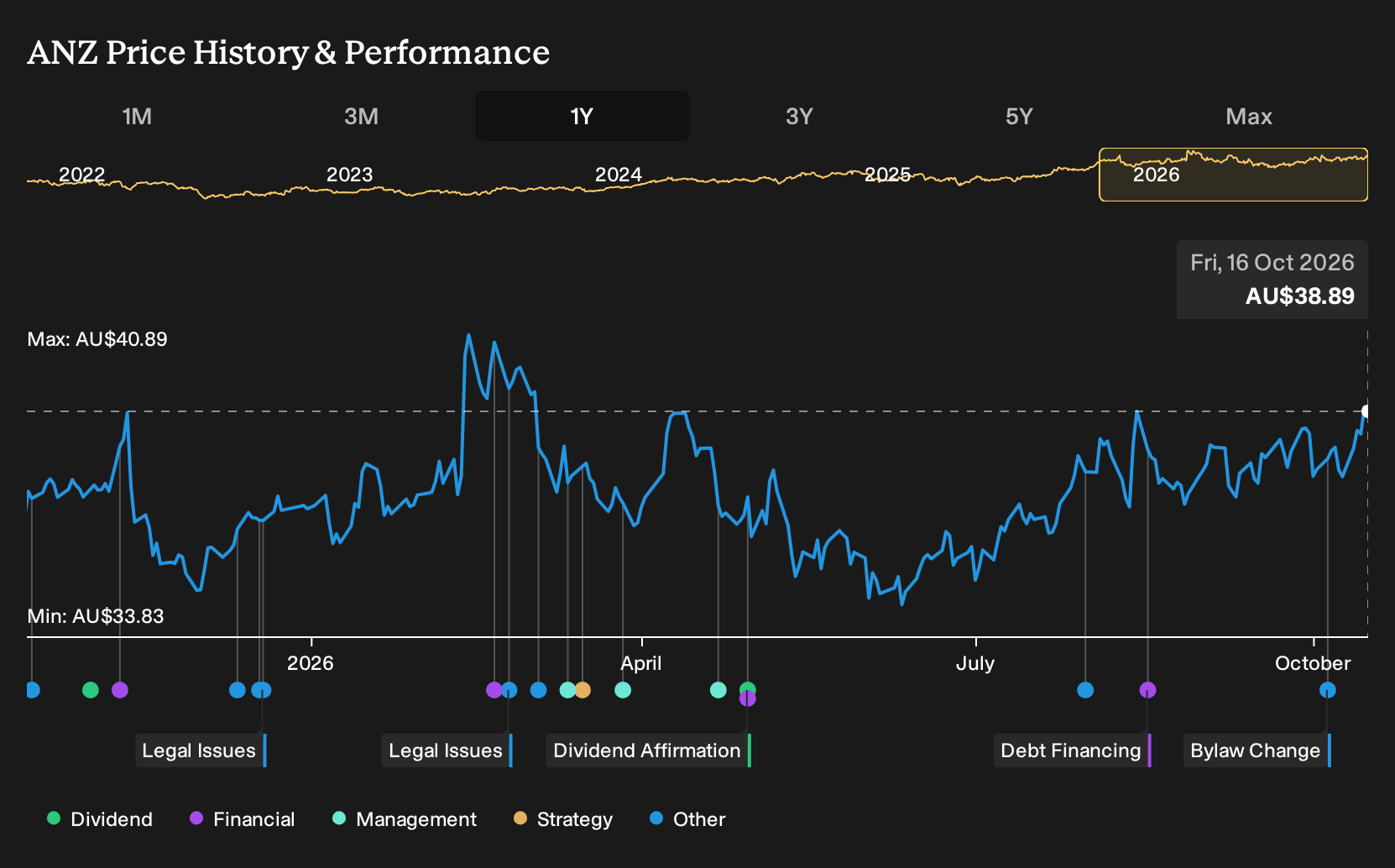
On price targets, the spread in views shows how much room there is for disagreement about that execution story. The average target sits at A$36.56, just 1.7% below the current A$37.18 share price, with a wide band from A$32.00 at the low end to A$41.00 at the high end. For an investor listening to the AGM governance arguments, that tight gap between price and consensus target suggests the market already treats ANZ Group Holdings as roughly fairly valued on the current forecast set. Any shift in confidence around the board’s decision making could therefore feed quickly into sentiment.
Under those consensus assumptions, ANZ Group Holdings is tied to quite specific operating hurdles. Management is expected to grow into A$24.2b of revenue and A$8.1b of earnings by 2029, while also absorbing Suncorp, completing the ANZ Plus replatform, and running down remediation overlays. The proposed advisory resolution does not force any particular capital allocation or risk posture, although it gives shareholders one more forum to test whether directors are still steering toward those forecast milestones or quietly resetting ambitions.
For investors who care about governance, the interesting question is whether an advisory clause nudges the board to be more transparent about the trade offs behind those numbers. If revenue growth stays around 4.0% but progress on margins or costs looks slower, a more formal channel for shareholder feedback could prompt earlier disclosure on how management is rebalancing spending across technology, integration and remediation. That level of detail can help you judge whether the current P/E assumptions still feel sensible or whether the risk premium around execution and oversight should be higher.
ANZ Group Holdings' narrative projects A$24.2b revenue and A$8.1b earnings by 2029. This requires 4.0% yearly revenue growth and an earnings increase of about A$2.2b from A$5.9b today.
Uncover why ANZ Group Holdings' fair value indicates a 6% potential downside to its current price, which leaves little room for error.
Exploring Other Perspectives
Four fair value estimates from the Simply Wall St Community cluster between A$32.18 and about A$40.36, so some readers see ANZ Group Holdings as close to fairly priced while others build in more upside. Set those opinions against execution risk on Suncorp, ANZ Plus and remediation, then explore the full spread of community views yourself.
Explore 3 other ANZ Group Holdings fair value estimates, including one that suggests up to 17% downside from the current price.
Reach Your Own Conclusion
Disagree with existing narratives? Extraordinary investment returns rarely come from following the herd, so go with your instincts.
- A great starting point for your ANZ Group Holdings research is our analysis highlighting 2 key rewards and 2 important warning signs that could impact your investment decision.
- See our latest analysis for ANZ Group Holdings. The report includes a comprehensive fundamental analysis summarized in a single visual, the Snowflake, making it easy to evaluate ANZ Group Holdings' overall financial health at a glance.
Looking for more investment ideas beyond ANZ Group Holdings?
If the governance story at ANZ Group Holdings has you thinking about portfolio balance, it can help to scan a broader universe of opportunities that match your own risk, income and quality preferences.
- For investors who want potential upside with tighter risk controls, start by reviewing the 6 resilient stocks with low risk scores that focus on resilience and balance sheet strength.
- If you are hunting for quality at a reasonable price, broaden your watchlist with the 4 high quality undervalued stocks that combine solid fundamentals with support from cash flows.
- For those who care most about income resilience, check how high-yielding payers with more robust coverage stack up in the 4 dividend fortresses to stress test your dividend exposure.
This article by Simply Wall St is general in nature. We provide commentary based on historical data and analyst forecasts only using an unbiased methodology and our articles are not intended to be financial advice. It does not constitute a recommendation to buy or sell any stock, and does not take account of your objectives, or your financial situation. We aim to bring you long-term focused analysis driven by fundamental data. Note that our analysis may not factor in the latest price-sensitive company announcements or qualitative material. Simply Wall St has no position in any stocks mentioned.
Have feedback on this article? Concerned about the content? Get in touch with us directly. Alternatively, email editorial-team@simplywallst.com