
- PRICING
- LIVE QUOTES
- LEARN
- HELP


EN
What Arrowhead Pharmaceuticals Doubters Missed
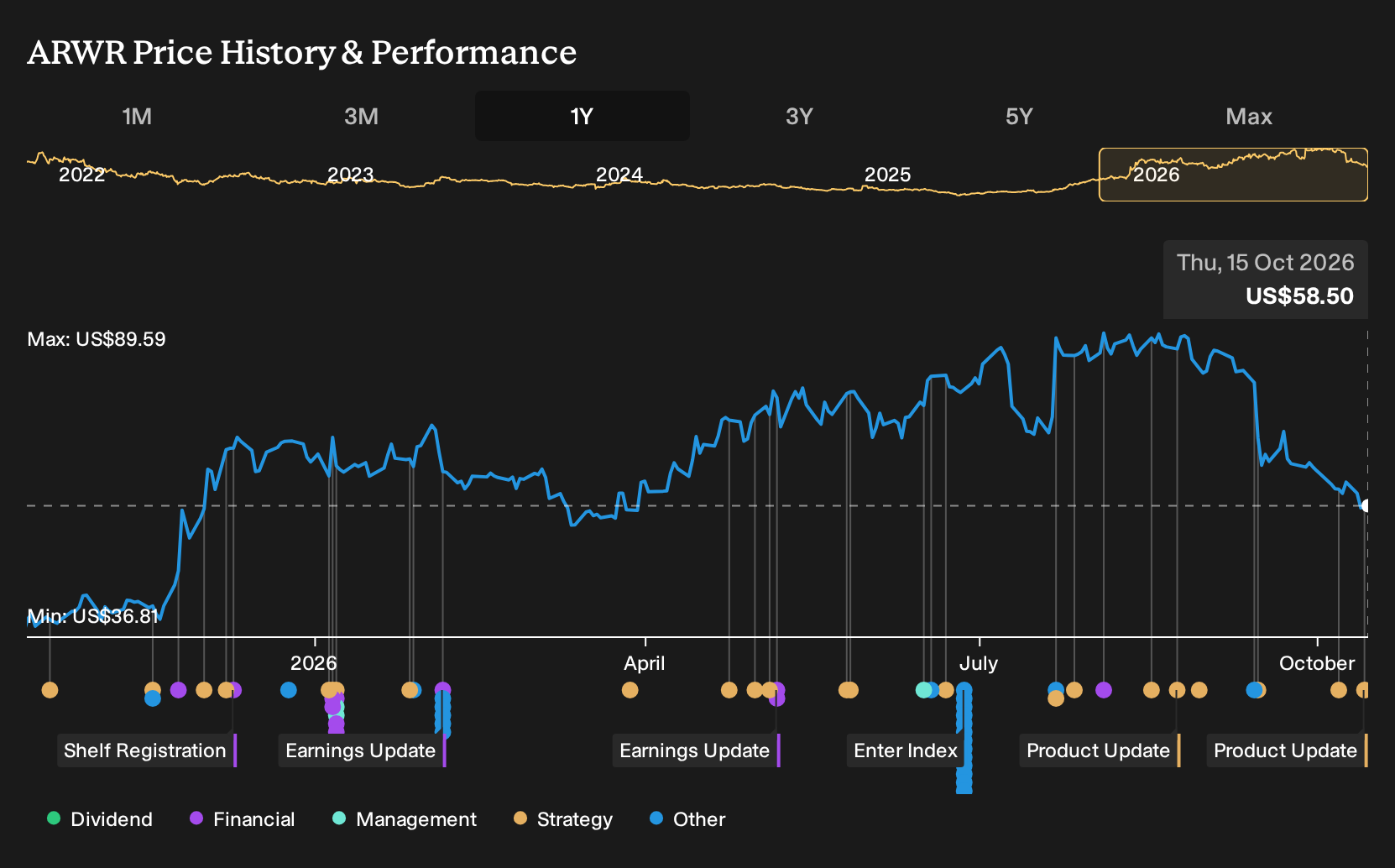
Arrowhead Pharmaceuticals spent much of the year reporting higher revenue alongside a deeper loss, while bears warned about regulatory hurdles and dependence on a handful of RNAi drugs. For Arrowhead Pharmaceuticals shareholders, the return over the past year was 50.1%, including dividends. If you had been weighing those clashing October 2025 research views against today’s outcome, what in the record back then might have justified taking that risk?
The useful thing about a Narrative is that the reasoning is checkable: the assumptions sit beside the argument, and together they imply an estimated Fair Value you can disagree with.
Arrowhead Pharmaceuticals is not the only name tied to this theme. Zero in on 34 healthcare AI stocks and compare how each one is priced.
The Two Stories Arrowhead Pharmaceuticals Investors Had To Weigh
The shares cost US$38.19 at the start of the period, and anyone looking at Arrowhead Pharmaceuticals then had to decide which story felt more plausible.
The bullish narrative pointed to a fair value of US$46.15. It leaned on an advancing RNAi pipeline, partnerships in places like Greater China, and an assumption that revenue would decline 11.0% while profit margin reached 14.2% alongside a future P/E of 166.8x.
The bearish view anchored on a fair value of US$17. It focused on reimbursement pressure, patent expiry, and heavy RNAi concentration, with revenue assumed to fall 48.6%, profit margin at 16.3% and a future P/E of 277.8x.
What The Evidence Did To The Arrowhead Pharmaceuticals Argument
The clearest new fact was clinical. Arrowhead Pharmaceuticals reported positive Phase 3 SHASTA-3 and SHASTA-4 data for plozasiran in severe hypertriglyceridemia and moved toward FDA and EU filings. This supported the optimistic case that the RNAi pipeline could convert into approved cardiometabolic products.
Financially, revenue reached US$75.253m in Q3 2026 while the firm still reported a net loss of US$194.28m, so profitability remained unproven. That mix of strong trial progress and ongoing losses cut both ways for the original narratives.
The lesson is simple. When a story leans heavily on new drug launches, treat two items as separate tests. Track whether pivotal trials and approvals arrive. Then check if revenue and net income move toward the margin assumptions used in the original thesis.
What Arrowhead Pharmaceuticals Buyers Are Paying For Now
Arrowhead Pharmaceuticals now trades at US$58.5, with this selected Narrative arguing that its Fair Value still sits above that level. The focus has shifted to whether plozasiran and a broader cardiometabolic line up can carry more of the load than past partnership driven expectations.
On that view, today’s price still does not fully credit the possibility that plozasiran uptake in severe hypertriglyceridemia and ARO DIMER PA in mixed hyperlipidemia together support a larger, more profitable cardiometabolic franchise.
"The main thing that has to go right is successful execution of the plozasiran expansion from FCS into severe hypertriglyceridemia, supported by the Priority Review Voucher, STAR program participation and the planned SHTG supplemental filing by year end 2026. The commercial buildout from roughly 20 FCS focused representatives to a field force covering about 20,000 high value prescribers for severe hypertriglyceridemia is largely in place ahead of launch."
The price and this Narrative do not agree. → Uncover what this Narrative says Arrowhead Pharmaceuticals is actually worth
Another Cardiometabolic Angle To Watch
Arrowhead Pharmaceuticals leans on RNAi to tackle complex cardiometabolic disease. You could also look one step sideways.
Weight loss and diabetes drugs keep pulling attention because they reshape how cardiometabolic risk is treated altogether.
One large player focuses on injectable treatments that help patients manage blood sugar and reduce body weight at the same time.
It is also working on a new compound that targets multiple signals plus a pill that removes the needle hurdle for many people.
If those tools change long term treatment patterns, Arrowhead Pharmaceuticals may share some cardiometabolic shelf space with a very different toolkit.
One Narrative has already put a figure on it. → Uncover the company trading 15% below one Narrative's Fair Value
This article by Simply Wall St is general in nature. We provide commentary based on historical data and analyst forecasts only using an unbiased methodology and our articles are not intended to be financial advice. It does not constitute a recommendation to buy or sell any stock, and does not take account of your objectives, or your financial situation. We aim to bring you long-term focused analysis driven by fundamental data. Note that our analysis may not factor in the latest price-sensitive company announcements or qualitative material. Simply Wall St has no position in any stocks mentioned.
Have feedback on this article? Concerned about the content? Get in touch with us directly. Alternatively, email editorial-team@simplywallst.com