
- PRICING
- LIVE QUOTES
- LEARN
- HELP


EN
Macy's (M) Shares Climbed, So What Is Behind The Latest Attention?
Macy's (M) has drawn renewed attention after its recent move, with the share price closing at $24.22. Investors are weighing this performance against revenue of $22.8b and net income of $750m.
Macy's recent jump in the share price, including a 6.79% 1 day share price return and a 9.69% 1 month share price return, comes on top of a 39.64% 1 year total shareholder return and a very large 3 year total shareholder return, signalling momentum that long term holders have already experienced.
Look beyond Macy's and see how this move compares with other retailers showing strong price action and solid fundamentals through our hand picked list of solid balance sheet and fundamentals (25 results).
The recent climb in Macy's share price sits between two stories. Is this move pointing to a sturdier underlying retailer, or mostly to investors re-rating the stock on changing sentiment as valuation metrics shift into focus?
Most Popular Narrative: 4% Overvalued
Macy's last closed at $24.22, while the most followed narrative pegs fair value closer to $23.36 using an 11.28% discount rate. That gap is small, and the thesis leans heavily on how luxury banners, higher average unit retail and efficiency gains shape earnings quality over time.
The ongoing store optimization program and the expanded Reimagine format, now covering about 200 locations that account for roughly 60% of Macy's stores and 75% of Macy's store sales, is focusing capital on stores that already show 9 of the last 10 quarters of growth and a 10 point NPS lift. This can improve sales productivity per square foot and support operating margin and earnings.
See why 20 investors see Macy's as 4% overvalued.
Result: Fair Value of $23.36 (OVERVALUED)
Still, the Macy's story can slip if the consumer keeps tilting to pure online rivals, or if pricing pressure erodes the margin benefits this narrative assumes.
Find out about the key risks to this Macy's narrative.
Another View on Macy's Valuation
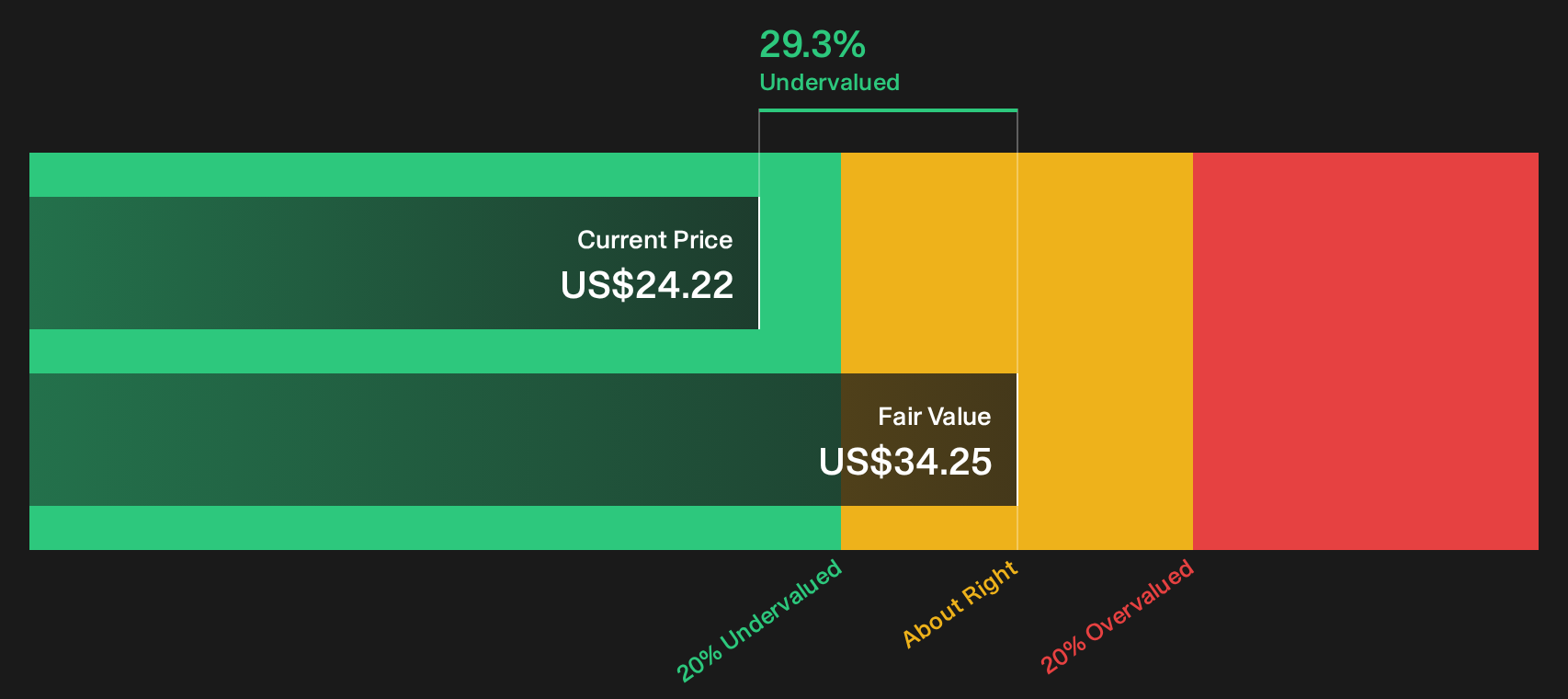
Analysts see Macy's as roughly 4% overvalued at $24.22 versus a $23.36 fair value, yet our DCF model points the other way. It suggests the shares trade below an estimated future cash flow value of $34.25, which raises a simple question: Is the market underestimating the cash Macy's can generate?
Our DCF approach focuses on those long term cash flows rather than near term earnings multiples. As a result, it can present a very different picture of valuation risk and opportunity for patient holders. Look into how the SWS DCF model arrives at its fair value.
Next Steps
Mixed views on Macy's valuation are clear, so move quickly, check the underlying figures yourself, and weigh both sides using our breakdown of 3 key rewards and 3 important warning signs
Looking For More Investment Ideas Beyond Macy's?
If you are serious about building a stronger portfolio, do not stop with Macy's. Use focused screeners to surface opportunities you might otherwise miss.
- Target potential mispricings by scanning a curated set of companies that combine quality with attractive entry points through our 32 high quality undervalued stocks.
- Strengthen your income stream by zeroing in on resilient payers using our focused list of 8 dividend fortresses.
- Protect your downside by prioritising financial resilience with our targeted 32 resilient stocks with low risk scores.
This article by Simply Wall St is general in nature. We provide commentary based on historical data and analyst forecasts only using an unbiased methodology and our articles are not intended to be financial advice. It does not constitute a recommendation to buy or sell any stock, and does not take account of your objectives, or your financial situation. We aim to bring you long-term focused analysis driven by fundamental data. Note that our analysis may not factor in the latest price-sensitive company announcements or qualitative material. Simply Wall St has no position in any stocks mentioned.
Have feedback on this article? Concerned about the content? Get in touch with us directly. Alternatively, email editorial-team@simplywallst.com