
- PRICING
- LIVE QUOTES
- LEARN
- HELP


EN
AI Tools Rollout Altering The Investment Case For Manulife Financial Stock?
- Manulife Financial has rolled out an enterprise AI platform and the Manulife Advisor AI Assistant, giving advisors 24/7 access to underwriting guidance across life, critical illness and Synergy products, alongside existing tools like MAUDE, Quick Quote and Intelligent Document Processing.
- The push to embed AI deeper into advisor workflows and back-office processes signals a focus on expense discipline, faster decisions and more consistent underwriting support, all within Manulife Financial's existing risk, governance and privacy framework.
- We will now assess how this enterprise AI build out at Manulife Financial could influence the existing investment narrative around efficiency.
Scan how Manulife Financial's AI push compares with other insurers investing in automation by reviewing a curated list of 8 resilient stocks with low risk scores.
Manulife Financial Investment Narrative Recap
To own Manulife Financial, you need to believe the business can continue to rely on Asia demand, fee based Global WAM earnings, and a more automated insurance engine to offset pressure in legacy books and alternative long duration assets. The latest AI announcements mainly reinforce that efficiency story rather than creating a new near term catalyst on their own.
The key swing factor still lies in execution on AI enabled expense control and steady fee income, while Canada group disability claims, ALDA volatility, and Global WAM net outflows remain the main operational threats. This week’s AI rollouts look helpful but not individually material compared with those larger moving parts.
The enterprise AI platform launch ties most directly to the Manulife Advisor AI Assistant news. Both are part of the same effort to standardize models, reuse approved use cases, and maintain risk, privacy, and underwriting discipline, while enabling faster advisor decisions and a leaner back office.
For catalysts, this platform matters because any expense savings or improved underwriting consistency can help offset pressure from weaker ALDA returns or choppy Global WAM flows. Execution risk remains significant, however. Models need to perform as intended, stay within governance limits, and avoid adding noise or error to already complex actuarial and underwriting workflows.
Manulife Financial AI Buildout Against Consensus Expectations
Manulife Financial's enterprise AI rollout sits against a consensus backdrop that already incorporates meaningful progress on both growth and profitability. Analysts are assuming revenue will rise by 22.9% per year over the next three years, while they model profit margins easing from 18.8% today to 13.9% by 2029. Together, these assumptions point to a story where higher volumes and more fee based activity do much of the heavy lifting, while cost control and underwriting discipline, including AI enabled tools, aim to keep the bottom line on track.
On earnings, the current consensus centers around CA$6.2b today and an expected CA$8.5b by 2029, with some analysts modeling as high as CA$9.9b. That range reflects very different views on how much AI driven productivity, Asia demand, and fee income can counter friction in legacy portfolios and alternative long duration assets. The spread between the base case and the upper end also highlights how much execution on technology and expense control could matter if underwriting or investment returns remain mixed.
Valuation work in the consensus hinges on that CA$8.5b earnings figure paired with a CA$61.5b revenue line in 2029 and a 14.6x P/E multiple. The current P/E of 15.9x and the broader Canadian insurance sector at 16.2x leave Manulife Financial priced in a relatively tight band against peers, with a consensus target of CA$65.4 only 8.4% above the recent CA$59.89 share price. In other words, analysts appear to view the stock as roughly fairly valued if the AI buildout, Asia growth, and Global WAM fee engine collectively land somewhere close to plan rather than materially surprising investors.
Manulife Financial's narrative projects CA$61.5b revenue and CA$8.5b earnings by 2029. This assumes 22.9% yearly revenue growth and about a CA$2.3b earnings increase from CA$6.2b today.
Uncover why Manulife Financial's fair value indicates a 5% potential upside to its current price, which could materialize more quickly than many investors expect.
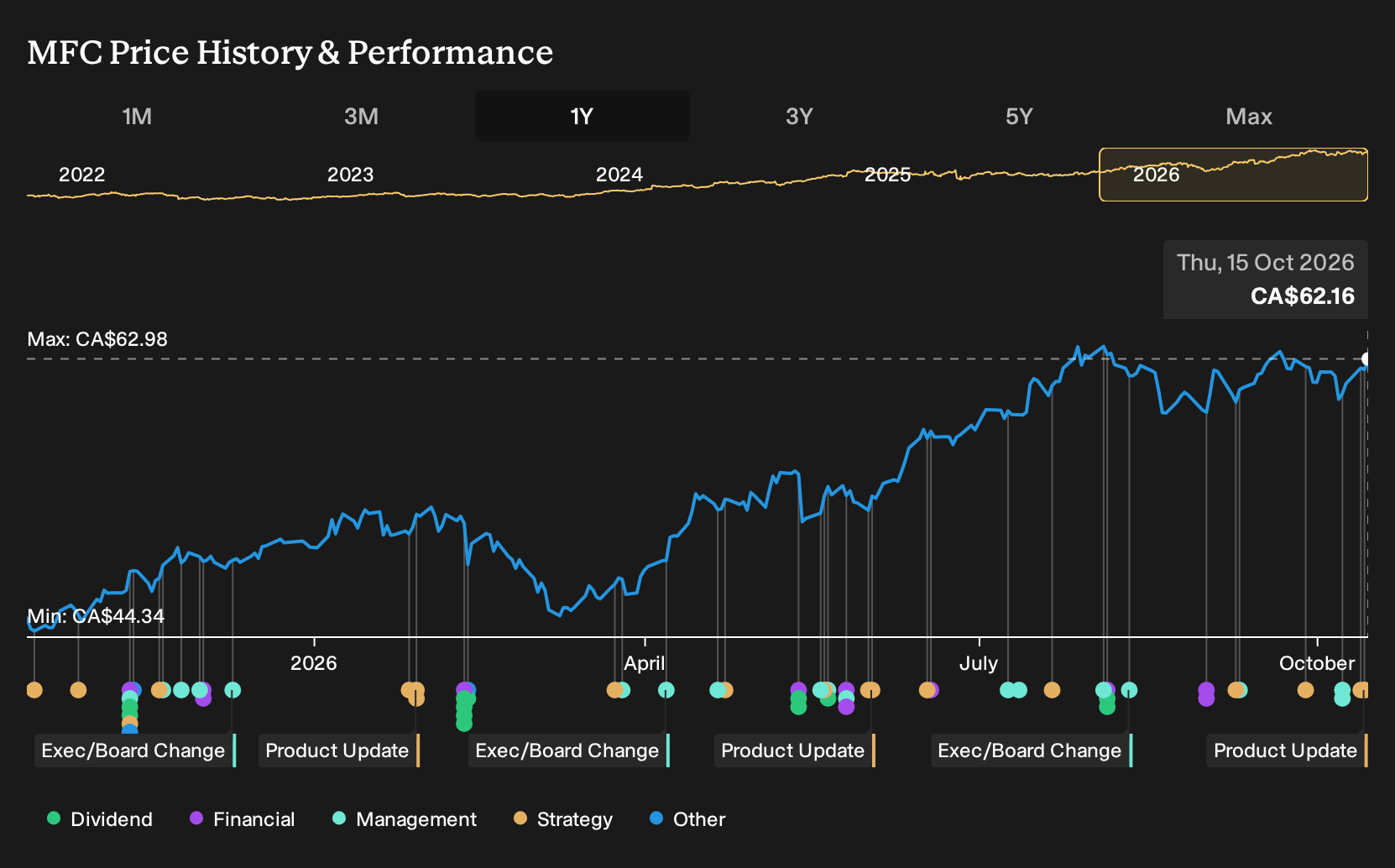
Exploring Other Perspectives
Four fair value views from the Simply Wall St Community range from CA$65.4 to CA$126.72. Some private investors therefore see Manulife Financial as only modestly mispriced, while others model a very large upside. When you place those contrasting forecasts alongside AI rollout risks, ALDA volatility and Asia driven catalysts, you get sharply different potential paths. Use that spread as a prompt to explore several alternative viewpoints before you commit fresh capital.
Explore 3 other Manulife Financial fair value estimates, including one that suggests it could be worth just CA$65.40.
Decide For Yourself
Disagree with existing narratives? Extraordinary investment returns rarely come from following the herd, so go with your instincts.
- A great starting point for your Manulife Financial research is our analysis highlighting 4 key rewards that could impact your investment decision.
- See our latest analysis for Manulife Financial. The report includes a comprehensive fundamental analysis summarized in a single visual, the Snowflake, making it easy to evaluate Manulife Financial's overall financial health at a glance.
Looking for more investment ideas beyond Manulife Financial?
If you want to stress test your thesis on Manulife Financial against other opportunities, a quick scan through curated stock lists can sharpen your watchlist and keep your capital focused where the risk and reward trade off looks most appealing.
- Prioritize resilience by reviewing a curated group of companies screened as 8 resilient stocks with low risk scores and see which ones match your comfort level.
- If you care most about balance sheet strength and fundamentals, filter for businesses that pass our list of solid balance sheet and fundamentals (8 results) to find candidates for deeper research.
- For investors hunting for potential mispricing, check out a focused set of 10 high quality undiscovered gems that may not yet be widely followed.
This article by Simply Wall St is general in nature. We provide commentary based on historical data and analyst forecasts only using an unbiased methodology and our articles are not intended to be financial advice. It does not constitute a recommendation to buy or sell any stock, and does not take account of your objectives, or your financial situation. We aim to bring you long-term focused analysis driven by fundamental data. Note that our analysis may not factor in the latest price-sensitive company announcements or qualitative material. Simply Wall St has no position in any stocks mentioned.
Have feedback on this article? Concerned about the content? Get in touch with us directly. Alternatively, email editorial-team@simplywallst.com