
- PRICING
- LIVE QUOTES
- LEARN
- HELP


EN
3 Bank Stocks To Watch As UBS Capital Rules Put Global Lenders In Focus
Global banking is at a crossroads, and UBS sits right in the spotlight as Switzerland debates tough new capital rules that could lock up more than $20b and reshape how big lenders operate across borders. That kind of regulatory rethink can reorder winners and laggards quickly, which means investors who wait for clarity often miss the move. This article walks through 3 large global banks that are closely tied to this UBS story, and explains why their exposure to cross border M&A and capital regulation might matter for your portfolio decisions.
The three stocks in the spotlight below are just a starting sample from this theme. The full screen surfaced 14 more large-cap global banks with equally compelling narratives that are not covered in the article. To identify, analyze, and compare those additional cross border banking candidates directly, head straight into the Large-Cap Global Banks (Cross-Border M&A and Capital Regulation Winners) screener.
Crédit Agricole (ENXTPA:ACA)
Overview: Crédit Agricole is a large French banking group that combines retail, corporate and investment banking, insurance and asset management across multiple regions worldwide.
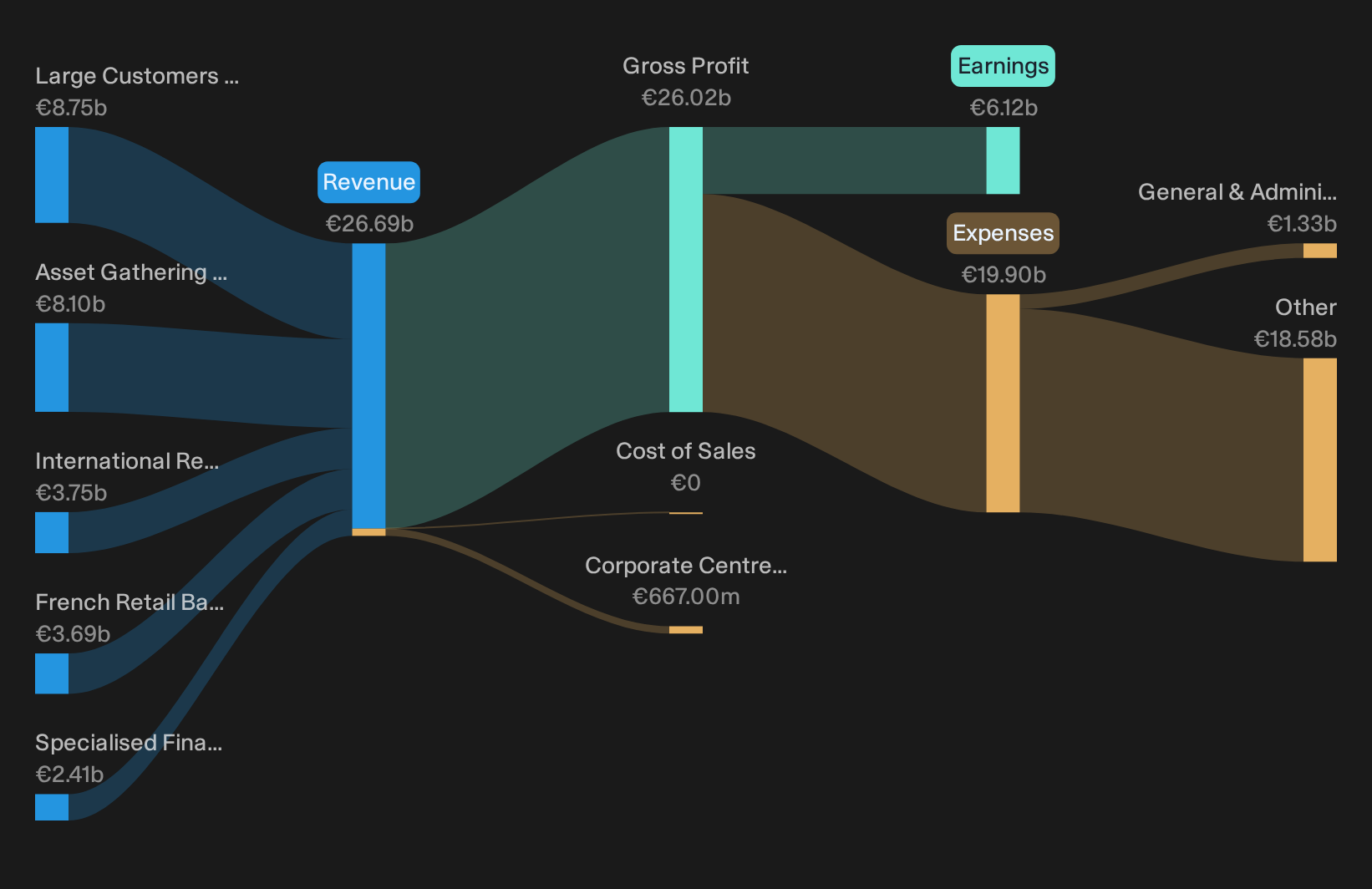
Operations: Crédit Agricole generates most of its income from Large Customers at €8.7b and Asset Gathering at €8.1b, alongside sizeable French and international retail banking and specialised financial services contributions.
Market Cap: €46.8b
Crédit Agricole fits this global banks theme as a full service European lender with the balance sheet and international reach that regulators and cross border dealmakers tend to watch closely.
Heavy investment in digital platforms, AI and new ventures in Germany and Asia may take longer than planned to scale. As a result, incremental IT and integration spend could keep the cost to income ratio elevated and weigh on net margins if revenue benefits arrive later than expected.
What happens if one quiet cost pressure outpaces the expected benefits will matter a lot for how this cross border story develops.
That cost pressure is only half the story, and the full narrative for Crédit Agricole shows how Crédit Agricole’s digital spend, capital position and cross border reach could be decoupling.
JPMorgan Chase (JPM)
Overview: JPMorgan Chase is a global universal bank that provides consumer, corporate, investment banking, payments and wealth management services across multiple regions.
Operations: JPMorgan Chase generates US$88.4b from Commercial and Investment Bank, US$69.9b from Consumer & Community Banking and US$26.6b from Asset & Wealth Management, with smaller corporate and adjustment items.
Market Cap: US$890.4b
JPMorgan Chase fits this Large Cap Global Banks theme as a systemically important lender with the reach, balance sheet and capital flexibility that cross border deal makers and regulators pay close attention to whenever the rules of the game are being rewritten.
Ongoing investment and active participation in tokenization, stablecoins and payment related technology, including the deposit token work, positions JPMorgan Chase to benefit from the next wave of technology adoption in banking and payments, which can support future revenue resilience and margin improvement. A later period of weaker capital markets activity or a credit downturn could reduce Markets and Investment Banking revenues and increase charge offs, which would undermine the earnings power currently supporting the share price narrative.
What happens if one policy shift or credit turn hits right as that new payments infrastructure scales will matter a great deal for future margins.
That timing risk is exactly why reading the full narrative for JPMorgan Chase can help you see whether JPMorgan Chase’s payments push is quietly accelerating or masking future pressure.

Citigroup (C)
Overview: Citigroup is a global universal bank that serves consumers, companies and governments with transaction services, markets, banking, cards and wealth across multiple regions.
Operations: Citigroup earns most of its US$94.5b segment revenue from Markets at US$24.4b and Services at US$23.5b, with meaningful contributions from Wealth, Banking and U.S. Personal Banking.
Market Cap: US$202.4b
Citigroup matters in this global banks screen because its worldwide payments, markets and advisory franchises sit directly in the cross border flow of capital and regulation that UBS’s next move could reshape.
Citigroup’s push into tokenized deposits, blockchain based cross border payments and a consortium backed stablecoin introduces new technology and compliance complexity. This could require sizable ongoing spend before commercial volumes materialise, putting pressure on revenue conversion and delaying any uplift to fee income and earnings.
What happens if one unseen cost and control pressure collides with that global payments build out could decide how far future returns stretch.
When those hidden pressures start to bite, the full narrative for Citigroup shows where Citigroup’s tokenization push could be quietly accelerating future returns or masking deeper risks.

Seeking Alternatives Before Momentum Flies
Fresh ideas move first. Once momentum builds, the cleanest entry points get caught quickly and edges drop fast. Scan these under the radar lists now and get in early.
- Target resilient cash generators by running the list of solid balance sheet and fundamentals (201 results) and focus on businesses where robust finances back up the equity story before the crowd catches on.
- Ride structural demand in critical materials through the 32 best rare earth metal stocks and track producers that could benefit most if supply tightens while prices are still resetting.
- Position ahead of the next power upgrade cycle with the 42 power grid technology and infrastructure stocks and zero in on enablers of grid reliability while valuations still look reasonable.
This article by Simply Wall St is general in nature. We provide commentary based on historical data and analyst forecasts only using an unbiased methodology and our articles are not intended to be financial advice. It does not constitute a recommendation to buy or sell any stock, and does not take account of your objectives, or your financial situation. We aim to bring you long-term focused analysis driven by fundamental data. Note that our analysis may not factor in the latest price-sensitive company announcements or qualitative material. Simply Wall St has no position in any stocks mentioned.
Have feedback on this article? Concerned about the content? Get in touch with us directly. Alternatively, email editorial-team@simplywallst.com