
- PRICING
- LIVE QUOTES
- LEARN
- HELP


EN
Where Are Hog Futures Heading During the 2026/2027 Offseason?
I asked where lean hog futures were heading in an August 25, 2026, Barchart article, where I concluded with the following:
Lean hog futures for October delivery could be at an attractive level if the technical support holds and the market’s bullish bias continues. The higher-low pattern is now a decade old, which could create an opportunity at the current price level.
Nearby lean hog futures for December 2026 delivery traded at 71.75 cents on August 24 and fell to under 67 cents per pound in mid-October 2026.
Lean hog futures are trending lower
Nearby CME lean hog futures reached a high of $1.10175 per pound on March 11, 2026, in anticipation of the 2026 grilling season, which began in late May and ran through early September.
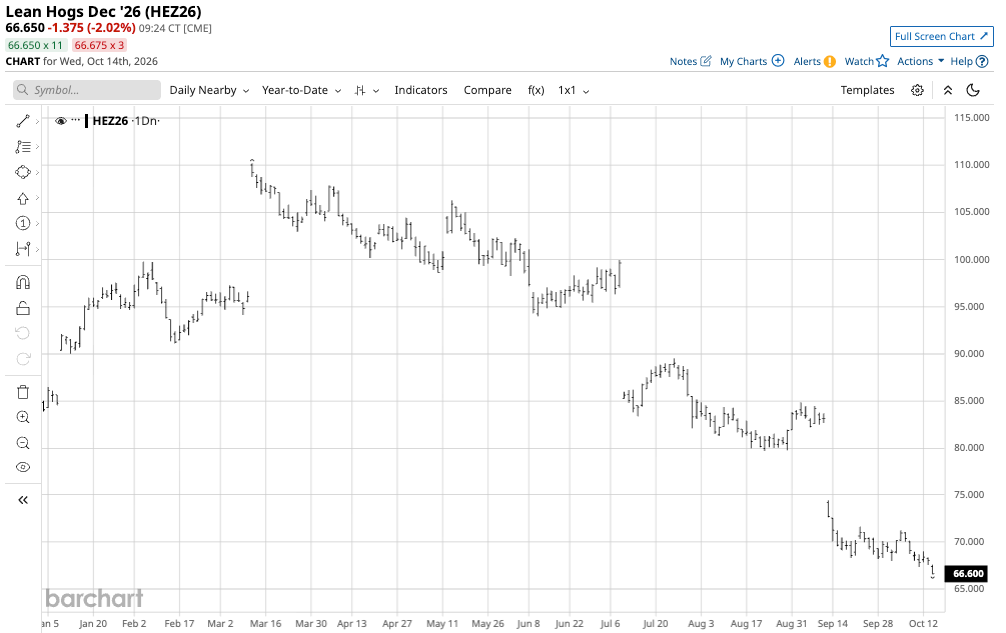
The daily year-to-date continuous lean hog futures chart shows that the pork futures ran out of upside momentum early and declined steadily through October 2026. The gaps on the charts reflect rolls from one active-month contract to the next and the seasonality of hog futures. At the most recent low of 66.550 cents per pound on October 14, 2026, lean hog futures were 39.6% lower than the March 11, 2026, high. Pork futures remain in a bearish trend in October 2026, as the off-season for demand will run until late May 2027.
The long-term chart is approaching a technical support level
Lean hold futures fell to a low of 41.50 cents per pound in 2020, when the global pandemic gripped markets across all asset classes. The hogs made a higher low of 64.575 cents per pound in early 2024.
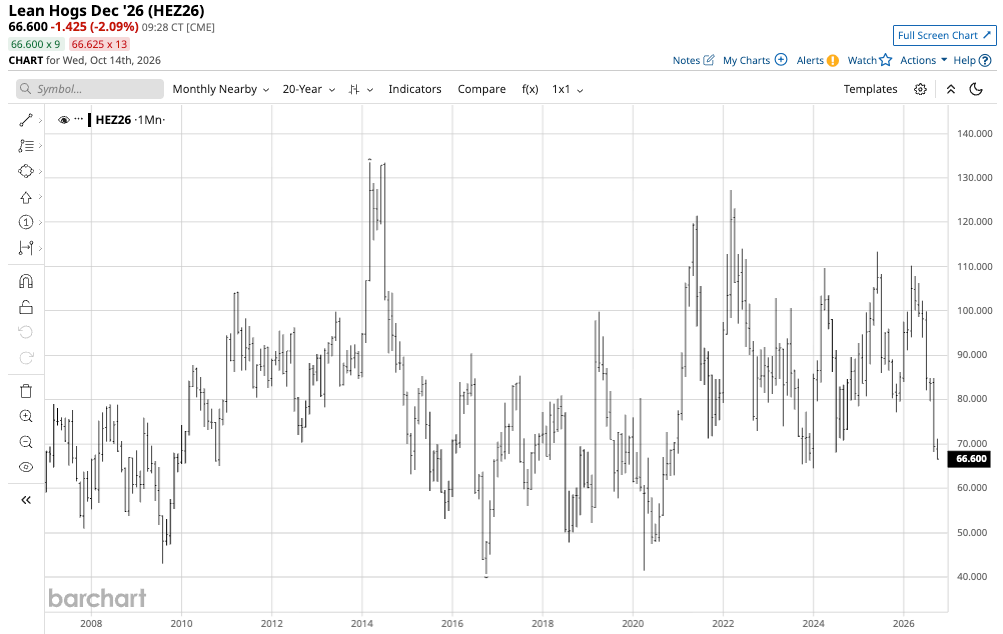
The 20-year monthly continuous chart shows that at 66.60 cents, the lean hogs are moving toward a test of the technical support at the January 2024 low of 64.575 cents. While hogs are not in a bullish trend, the longer-term chart shows a slight bullish bias.
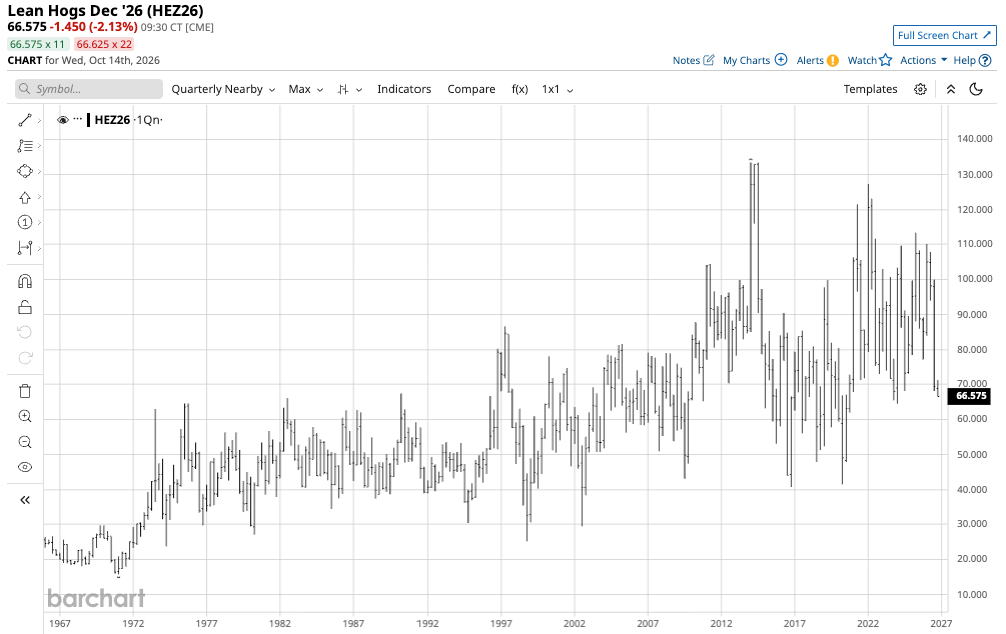
The quarterly chart since 1966 highlights the bullish bias in lean hog futures. A decline below 64.575 cents could set up a technical selloff toward the 2020 low.
The forward curve reflects seasonal trading patterns
The lean hog forward futures curve reflects both seasonal trends and the overall slightly bullish bias.
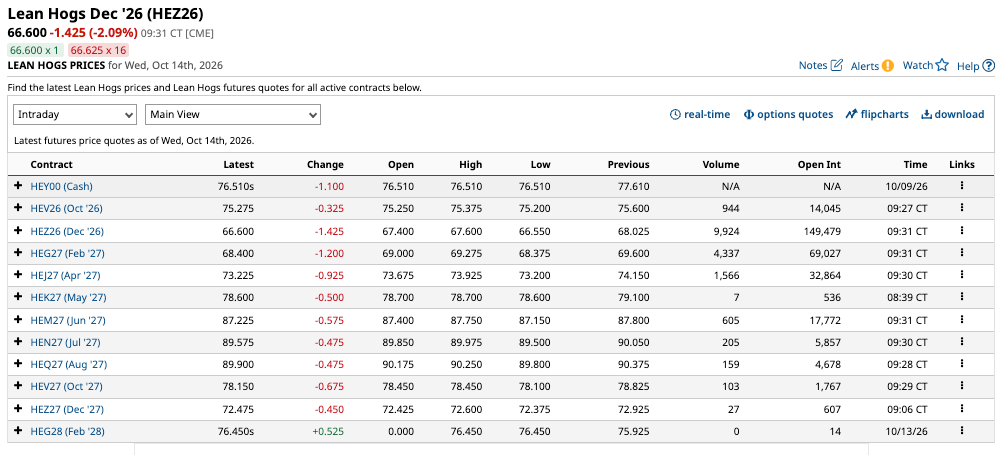
The forward curve illustrates that prices for the 2026 and early 2027 off-season for demand are below 70 cents per pound. They begin to rise in April 2027, moving toward just below 90 cents per pound during the peak season in June, July, and August 2027. Prices fall back below 80 cents during the offseason after September 2027. However, the lowest price on the board is the December 2026 contract at 66.60 cents per pound, reflecting seasonal weakness and abundant supplies.
From a fundamental perspective, the USDA’s latest October 2026 WASDE report told the pork market:
Pork production is lowered on a slower expected pace of slaughter and lighter dressed weights.
The USDA’s Quarterly Hogs and Pigs report, released on September 24, estimated a lower pig crop for June-August and lower farrowing intentions for September-November. This supports lower hog slaughter expectations for the first half of 2027.
Hog price forecasts are decreased for the remainder of 2026 and the first half of 2027 on persistent weakness in the pork cutout.
Meanwhile, the 2027 production and consumption statistics are a leap of faith in October 2026. Diseases, rising production costs from inflation, higher feed prices, and other factors make futures prices educated guesses for 2027.
Buying lean hogs scale-down on price weakness
The long-term bullish bias, rising production costs, and uncertainty over 2027 pork output could provide an opportunity if lean hog futures continue to decline and break through the 64.575-cent technical support level during the offseason months in 2026 and early 2027.
I favor buying lean hog futures for delivery in May through August 2027 on a scaled-down basis. The 2026 high was just over $1.10 per pound, and July and August 2027 delivery is currently 20 cents below that level. Further declines to below 85 and 80 cents could create a compelling buying opportunity for the 2027 peak consumption season.
The futures are the only route for direct exposure
No ETF or ETN products track lean hog futures. Several agricultural ETFs, such as DBA, include lean hog exposure in their agricultural portfolios. You can trade pork directly only through the CME futures market.
Each lean hog futures contract contains 40,000 pounds of pork. At 66.60 cents per pound, the December 2026 futures contract is worth $26,640. Futures require special accounts and are leveraged. The original margin requirement of $1,650 per contract means a trader can control $26,640 of pork futures with a 6.2% down payment. If equity on a long or short position falls below $1,500 per contract, the CME requires maintenance margin payments.
Lean hog futures are moving toward a critical technical support level. Any price weakness below that level over the coming weeks and months that pushes peak-season 2027 prices lower could be a golden opportunity to accumulate lean hog futures for the coming year. Pork prices could be heading lower, but I would view that as an opportunity for 2027.
On the date of publication, Andrew Hecht did not have (either directly or indirectly) positions in any of the securities mentioned in this article. All information and data in this article is solely for informational purposes. For more information please view the Barchart Disclosure Policy here.