
- PRICING
- LIVE QUOTES
- LEARN
- HELP


EN
Why Ryan Cohen Keeps Doubling Down on GameStop Stock
When a company executive puts more of his own money into the business he runs, investors tend to pay attention. After all, confidence is one thing when you are sitting in the corner office collecting a paycheck—putting millions of your dollars on the line is a different ball game. And when that executive keeps coming back for more, Wall Street naturally starts asking questions.
That brings us to Ryan Cohen, CEO of GameStop (GME), the specialty retailer known for its video game consoles, accessories, gaming software, and entertainment products. Cohen has been on a shopping spree of his own lately, except his preferred merchandise is GameStop stock.
According to a recent regulatory filing, Cohen purchased another 844,130 shares for approximately $22.8 million, paying between $26.75 and $27 per share. The latest transaction marks his second stock purchase this month, following a $17.1 million acquisition disclosed in an Oct. 2 SEC filing.
But that is hardly the end of the story. Cohen also bought 450,000 shares on Sept. 29 at an average price of $23.48, another 1,150,680 shares on Sept. 21 at $22.94, and 1 million shares on Sept. 10 at approximately $20.38. Altogether, these five purchases amount to roughly 4.1 million shares worth about $97 million, lifting his total ownership to 9.1%.
The timing makes things particularly interesting—GameStop's shares are already up 39% on a year-to-date (YTD) basis. Cohen is not simply swooping in after a selloff.
Insider buying can signal confidence that a stock is undervalued, but it does not guarantee that the business will deliver. So, what might be driving Cohen’s confidence, and can GameStop’s fundamentals justify it? Let’s look at the bigger picture.
About GameStop Stock
For those unfamiliar with the business beyond its meme-stock fame, GameStop is a specialty retailer focused on video games and gaming-related merchandise. Founded in 1996 and headquartered in Grapevine, Texas, the company sells new and pre-owned gaming consoles, software, controllers, headsets, virtual reality equipment, and other accessories. In other words, whether gamers are looking for the latest hardware or a more budget-friendly pre-owned console, GameStop wants to be on their shopping list.
The company operates through a combination of physical stores and e-commerce platforms, giving customers multiple ways to browse and buy its products. Its business spans the United States, Canada, Australia, and Europe, serving everyone from dedicated gaming enthusiasts to casual players hunting for a good deal.
Operating in the consumer cyclical sector, GameStop has a market capitalization of approximately $13.7 billion. While its traditional video game retail business faces competition from digital distribution, the company continues to explore opportunities in adjacent categories, including trading cards and collectibles, to broaden its appeal and strengthen its retail business.
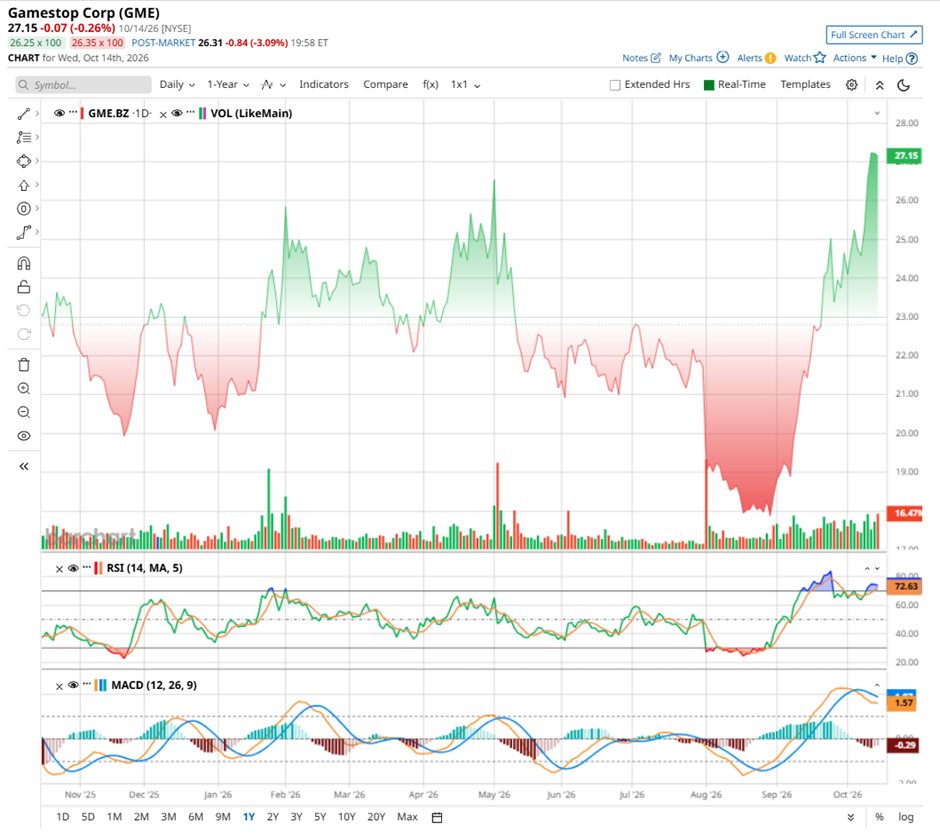
Shares of the video game retailer have seen plenty of ups and downs over the past year, and staying predictable clearly is not its strong suit. GME stock hit a fresh 52-week high of $28.22 on Oct. 14 and has gained 20% over the past year. The momentum has picked up lately, with GME jumping 26% over the past three months, 30% over the past month, and 10.5% in just five trading sessions.
The latest rally has been fueled partly by CEO Ryan Cohen’s repeated stock purchases, which have strengthened investor confidence alongside improving profitability and balance-sheet developments. Still, enthusiasm can only carry a stock so far before investors start asking what comes next. GameStop’s long-term growth prospects remain a key question, particularly as its traditional retail business faces structural challenges.
The technical picture also suggests investors may want to keep their excitement in check. GME’s 14-day Relative Strength Index (RSI) sits near 74, above the commonly watched 70 threshold that signals overbought conditions. That does not guarantee a pullback, but it suggests the rally could be getting stretched. Meanwhile, the MACD line has slipped below its signal line, a bearish crossover that points to weakening momentum.
Valuation-wise, GME stock comes with a premium price tag. The stock is priced at about 15.1 times forward-adjusted earnings and 3.52 times sales, both above sector averages. That premium suggests investors are pricing in better days ahead. GameStop will need to deliver consistent results to prove those expectations aren’t getting ahead of the business.
A Snapshot of Its Q2 Earnings Report
GameStop’s second-quarter fiscal 2026 results offered investors an interesting contradiction—revenue was heading south, but profitability was moving in the opposite direction. For the quarter ended Aug. 1, revenue fell 18.7% year-over-year (YoY) to $790.2 million. That decline reflected last year’s Nintendo Switch 2 launch, planned store closures, and the divestiture of its French operations. Still, investors seemed willing to look beyond the shrinking top line, sending GME stock up 5.3% intraday on Sept. 9, the first trading day after the earnings release.
The bigger story was GameStop’s changing product mix. Video game revenue plunged 46.8% annually to $263.2 million, while pre-owned and refurbished sales dropped 31.7% to $170.7 million. Collectibles, however, were doing considerably better, with revenue jumping 56.5% to $356.3 million. Collectibles accounted for 45.1% of total revenue, up from 23.4% a year earlier, while video games’ share fell from 50.9% to 33.3%.
That shift appears to be paying off. GameStop reported operating income of $160.2 million, its highest-ever second-quarter figure, marking a 141.3% annual increase. Adjusted EPS also edged up to $0.27 from $0.25. Not bad for a company whose revenue line was hardly throwing a party.
Meanwhile, GameStop ended the quarter with $5.4 billion in cash, cash equivalents, marketable securities, digital assets, and related receivables. That included $5.1 billion in cash, cash equivalents, and marketable securities, down from $8.7 billion a year earlier, alongside $300 million in digital assets and related receivables. The company also held approximately 43.4 million eBay (EBAY) shares valued at $4.9 billion as of Aug. 1 and reduced its total long-term debt to approximately $2.8 billion.
Looking ahead, management raised its fiscal 2026 adjusted EBITDA outlook to more than $650 million, up from its previous target of over $600 million. With adjusted EBITDA already reaching $339.7 million in the first half, GameStop appears to have some momentum behind its profitability goals. The challenge now is to sustain that progress while stabilizing revenue.
What Do Analysts Expect for GME Stock?
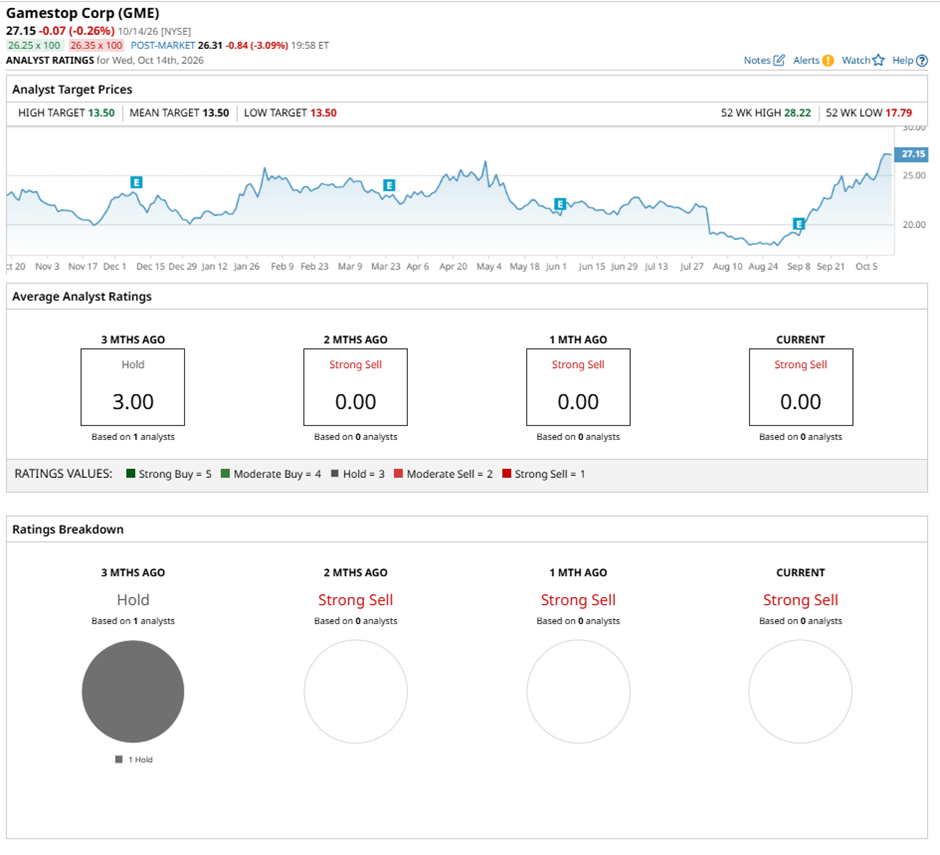
If you’re looking to Wall Street for a little guidance on GameStop, don’t hold your breath. The stock currently lacks fresh analyst coverage, leaving investors largely on their own when it comes to judging its fair value and earnings potential. The last known call was a “Hold” with a $13.50 mean price target, issued three months ago. With shares now well above that level, investors may want something more current to go on.
Conclusion
Ryan Cohen’s latest purchase gives GameStop bulls another reason to feel optimistic, but investors should keep their feet on the ground. Insider buying can be an encouraging signal because executives have intimate knowledge of their businesses, and Cohen has been closely involved with GameStop since 2021, taking over as CEO in 2023. His repeated purchases suggest he is willing to put more skin in the game, even after the stock’s recent rally.
Under his leadership, GameStop has been trimming costs, closing underperforming stores, and shifting more attention toward trading cards and collectibles. The goal is to build a leaner, more sustainable retail business rather than depend on meme-stock enthusiasm to keep investors interested. Recent improvements in profitability offer some encouragement, while the company’s evolving product mix could give it additional avenues for growth.
Still, there is a difference between having a confident CEO and owning a business that consistently delivers. GameStop must demonstrate that it can sustain its earnings improvement, manage its changing retail strategy, and generate dependable cash flow over time. Its premium valuation also leaves investors with plenty to think about, particularly without fresh Wall Street analyst coverage to help assess its prospects. Cohen may be doubling down, but investors should do their homework before following his lead. Ultimately, GameStop’s long-term success will depend less on who buys its stock and more on what the business delivers.
On the date of publication, Sristi Suman Jayaswal did not have (either directly or indirectly) positions in any of the securities mentioned in this article. All information and data in this article is solely for informational purposes. For more information please view the Barchart Disclosure Policy here.