
- PRICING
- LIVE QUOTES
- LEARN
- HELP


EN
Special Dividend Could Be A Game Changer For Vistance Networks (VISN)
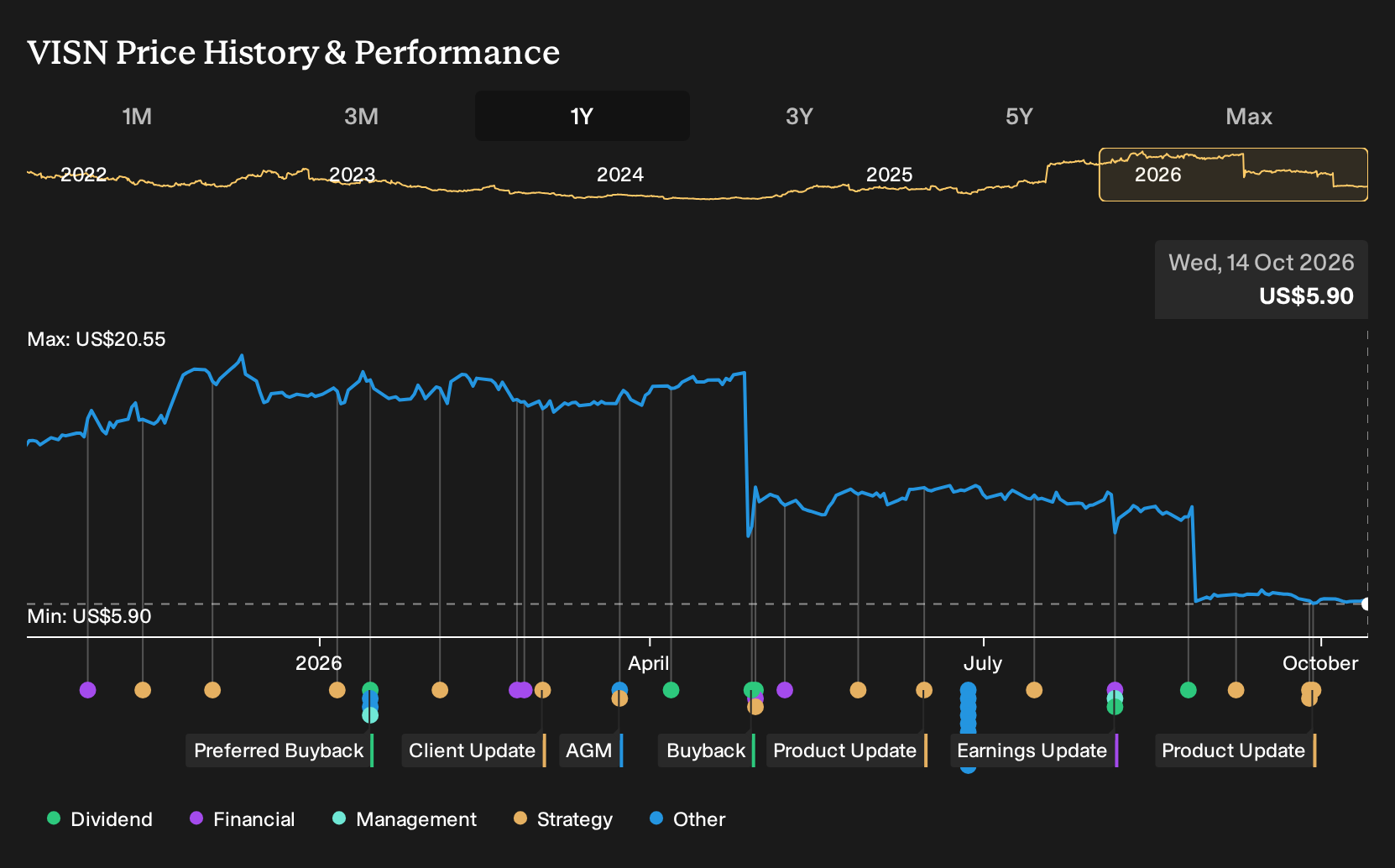
- Vistance Networks announced a special cash distribution of $1.50 per share, approved by its board and funded with available cash and proceeds from the July 2026 sale of the Ruckus Networks business. The distribution will be paid on November 6, 2026 to shareholders of record on October 26, 2026, with a Nasdaq-defined ex-dividend date of November 9, 2026.
- The one time dividend indicates that Vistance Networks is returning a meaningful portion of recent asset sale proceeds directly to shareholders instead of retaining all of this cash for future reinvestment in the remaining operations.
- The focus now turns to how Vistance Networks' investment narrative adapts as it channels Ruckus sale cash into a $1.50 special dividend.
Vistance Networks Investment Narrative Recap
To own Vistance Networks, you need to believe the refocused Aurora and RUCKUS portfolio can generate steadier cash flow despite more cyclical, project driven demand. The business is currently unprofitable, with revenue of US$1.99b and a reported loss of US$19.9m, so execution on product cycles and cost control sits front and center.
The US$1.50 special dividend partly answers what happens to cash from the Ruckus sale but does not change the core operational swing factors. The biggest near term catalyst still sits in Aurora deployment cycles, such as DOCSIS 4.0 upgrades. Key risks remain customer concentration, technology shifts, and a smaller, less diversified business mix.
The sale of the CCS segment is the key backdrop for this payout. That transaction left Vistance Networks more tightly focused on Aurora Networks and enterprise connectivity. Analysts previously highlighted that the divestiture removed a major historical driver of more predictable revenue and margins.
Against that context, the special dividend shows part of the CCS proceeds going directly to investors instead of staying on the balance sheet. You still need to judge whether the remaining operations, exposed to large cable customers and faster product cycles, can support ongoing reinvestment needs once this one time distribution has been made.
What The Vistance Networks Forecasts Assume
Vistance Networks' current analyst playbook leans on a clear set of numbers that tie the special dividend back to the longer term outlook. Forecasters are working off revenue that is modeled to grow 7.6% a year over the next three years, while profit margins are expected to compress from 13.2% today to 3.7% in about three years.
Earnings today are estimated at US$255.4 million. Consensus projections call for earnings of US$89.6 million by 2029, with analysts also assuming earnings per share of US$0.24 by around April of that year. That implies a drop in earnings of about US$165.8 million between now and the 2029 forecast period.
On those forecasts, the same group of analysts is effectively underwriting a future P/E of 93.0x on 2029 earnings, compared with 16.5x today and a current reported P/E of 44.3x for the wider US communications peer group. Their models also include roughly 4.09% yearly growth in the share count over the next three years and a discount rate of 12.33% when pulling those future estimates back into today's valuation work.
Vistance Networks' narrative projects US$2.4b revenue and US$89.6 million earnings by 2029. This requires 7.6% yearly revenue growth and an earnings decrease of about US$165.8 million from US$255.4 million today.
Uncover why Vistance Networks' fair value indicates a 292% potential upside to its current price, a gap that could narrow quickly.
Exploring Other Perspectives
You are seeing two very different stories for Vistance Networks. The bullish analysts leaned hard into DOCSIS 4.0 as a long running catalyst, with revenue modeled at US$2.5b and earnings at US$79.4 million by 2029. That is more optimistic than the consensus US$2.4b and US$89.6 million path. The new US$1.50 special dividend has not been baked into either view yet, so this payout could push forecasts and opinions in very different directions. It is worth exploring both sets of expectations before deciding how you feel about the trade off between upfront cash and future earnings power.
Explore 5 other Vistance Networks fair value estimates, including one that suggests as much as 324% upside from the current price!
Reach Your Own Conclusion
Disagree with existing narratives? Extraordinary investment returns rarely come from following the herd, so go with your instincts.
- A great starting point for your Vistance Networks research is our analysis highlighting 3 key rewards and 2 important warning signs that could impact your investment decision.
- See our latest analysis for Vistance Networks. The report includes a comprehensive fundamental analysis summarized in a single visual, the Snowflake, making it easy to evaluate Vistance Networks' overall financial health at a glance.
Looking For More Investment Ideas Beyond Vistance Networks?
If the Vistance Networks story has you thinking about portfolio balance, it can help to line it up against other opportunities that offer different mixes of income, quality, and risk. The Simply Wall St Screener lets you scan for stocks that fit your criteria in a structured way rather than relying on headlines or hunches.
- If capital preservation and steadier profiles appeal to you, start with a basket of companies screened for resilience and lower risk using our 32 resilient stocks with low risk scores.
- For those hunting for strong fundamentals at valuations that may not fully reflect them, cast a wider net across a curated 20 high quality undiscovered gems that could sit alongside a position in Vistance Networks.
- Income focused investors can compare Vistance Networks' special dividend with a broader range of payout opportunities by running through a 7 dividend fortresses that meet your return and stability preferences.
This article by Simply Wall St is general in nature. We provide commentary based on historical data and analyst forecasts only using an unbiased methodology and our articles are not intended to be financial advice. It does not constitute a recommendation to buy or sell any stock, and does not take account of your objectives, or your financial situation. We aim to bring you long-term focused analysis driven by fundamental data. Note that our analysis may not factor in the latest price-sensitive company announcements or qualitative material. Simply Wall St has no position in any stocks mentioned.
Have feedback on this article? Concerned about the content? Get in touch with us directly. Alternatively, email editorial-team@simplywallst.com