
- PRICING
- LIVE QUOTES
- LEARN
- HELP


EN
AI Benefits Tool Launch Might Change The Case For Investing In Aflac (AFL)
- bswift announced an AI powered carrier configuration toolset that uses Emma Intelligence to automate plan, rate, and rules setup, with Aflac as the exclusive launch partner for these carrier specific capabilities.
- For Aflac, being the sole initial carrier on this AI tooling points to a push for leaner benefits administration and potentially lower configuration effort for complex voluntary products.
- The focus now turns to how Aflac's investment narrative might evolve as this AI driven partnership influences benefits configuration efficiency.
Aflac Investment Narrative Recap
For Aflac, the core belief is that a mature supplemental insurer can keep earning solid returns while premium growth stays muted and benefit ratios face pressure, especially in Japan. The bswift AI configuration partnership fits that story at the margin. It targets leaner plan setup and fewer errors, which supports expense discipline rather than changing the revenue outlook on its own.
The near term swing factor still sits in Japan, where falling earned premiums and a higher benefit ratio remain key watchpoints. The largest risk stays intact. Prolonged margin strain or reputational fallout from the cybersecurity breach could matter more than any efficiency gains from this new AI tooling.
The most relevant parallel announcement is the 16th annual Aflac WorkForces Report, which shows many workers remain financially exposed to health events while younger employees increasingly use AI to research benefits. That data lines up neatly with bswift’s AI powered configuration push. It speaks to where benefits decisions are actually being made.
For you, the link is practical. If Aflac can connect AI driven administration on platforms like bswift with clearer education for stressed, digitally fluent employees, it may support uptake of U.S. group and voluntary products that analysts already view as important catalysts. Execution risk stays real, especially with Japan pressures, but the direction of travel on tooling and education is consistent.
Aflac consensus expectations behind the AI story
Aflac's analyst model sketches a fairly tight set of expectations that sit behind the AI and benefits configuration headlines. Consensus assumes revenue declines by 1.2% a year over the next three years and profit margins ease from 26.9% today to 20.5% by 2029. Earnings are projected at US$3.6b in that 2029 window, down from US$4.9b today, with share count expected to shrink by 4.34% annually over the next three years as buybacks continue to play a meaningful role in per share maths.
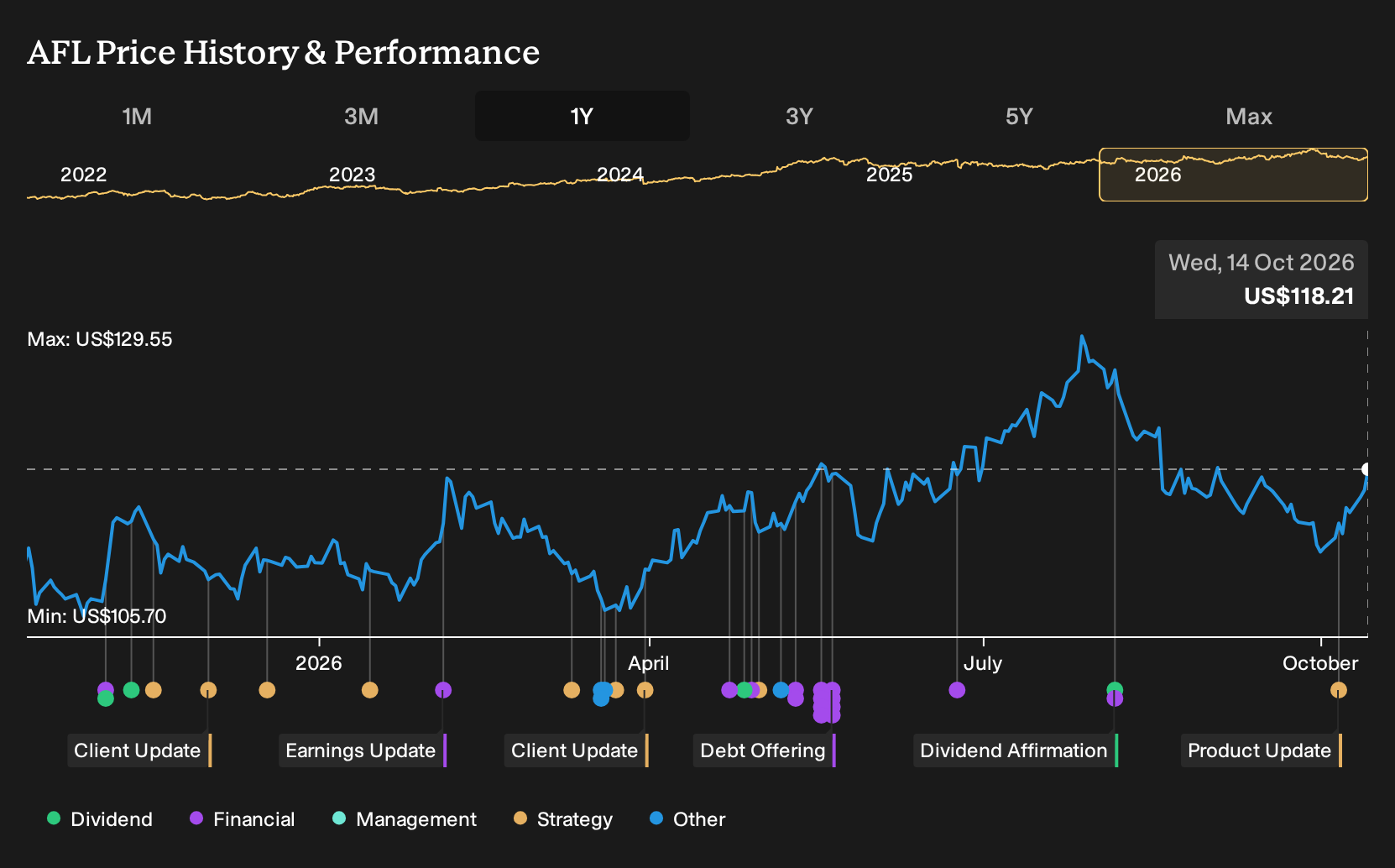
Those same estimates feed directly into how the stock is being framed. To line up with the analyst view, you would be underwriting 2029 revenue of US$17.4b and earnings of US$3.6b, and a future P/E of 18x on those earnings, compared with about 12x today and 11.1x for the wider U.S. insurance group. At a current share price of US$116.33, that consensus target of US$118.53 is only 1.9% higher, which signals that the market, on average, already bakes in this softer revenue path and lower margin profile alongside ongoing capital return.
Aflac's narrative projects US$17.4b revenue and US$3.6b earnings by 2029. This rests on revenue declining 1.2% per year and an earnings decrease of US$1.3b from US$4.9b today.
Uncover why Aflac's fair value indicates that it is in line with its current price.
Exploring Other Perspectives
Two fair value views from the Simply Wall St Community bracket Aflac tightly around US$118.53 at the low end and stretch out to about US$173.57 at the high end, which is a wide gap for the same ticker. That spread, set before the bswift AI announcement and Japan cyber issues, shows how differently private investors can read the same mix of earnings pressure, capital strength and new product activity. Use it as a cue to test multiple angles rather than rely on a single narrative.
Explore another Aflac fair value estimate, including one that suggests as much as 47% upside from the current price.
Decide For Yourself
Don't just follow the ticker; dig into the data and build a conviction that's truly your own.
- A great starting point for your Aflac research is our analysis highlighting 3 key rewards and 2 important warning signs that could impact your investment decision.
- See our latest analysis for Aflac. The report includes a comprehensive fundamental analysis summarized in a single visual, the Snowflake, making it easy to evaluate Aflac's overall financial health at a glance.
Looking for more Aflac sized investment ideas?
Once you have a view on Aflac, it can help to widen the net and compare it with other companies that share some of the qualities you care about most. Use the Simply Wall St Screener to build a shortlist that fits your own risk tolerance, time horizon, and income needs.
- If you want potential bargains with strong fundamentals, start by reviewing 32 high quality undervalued stocks that may offer a more attractive entry point based on current estimates.
- For investors who care most about income resilience, you can scan 7 dividend fortresses that focus on higher yields with an emphasis on durability.
- If balance sheet strength is a priority, filter for resilience first by working through the list of solid balance sheet and fundamentals (25 results) to find candidates that match your comfort level on financial risk.
This article by Simply Wall St is general in nature. We provide commentary based on historical data and analyst forecasts only using an unbiased methodology and our articles are not intended to be financial advice. It does not constitute a recommendation to buy or sell any stock, and does not take account of your objectives, or your financial situation. We aim to bring you long-term focused analysis driven by fundamental data. Note that our analysis may not factor in the latest price-sensitive company announcements or qualitative material. Simply Wall St has no position in any stocks mentioned.
Have feedback on this article? Concerned about the content? Get in touch with us directly. Alternatively, email editorial-team@simplywallst.com