
- PRICING
- LIVE QUOTES
- LEARN
- HELP


EN
What Black Hills Stockholders Should Know About Its Arkansas Rate Approval
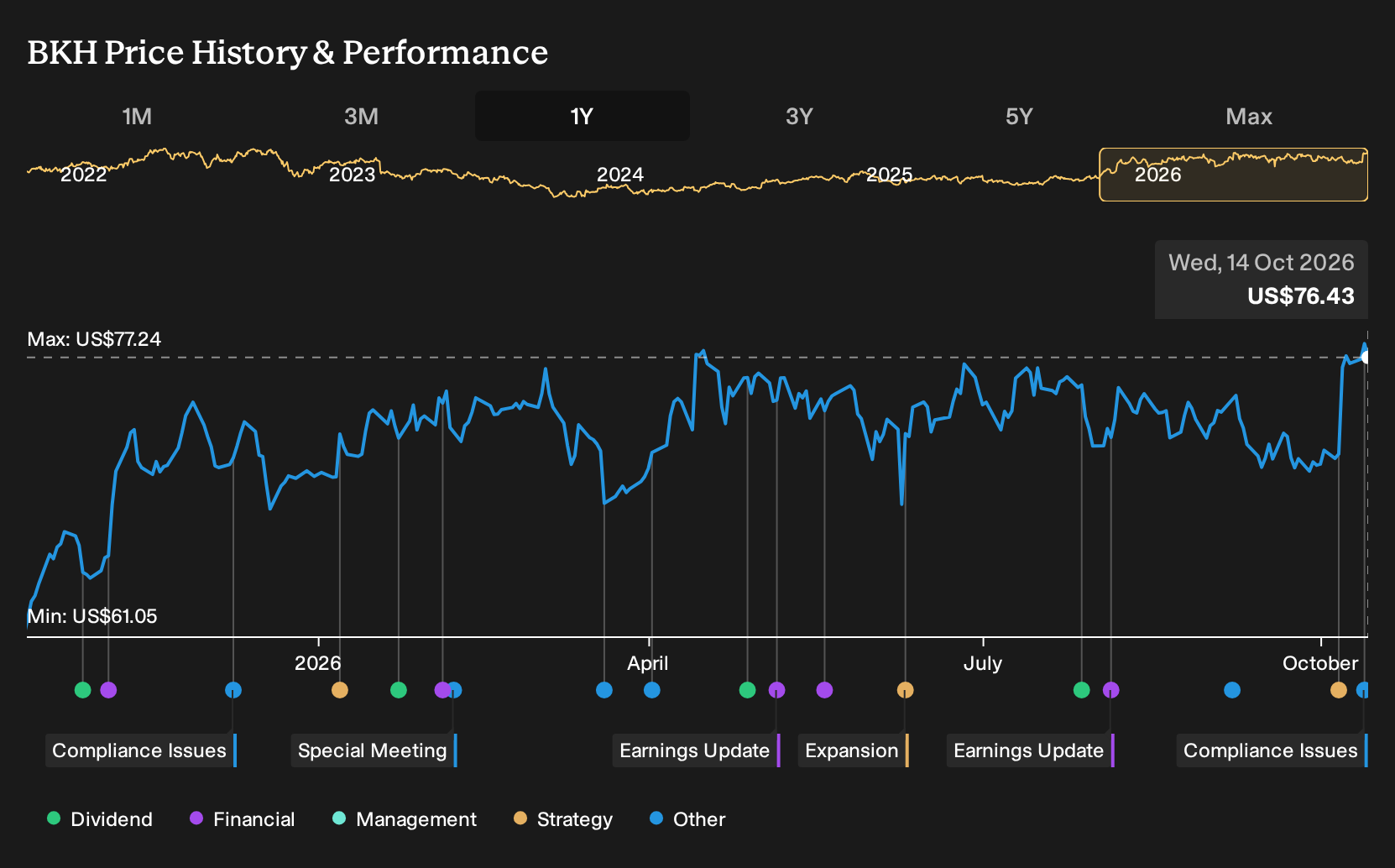
- Black Hills Corp. received approval for new natural gas rates in Arkansas that support recovery of about $147 million in system investments and add roughly $17.9 million in annual revenue for serving more than 189,000 customers.
- The Arkansas decision locks in a 9.8% allowed return on equity and a 47.5% equity / 52.5% debt capital structure for this utility, shaping how future spending and financing translate into regulated earnings.
- We will look at how Black Hills' long term investment narrative is affected by Arkansas' approval of new rates and allowed returns.
Black Hills Investment Narrative Recap
To own Black Hills, you need to believe that a regulated utility model and large capital plan can translate into steady earnings, while weather and financing costs stay manageable. The Arkansas rate approval helps on that first point. It locks in cost recovery and an allowed 9.8% return on equity for recent gas investments, but it does not radically change the near term story.
The bigger swing factor in the short run still comes from data center driven load growth and related project execution, alongside the risk that future rate cases are less supportive than this Arkansas outcome. Warm winters and interest coverage remain pressure points that could make the path bumpy, even if the long term plan stays intact.
The Google data center agreements in Wyoming are the most important backdrop for thinking about this Arkansas decision. Those contracts envision 590 MW of grid connected supply and 2.1 GW of third party resources under a managed microgrid, with Black Hills planning US$1.8b of generation investment between 2027 and 2029 and long dated microgrid management fees through 2048.
Both the data center project and the Arkansas ruling point to the same operational test. Black Hills needs to secure constructive regulatory treatment on heavy capital spending, while keeping existing retail customers insulated from large cost shifts. Execution on Cheyenne construction, transmission build out and microgrid operations will likely shape how investors view the durability of this regulated growth narrative.
Black Hills' current analyst narrative points to US$3.7b in revenue and US$593.3m in earnings by 2029. That outlook assumes revenue growth of 17.1% per year and an earnings increase of about US$294m from US$299.1m today.
Discover why Black Hills' fair value indicates a 9% potential upside to its current price that may not last much longer.
Exploring Other Perspectives
The Simply Wall St Community only shows two fair value views on Black Hills so far, yet they still span roughly US$66.5 to US$83.2 per share. That gap reflects how differently investors weigh the Arkansas rate approval, data center contracts and weather sensitivity. Use these contrasts to test your own assumptions and explore further viewpoints.
Explore another Black Hills fair value estimate, including one that suggests as much as 13% downside from the current price.
Decide For Yourself
Don't just follow the ticker. Dig into the data and build a conviction that's truly your own.
- A great starting point for your Black Hills research is our analysis highlighting 3 key rewards and 2 important warning signs that could impact your investment decision.
- See our latest analysis for Black Hills. The report includes a comprehensive fundamental analysis summarized in a single visual, the Snowflake, making it easy to evaluate Black Hills' overall financial health at a glance.
Looking For More Investment Ideas Beyond Black Hills?
If Black Hills has sharpened your thinking about regulated utilities and income, you can use that same lens across the wider market with the Simply Wall St Screener. It helps you move from a single ticker to a structured watchlist built around the balance of quality, risk and income you are seeking.
- If capital preservation is high on your list, you could start with a basket of companies screened for resilience and lower risk scores through 32 resilient stocks with low risk scores.
- If reliable income streams appeal to you, you may focus on businesses with stronger yields and stability characteristics by checking out 7 dividend fortresses.
- If you prefer quality first and want to avoid weaker fundamentals, you can build a watchlist using the list of solid balance sheet and fundamentals (25 results) as your initial hunting ground.
This article by Simply Wall St is general in nature. We provide commentary based on historical data and analyst forecasts only using an unbiased methodology and our articles are not intended to be financial advice. It does not constitute a recommendation to buy or sell any stock, and does not take account of your objectives, or your financial situation. We aim to bring you long-term focused analysis driven by fundamental data. Note that our analysis may not factor in the latest price-sensitive company announcements or qualitative material. Simply Wall St has no position in any stocks mentioned.
Have feedback on this article? Concerned about the content? Get in touch with us directly. Alternatively, email editorial-team@simplywallst.com