
- PRICING
- LIVE QUOTES
- LEARN
- HELP


EN
Vanguard Economist Says: Fed Rate Hikes Won't Hurt Stock Prices (Yet)
Key Points
A leading economist from Vanguard, Joe Davis, isn’t worried about Fed rate hikes hurting the stock market.
He believes the Fed would need to raise rates above 5% before the stock market or economy would suffer.
The past 50-year average federal funds rate is 4.64%, which is 76 basis points higher than today's effective rate.
Rising interest rates are often seen as a threat to the stock market. When rates (and bond yields) rise, it can put pressure on stocks by slowing the economy and siphoning money away from the stock market into other asset classes.
The Federal Reserve raised interest rates in September to a target range of 3.75% to 4%. Fed Chair Kevin Warsh appears determined to fight inflation with additional rate hikes. But that doesn't mean it's time for stock investors to panic.
Missed Nvidia in 2009? This Rare Signal Is Flashing Again. In 2009, a "Double Down" signal flashed for a little-known chipmaker called Nvidia. For the first time in years, that same "Total Conviction" signal is flashing for a company 1/100th the size of Nvidia. Continue »
Recent analysis from Vanguard economist Joe Davis says that Fed rate hikes are unlikely to hurt the stock market or the economy. The economy and the stock market seem resilient, even if the Fed hikes rates one more time in 2026 or a few more times in 2027.
Let's look at what this top Vanguard economist has to say about higher interest rates, and why long-term investors shouldn't be afraid to keep buying stocks.
Image source: Getty Images.
"North of 5%" interest rates could hurt earnings potential
In a recent video, Vanguard Global Chief Economist Joe Davis was asked about how high the Fed could hike interest rates before the stock market might suffer a downturn. Davis said that "even if a few more interest rate hikes could be in store, I see a theme of resilience, both for the financial markets and for the economy at large."
Even though the Fed hiked rates to a range of 3.75% to 4% in September, Davis isn't concerned (yet) about additional rate hikes causing negative impacts on the stock market or the economy. He said that before that happens, the Fed would have to hike rates "materially higher" than their current levels. Davis said "north of 5%" interest rates would put the market in range of significant potential for rate-related declines in earnings and economic activity.
We're not there yet. Even if the Fed hikes rates by another 25 to 50 basis points by the end of 2026, the stock market seems likely to absorb those higher rates.
How to invest for higher interest rates
If you're feeling nervous about Fed rate hikes, it's important to remember that the stock market has a long-term trend of delivering 9.98% annualized returns. That's the average annual return for the S&P 500 index (SNPINDEX: ^GSPC) since 1928. The Vanguard S&P 500 ETF (NYSEMKT: VOO) has delivered annualized returns of 13.75% (by net asset value) for the past five years, which includes the Fed's big rate hike cycle of 2022-2023.
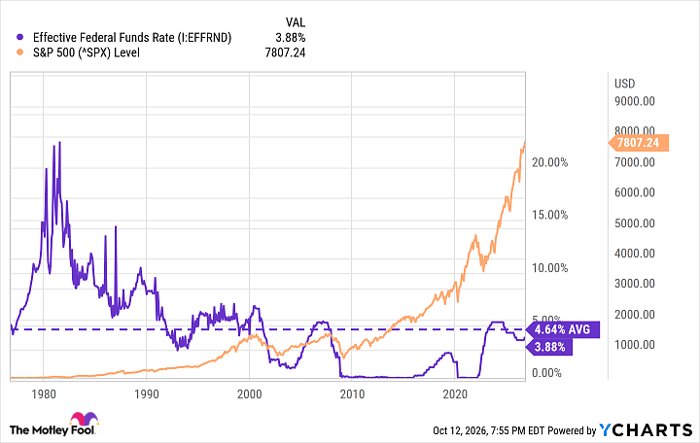
It seems unlikely that the Fed is about to hike rates by 5% in the next year. VOO could still be a good choice for long-term investors, even if interest rates go higher from here. And today's higher interest rates are still well below their long-term historical average. This chart shows the past 50 years (since October 1976) of the effective federal funds rate and the S&P 500 index.
Effective Federal Funds Rate data by YCharts
Today's fed funds rate is 3.88%, still 76 basis points below the past 50-year average rate of 4.64%. The Fed could hike rates three more times (by 25 basis points each) and still just be hitting the average. That level of interest rate hike seems unlikely to damage the stock market, at least anytime soon.
The long-term trend over the past 50 years is clear: Interest rates have tended to go lower while the S&P 500 has gone up, and up, and up. Sometimes the Fed hikes rates steeply and quickly, like it did in 2022. Rapid rate hikes can be bad for stocks in the short run. But the stock market is incredibly resilient. Buying low-cost index funds like the Vanguard S&P 500 ETF is likely still a great choice -- especially for patient investors who can leave that money alone to grow and compound for several years.
Ben Gran has no position in any of the stocks mentioned. The Motley Fool has positions in and recommends Vanguard S&P 500 ETF. The Motley Fool has a disclosure policy.