
- PRICING
- LIVE QUOTES
- LEARN
- HELP


EN
How to Play TRXB Stock After the TRex Bio IPO
TRex Bio (TRXB) is a biotech newcomer with some heavyweight backing, including pharmaceutical giant Eli Lilly (LLY). The South San Francisco-based company is developing immunoregulatory medicines designed to target regulatory T cells, which play an important role in controlling inflammation in body tissues. With big ambitions and promising research, TRex recently made its stock market debut on Oct. 9, 2026, officially starting to trade on the Nasdaq Global Select Market, hoping to win over investors looking for the next big biotech opportunity.
Through the IPO, TRex Bio raised approximately $116.7 million in gross proceeds by selling 8.3 million shares at $14 apiece. The company plans to use the proceeds to advance its lead drug candidate, TRB-061, which is being tested in patients with moderate-to-severe atopic dermatitis, while progressing its broader pipeline of immunoregulatory medicines.
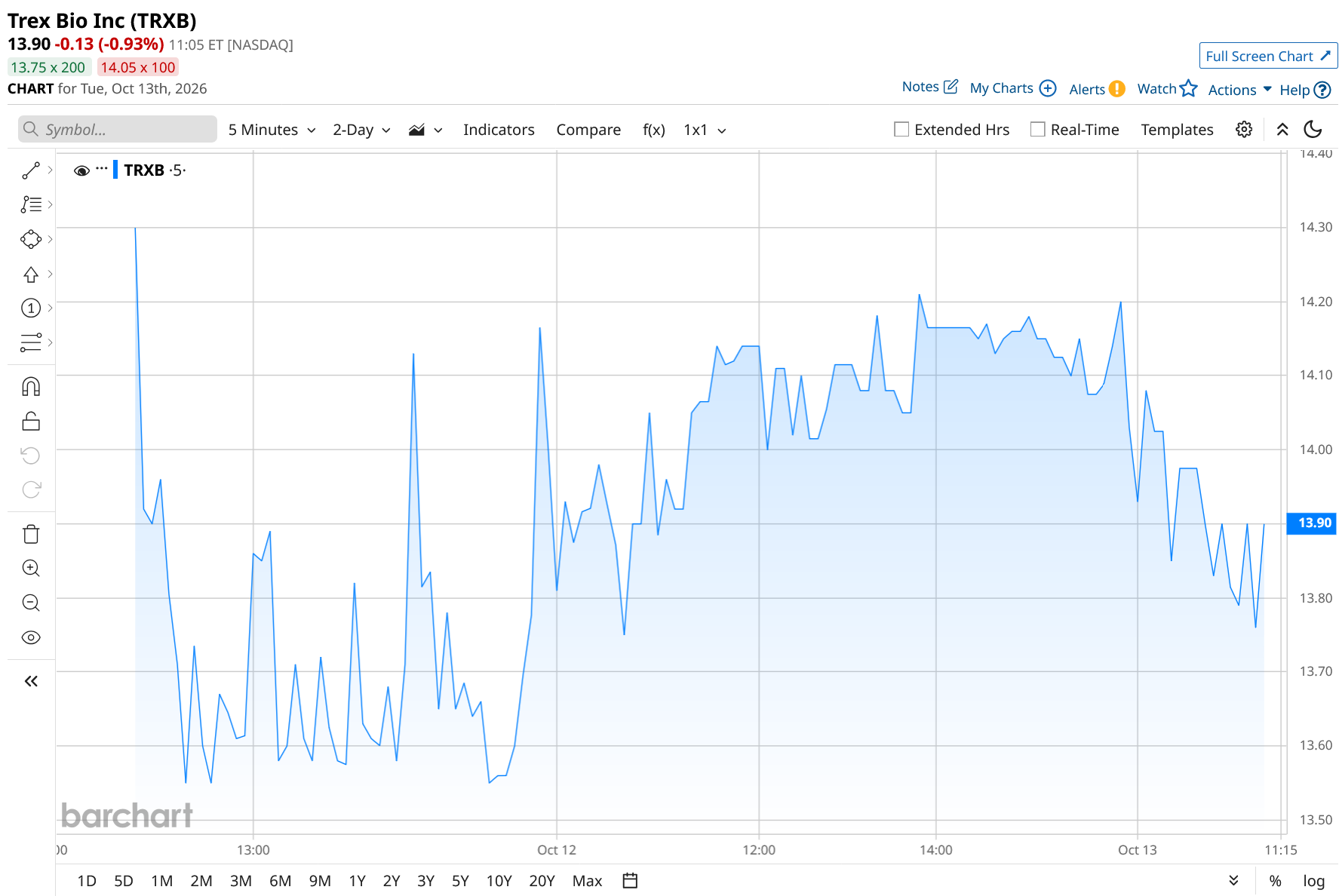
However, its IPO got off to a rather underwhelming start. TRXB priced its shares at $14, the lower end of its expected range, and opened below that level on its first day of trading. Although the stock briefly climbed to $15.50 before closing at its IPO price, the initial excitement was hardly enough to call it a breakout. Shares have since moved back slightly below $14, but the early trading action leaves investors weighing the company’s potential against the risks of an emerging biotech business. So, is TRXB worth a closer look now, or should investors wait for a clearer signal?
About TRex Bio Stock
Based in South San Francisco, California, TRex Bio is a clinical-stage biotech company working on a different approach to treating autoimmune and inflammatory diseases. Instead of broadly suppressing the immune system, the company is developing medicines designed to restore immune balance directly within affected tissues. Its research focuses on regulatory T cells, or Tregs, which help control inflammation and maintain healthy tissue function.
At the heart of its research is the proprietary Deep Biology Platform, which studies how Tregs function in human tissues to identify new drug targets. This approach has helped TRex Bio build its own pipeline while attracting pharmaceutical partners, including Johnson & Johnson and Eli Lilly. Backed by these collaborations and years of research, the company has moved from an early-stage immunology startup toward developing potential treatments for patients with unmet medical needs.
Its latest milestone came on Oct. 9, 2026, when TRex Bio made its public market debut, giving investors their first opportunity to buy into its developing biotech story. TRex Bio’s market capitalization stood at approximately $384.24 million at its IPO price and has since edged up to around $385.06 million.
TRXB stock market debut was hardly a blockbuster, but it managed to hold its ground. Shares closed flat at $14 on their first day of Nasdaq trading, matching the IPO price. The next session, on Oct. 12, brought a small bump in optimism as the stock opened at $14.19 and climbed to an intraday high of $14.36. However, the early gains did not stick, and shares eventually closed at $14.03 yesterday and slid below the $14 mark again this morning, leaving investors waiting for a stronger signal.
A Closer Look at TRex Bio’s Financials
As a clinical-stage biotech company, TRex Bio is still working toward bringing its first commercial product to market, which means revenue is not yet part of the picture. For now, investors need to look closely at its research spending, rising losses, and cash reserves to understand how well it can fund its drug development plans.
For the six months ended June 30, 2026, TRex Bio’s loss from operations climbed 61% year-over-year (YoY) to $31 million, while its net loss widened 65.4% to $29.3 million. A major reason behind the higher losses was the company’s growing investment in research and development, which surged 74% YoY.
That increase was driven by higher clinical trial costs for its lead candidate, TRB-061, along with increased spending on other drug candidates, preclinical research, manufacturing-related work, and additional employees. General and administrative expenses also moved higher as the company spent more on professional services, patent prosecution, intellectual property development, and staffing. TRex Bio is spending more as it advances its pipeline, but that research comes at a cost.
Cash flow offers another important piece of the picture. The company used $27 million in cash for operating activities during the first half of 2026, reflecting the funding required to keep its research moving forward. Still, its balance sheet provides some breathing room. On a pro forma, as-adjusted basis, TRex Bio had $194.9 million in cash, cash equivalents, and marketable securities.
That cash cushion could help support its clinical programs in the near term, although continued research spending and clinical setbacks remain risks investors should keep in mind.
Final Thoughts on TRBX Stock After Its IPO
So, how should investors play TRXB stock after its IPO? TRex Bio has some serious names in its corner, including Eli Lilly, Pfizer Ventures, Johnson & Johnson Innovation, SV Health Investors, Janus Henderson Investors, Alexandria Venture Investments, Delos Capital, and Polaris Partners. That kind of backing adds credibility to its research ambitions, but let’s not confuse a strong investor lineup with a guaranteed stock market win.
The next big test will be its clinical progress. TRex Bio expects to report topline data from its lead candidate, TRB-061, in mid-2027. The company is also targeting a Phase 1 trial launch for TRB-071, its investigational inflammatory bowel disease treatment, in the first half of 2027. These milestones could give investors a better sense of whether its research can translate into promising treatments.
For now, TRex Bio remains a pre-revenue biotech stock with rising losses, although its nearly $195 million in pro forma cash and marketable securities provides some financial breathing room. With shares barely budging after their Nasdaq debut, investors may want to watch clinical updates and cash burn before jumping in. After all, in biotech, a promising pipeline is exciting, but clinical trials will determine its true potential. Sometimes, patience is an investment strategy, not a missed opportunity.
On the date of publication, Sristi Suman Jayaswal did not have (either directly or indirectly) positions in any of the securities mentioned in this article. All information and data in this article is solely for informational purposes. For more information please view the Barchart Disclosure Policy here.