
- PRICING
- LIVE QUOTES
- LEARN
- HELP


EN
SpaceX Has Entered the Wireless Fight. 3 Telecom Stocks Just Got a New Rival.
For years, America’s wireless giants competed on network coverage, pricing, and speed. Now, a company that built its business by sending rockets into space wants a piece of that market. Elon Musk's SpaceX (SPCX) plan to acquire spectrum to bring its vision closer to reality has posed a threat to the country's established mobile carriers.
After the announcement, the three largest telecom giants in the U.S., AT&T (T), Verizon Communications (VZ), and T-Mobile (TMUS) saw their shares fell sharply as investors were rattled by the possibility of a new competitor entering the wireless market. But is dethroning these legacy players, the telecom sector's heavyweights for years, really that easy? Has the market overreacted to the threat?
Let’s find out.
SpaceX Is Moving Beyond Satellite Internet
SpaceX has made a significant move toward building a more direct presence in the U.S. wireless market. On Oct. 9, the company agreed to acquire up to 14 MHz of paired low-band spectrum in the 800 MHz range from Grain Management for approximately $8 billion. The transaction, upon closing, will give SpaceX access to valuable frequencies that could help Starlink Mobile expand beyond its existing satellite-connectivity model.
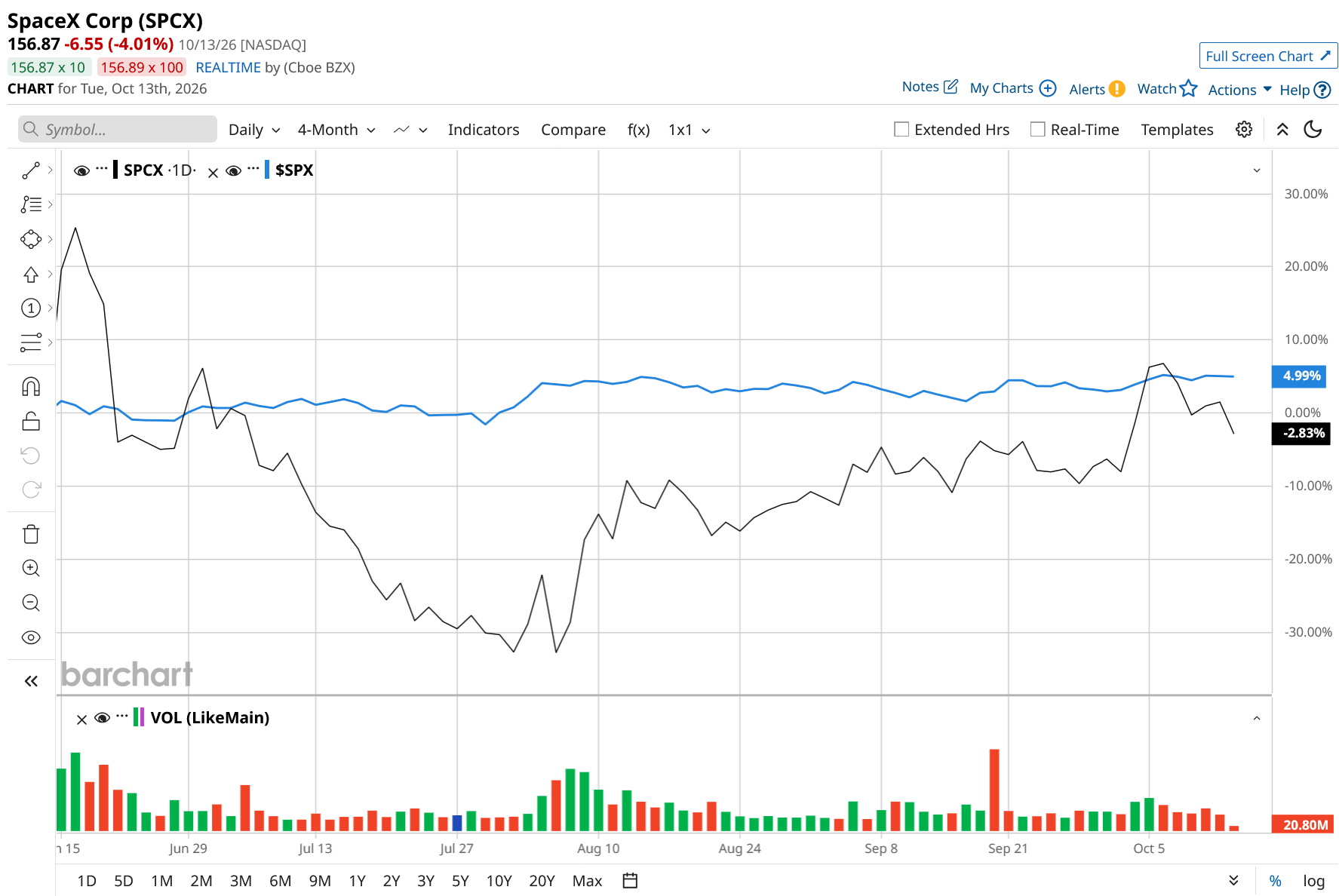
Shortly after the announcement, SPCX stock climbed 1.6% but has since tanked 4% in this morning's trading. The stock is currently trading about 2% below its June IPO price.
Low-band spectrum matters because it can cover wider areas and deliver better indoor reception than higher-frequency bands, making it valuable for expanding wireless coverage. This will be highly useful for places where conventional mobile networks struggle. The acquisition also builds on SpaceX’s separate agreement with EchoStar (ECHO) involving additional spectrum for Starlink Mobile. During the Q2 earnings call, SpaceX management discussed plans to integrate 65 MHz of EchoStar spectrum into its next-generation mobile service. Both these agreements are distinct developments that highlight the company's intention to expand its wireless capabilities.
SpaceX is also not entering the wireless market without an established connectivity business. The company discussed continued growth across Starlink’s consumer, enterprise, and government operations in the second quarter. SpaceX's total revenue increased 92% year-over-year (YoY) to $7.81 billion, while its net loss narrowed to $541 million. Although SpaceX remains unprofitable, management sees massive opportunity in mobile connectivity.
The Big 3 Telecom Giants Just Got a New Rival
The market reaction showed that investors have taken SpaceX's ambitions seriously. Since the Oct. 9 announcement, Verizon stock has fallen 6.2%, while AT&T and T-Mobile have declined by 8.5% and 11.3%, respectively, as of the Oct. 12 closing price. However, the selloff was more about concerns of a potential new competitor and not proof that SpaceX has already taken customers away from these carriers.
These are not small operators that SpaceX can easily push aside.
Verizon has been the longstanding wireless heavyweight, with AT&T as its traditional rival. T-Mobile, on the other hand, gained substantial ground following its 2020 merger with Sprint and has been an aggressive challenger since then. Each has a nationwide customer base, established infrastructure, and years of experience operating in a fiercely competitive market.
Each carrier also has a different strength to defend. AT&T can draw on its fiber and wireless businesses to bundle connectivity services and deepen customer relationships. In the second quarter, AT&T generated $31.6 billion in revenue, up 2.3% YoY, and added 432,000 postpaid phone subscribers. Similarly, Verizon's established mobile network gives it a substantial presence in the market, where reliability, capacity, and consistent coverage remain important to customers. The company generated $34.3 billion in revenue in the second quarter.
Meanwhile, T-Mobile has built considerable momentum through customer acquisition, competitive offerings, and its growing network footprint. Its revenue in the second quarter climbed 9% to $19 billion, and postpaid service revenue rose 13% to $15.9 billion.
That said, SpaceX also brings something that these companies cannot easily replicate—a satellite network built to expand connectivity beyond the reach of conventional cell towers. That could appeal to rural customers, travelers, and people who regularly encounter dead zones.
During the Q2 earnings call, SpaceX’s President and COO Gwynne Shotwell pointed to the roughly $600 billion in annual revenue generated collectively by AT&T, Verizon, and T-Mobile, expressing confidence that Starlink Mobile could win customers from them.
Can SpaceX Deliver?
The buzz of a new competitor like SpaceX entering the wireless market might have excited investors. The financial opportunity is also substantial for SpaceX if it can convert its satellite infrastructure into a broader mobile business. However, there are also practical hurdles that investors need to consider. SpaceX must secure the required regulatory approvals, deploy its planned satellite technology, and establish a service that can compete on price, capacity, and reliability. These three traditional carriers already operate extensive terrestrial networks, with a massive and loyal customer base and infrastructure that is difficult to replicate.
SpaceX's satellite advantage could be valuable, but only time will tell if SpaceX can deliver reliable, competitively priced service at scale and how many paying customers it ultimately attracts. Until that happens, investors should treat the threat as a serious long-term competitive development rather than assume the three telecom giants are already losing their grip on the market.
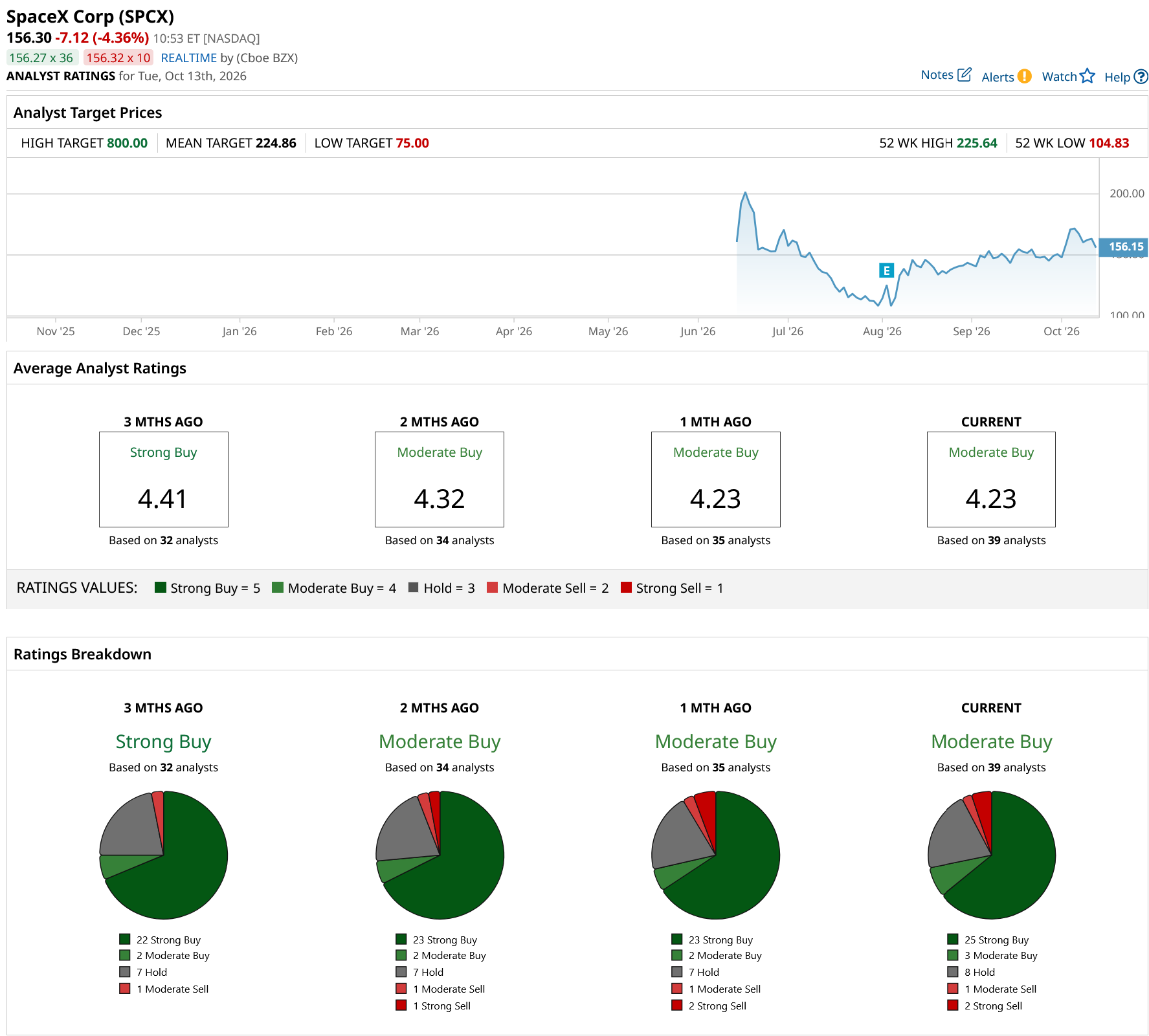
On Wall Street, AT&T's and Verizon's respective stocks hold overall “Moderate Buy” ratings, while T-Mobile is a consensus “Strong Buy.” Meanwhile, SPCX stock holds a consensus “Moderate Buy” rating. Of the 39 analysts that cover the stock, 25 rate it a “Strong Buy,” three say it is a “Moderate Buy,” eight rate it a “Hold,” and one recommends a “Moderate Sell,” with two analysts recommending a “Strong Sell.”
The average target price of $224.86 implies SPCX can climb by 44% from current levels. However, the stock has a high price estimate of $800, which suggests a potential upside of 412% over the next 12 months.
On the date of publication, Sushree Mohanty did not have (either directly or indirectly) positions in any of the securities mentioned in this article. All information and data in this article is solely for informational purposes. For more information please view the Barchart Disclosure Policy here.