
- PRICING
- LIVE QUOTES
- LEARN
- HELP


EN
Historically, the S&P 500 Rallies After the Midterm Elections. But Here's Why That Might Not Happen This Time Around
Key Points
During midterm election cycles, the S&P 500 has typically generated positive returns.
When President Trump was last in power, that didn't happen, and the S&P 500 declined by more than 10%.
The ongoing war in Iran, rising interest rates, and adverse economic conditions could all weigh on the market's near-term performance.
The midterm elections are coming up soon, and they could have a big impact on the stock market. A change in the political outlook may alter investor expectations for what lies ahead.
While in the past, the S&P 500 (SNPINDEX:^GSPC) has normally experienced a boost following the midterm elections, that may not happen this time around. Here's why.
Missed AI’s "Act 1"? Act 2 Could Be 15x Bigger. Most investors think they missed the AI boat because they didn't buy Nvidia in 2005. But according to our analysts, we’re only at the end of "Act 1"—the R&D phase. "Act 2" is the global rollout. Continue »

Image source: Getty Images.
The S&P 500 has historically averaged a 7% return in the period around midterm elections
According to data from Bloomberg and Deutsche Bank, the S&P 500 has done well in past midterm election cycles, rising 21 out of the last 23 times. This covers a period spanning one month prior to the election to two months afterward.
While it's a strong trend, what's important to note, however, is that its worst performance and the glaring exception to the trend came in 2018, when it declined by more than 10% during that time. That was also the last time President Trump was in power during the midterm elections. Meanwhile, the largest gain took place in 1998 amid the dotcom bubble. Another strong year was in 2002, as the market was recovering from the crash.
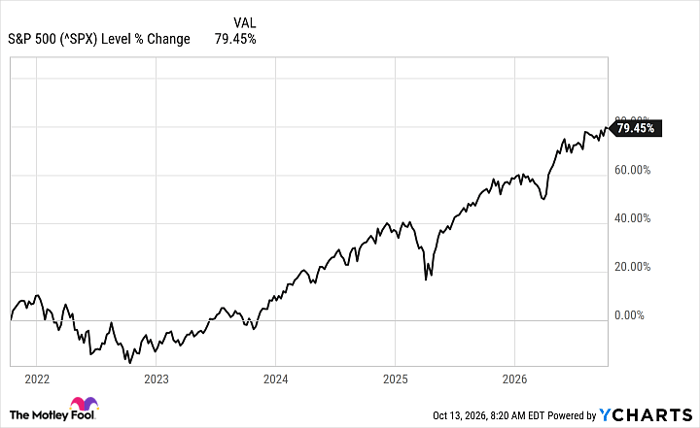
Relying on historical patterns isn't necessarily all that helpful because there are other factors to consider, such as the fact that valuations are incredibly high right now for many stocks, which can make it difficult to still expect a strong rally in the months ahead. There's also the war with Iran that continues to drag on.
Given all the economic challenges, geopolitical issues, and high stock valuations, I'm not optimistic that the market will experience a big rally in the next few months; a decline may be far more likely, as it isn't as simple as assuming that stocks will always go up around midterm elections.
What should investors do?
The stock market may be overdue for a correction in the near future, but that doesn't mean the solution is for investors to exit all of their positions. Tracking the S&P 500 through index funds can still be a solid option for long-term investors.
However, for those who may not be willing or able to remain invested for a long time frame, it may be optimal to divert cash toward defensive stocks that pay dividends, which can provide stability and cash flow.
But the big takeaway is that investors shouldn't assume that, just because the market typically does well during the midterm election cycle, it will rally this time around as well. There could, instead, be some significant adversity ahead that weighs on the markets.
David Jagielski, CPA has no position in any of the stocks mentioned. The Motley Fool has no position in any of the stocks mentioned. The Motley Fool has a disclosure policy.