
- PRICING
- LIVE QUOTES
- LEARN
- HELP


EN
Prediction: The Global Bond Market Sell-Off Could Spell Trouble for Wall Street. Here's What History Says Comes Next.
Key Points
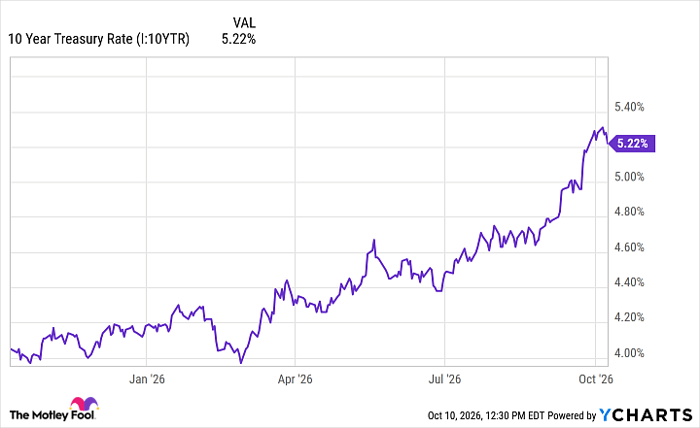
Global government bonds are going through a sell-off, with bond yields on 10-year U.S. Treasuries rising by 1.2% in the past year.
When bond yields go up, borrowing costs rise, which can hurt economic growth and reduce corporate profits, leading to a stock market decline.
Despite higher bond yields, the S&P 500 reached a new record high in October; long-term investors might want to keep buying stocks.
The global bond market is going through a sell-off. This can be seen in rising yields on U.S. Treasury bonds, with the 10-year Treasury yield up about 1.2% over the past year.
Missed AI’s "Act 1"? Act 2 Could Be 15x Bigger. Most investors think they missed the AI boat because they didn't buy Nvidia in 2005. But according to our analysts, we’re only at the end of "Act 1"—the R&D phase. "Act 2" is the global rollout. Continue »
10 Year Treasury Rate data by YCharts
Bond yields are also rising at similar levels for government debt in other major developed economies. In the past year, 10-year government bond yields have risen by 0.85% in Germany, 0.77% in the U.K., and 1.32% in Japan. All of these countries, like the U.S., are suddenly having to pay more interest on their national debt.
When bond yields rise, bond prices fall. A bond sell-off means that bond investors refuse to buy bonds unless they are paid a higher interest rate by bond issuers (the borrowers). This drives down prices for existing bonds and drives up bond yields.
A bond market sell-off can be a warning sign for the stock market. Let's look at what this might mean for your investments.

Image source: Getty Images.
Why a global bond market sell-off may be bad news for stocks
When bond yields go up, the cost of money does too. Banks charge more for loans. Businesses and consumers have to pay more to borrow. It becomes more expensive and difficult for companies to issue debt, refinance existing debt, or raise capital for new investments, new products, new factories, and expansions.
More money being spent on paying off debt (by governments, businesses, and consumers) means there's less money in the economy for everything else. Fewer homes and cars are bought. Fewer factories are built. New job creation falls. Economic growth slows or declines. Bad news for bond prices can ultimately be bad for stock prices, too.
Higher bond yields can also change how investors put their money to work. When risk-free U.S. Treasuries are paying more than 5% per year for 10 years, some investors might decide to shift money out of risky stocks and into the guaranteed income of government bonds. Higher bond yields mean stocks have to generate higher earnings to compete for investors' money. If not, the stock market might enter a sell-off, too.
Why a global bond market sell-off is nothing to fear
And yet...despite the past year of fast-rising bond yields, the S&P 500 index (SNPINDEX: ^GSPC) is up about 19% in the past year, and reached a new all-time high on Oct. 6. And S&P 500 earnings are going strong. Analysts expect S&P 500 companies to report third-quarter year-over-year earnings growth of nearly 30%, according to CNBC.
Investors might keep buying stocks as long as companies continue to report strong profits. The artificial intelligence (AI) boom is driving hundreds of billions of dollars of capital expenditures, which are spilling over into the economy. Tech stocks make up about 40% of the S&P 500, and those companies are generally still highly profitable. CNBC reported an estimated 65% earnings-per-share growth in the tech sector as of Oct. 7.
Both things can be true: The global bond market sell-off might mean that bond yields keep going up, and the stock market might also keep going up.
How to invest during a global bond market sell-off
It's important for investors to be aware of the risks of rising bond yields. Borrowing costs go up. You might see the effects of this in your personal finances when looking at mortgage rates or auto loan rates. But higher bond yields don't automatically mean that a recession is coming, or that the stock market will crash.
And what if the stock market does crash? Right now could still be a great time to buy stocks -- if you're a long-term investor in low-cost index funds like the Vanguard S&P 500 ETF (NYSEMKT: VOO). During the past 16 years, this popular S&P 500 exchange-traded fund (ETF) has delivered annualized returns of 14.94%.
In the very long run, in the 98 years since 1928, the S&P 500 has delivered an average annual return of 9.98%. That includes every major stock market crash, recession, crisis, and global bond market sell-off along the way.
No one knows what will happen next for stock prices or bond yields. The short term is unpredictable. But history shows that despite occasional problems, volatility, and economic crises, the stock market is incredibly resilient over the long haul.
Ben Gran has no position in any of the stocks mentioned. The Motley Fool has positions in and recommends Vanguard S&P 500 ETF. The Motley Fool has a disclosure policy.