
- PRICING
- LIVE QUOTES
- LEARN
- HELP


EN
Digital Asset Rollout Could Be A Game Changer For Fiserv Stock (FI)
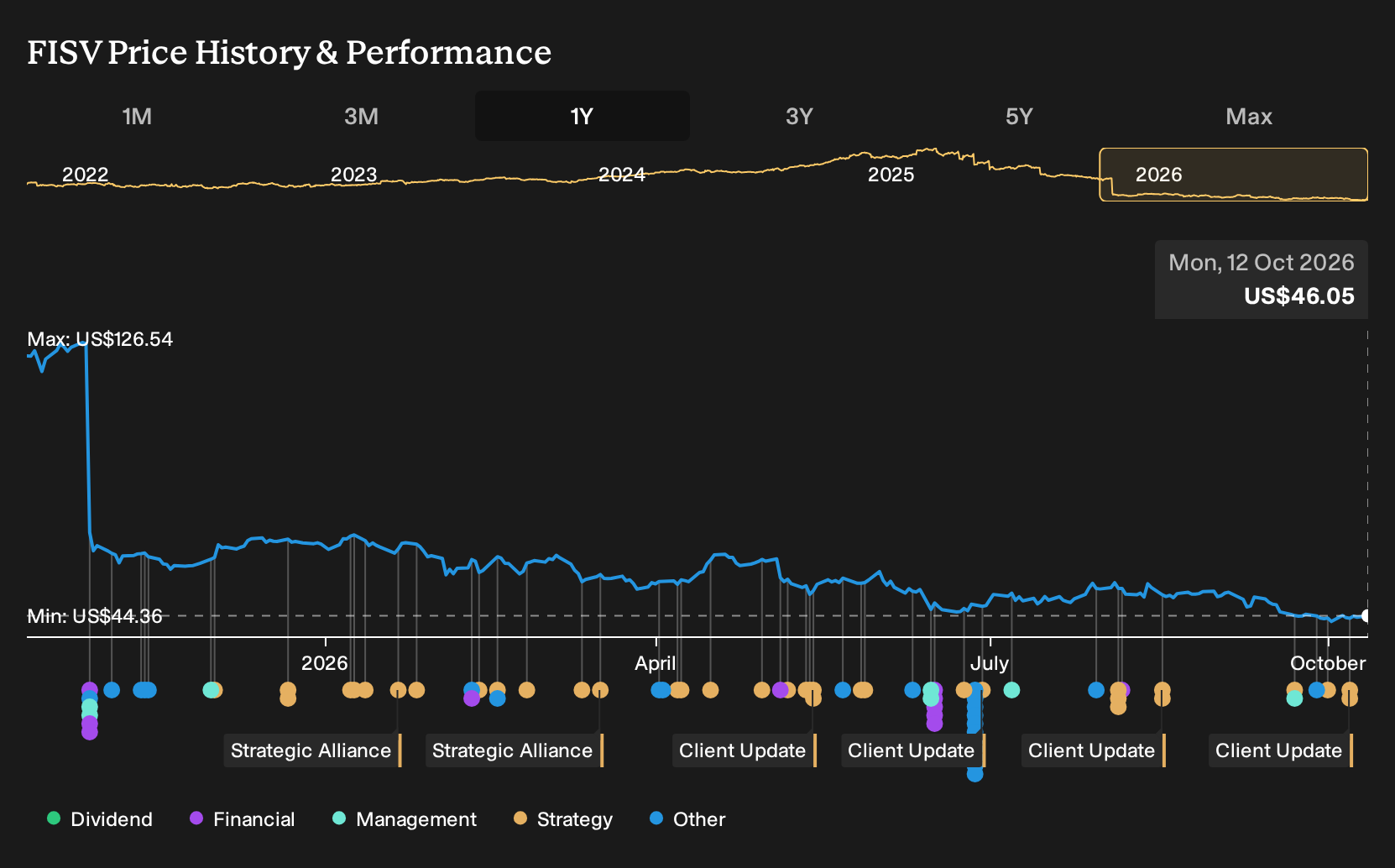
- Fiserv reported new client deployments including CashFlow Central with Fulton Bank for integrated small business payments, Clover Sport at Hard Rock Stadium for venue commerce, and a live digital asset platform supporting Roughrider Coin across North Dakota banks.
- These launches push Fiserv further into small business cash flow tools, large venue commerce systems, and regulated stablecoin infrastructure, expanding how its technology connects to real world payment flows.
- We will now examine how Fiserv's rollout of Roughrider Coin and other launches might influence its broader investment narrative.
Scan how Fiserv’s push into cash flow tools, stadium payments and stablecoins compares with other payment-focused businesses by checking out 20 high quality undiscovered gems in this corner of the market.
Fiserv Investment Narrative Recap
To own Fiserv, you need to be comfortable with a story that leans on stable recurring payment and banking technology, gradual margin work through Project Elevate, and steady rather than rapid top line expansion. The near term hinge is execution, especially after earlier revenue softness and trimmed 2026 guidance on organic sales, margins and EPS.
Right now, the key short term catalyst is proof that Merchant and Financial Solutions can stabilise and then improve from recent declines while cost actions hold. The biggest risk is further guidance cuts if demand stays muted or large clients are slow to ramp, in which case the margin expansion thesis weakens.
Out of the recent announcements, the Roughrider Coin launch on Fiserv’s digital asset platform is most relevant to those catalysts. It puts real transactions from more than 90 North Dakota institutions onto its infrastructure and tests issuance, reserve, custody and settlement tooling in a regulated setting with VersaBank and Fireblocks.
For you as an investor, this is a live check on Fiserv’s ability to extend its payments rails into new use cases while keeping operational risk and compliance tight. Success would support the idea that modernization and new rails can offset slower headline growth, while any hiccups would add to concerns around execution and future guidance.
Fiserv's current earnings are reported at US$2.8b, with analysts forecasting US$3.1b in earnings on US$21.3b in revenue by 2029. This implies flat revenue expectations over the next few years, and an earnings increase of about US$0.3b from today to the 2029 consensus level.
Uncover why Fiserv's fair value indicates a 28% potential upside to its current price, which could narrow quickly.
Exploring Other Perspectives
One alternate view is that rising tech and cybersecurity spending could squeeze Fiserv margins, even if wins like CashFlow Central, Clover Sport and Roughrider Coin gain traction. The most cautious analysts were pencilling in US$20.0b of revenue and US$2.2b of earnings by 2029. That is far lower than consensus and leaves plenty of room for opinions to shift as you compare these pre news forecasts with your own expectations.
Explore 13 other Fiserv fair value estimates, including one that suggests as much as 13% downside from the current price.
The Verdict Is Yours
Disagree with existing narratives? Extraordinary investment returns rarely come from following the herd, so trust your own analysis and judgment.
- A great starting point for your Fiserv research is our analysis highlighting 3 key rewards and 1 important warning sign that could impact your investment decision.
- See our latest analysis for Fiserv. The report includes a comprehensive fundamental analysis summarized in a single visual, the Snowflake, making it easy to evaluate Fiserv's overall financial health at a glance.
Looking For More Fiserv-Like Investment Ideas?
If the Fiserv story has sharpened how you think about payment platforms, risk and cash generation, you can use that same lens to scan a wider opportunity set with the Simply Wall St Screener before making your next move.
- For investors who want potential mispricing with quality to back it up, start with a focused list built around 29 high quality undervalued stocks.
- If capital preservation and steadier profiles are a priority, filter for businesses that pass strict balance sheet checks through the list of solid balance sheet and fundamentals (25 results).
- When the goal is to find shares that may be overlooked yet financially sound, cast a wider net across the market using 20 high quality undiscovered gems.
This article by Simply Wall St is general in nature. We provide commentary based on historical data and analyst forecasts only using an unbiased methodology and our articles are not intended to be financial advice. It does not constitute a recommendation to buy or sell any stock, and does not take account of your objectives, or your financial situation. We aim to bring you long-term focused analysis driven by fundamental data. Note that our analysis may not factor in the latest price-sensitive company announcements or qualitative material. Simply Wall St has no position in any stocks mentioned.
Have feedback on this article? Concerned about the content? Get in touch with us directly. Alternatively, email editorial-team@simplywallst.com