
- PRICING
- LIVE QUOTES
- LEARN
- HELP


EN
Wall Street's earnings report opens tonight: At a time when stock prices are mired in a technical correction, it is difficult to resolve triple anxiety even if profits increase 20% ahead of time
The Zhitong Finance App learned that major US bank stocks hovered in a technical correction range when the earnings season opened on Tuesday, and long-term borrowing costs climbed to the highest level in decades, causing the market to pay special attention to bank executives' judgments about the health status and credit prospects of American consumers.
According to compiled analyst estimates, Wall Street's largest banks are expected to post quarterly stock trading revenue of around $19 billion. At the same time, the scale of loans is expected to increase year over year, and credit quality is also expected to remain stable. However, the KBW Bank Index, which is the industry benchmark, has fallen by about 12% since its peak in mid-August, exceeding the 10% technical correction threshold. This decline coincided with a sharp rise in US bond yields and the Federal Reserve's first rate hike in three years. The index is experiencing its worst quarterly performance since the beginning of 2023 — when a similar round of yield increases triggered a regional banking crisis and hit bank stocks hard.
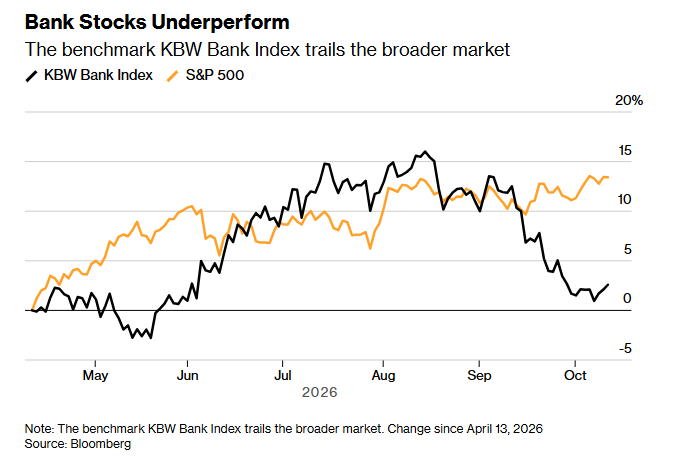
This makes banks need to find a balance between deposit-side payment costs and loan-side returns, and drastic fluctuations in the bond market place pressure on them. Matt Miskin, strategist at Manulife John Hancock Investments, pointed out that the continued rise in interest rates on credit cards, car loans, and home mortgages is putting additional pressure on banks. He said, “Higher yields can bring better income, but they may also hit a tipping point, making it impossible for consumers to repay such loans.”
Currently, the 10-year US Treasury yield is stable at around 5.2%, having previously hit the highest level since 2002. The yield on 30-year treasury bonds rose to around 5.6%, also approaching a 20-year high. The minutes of the Federal Reserve's September meeting showed that all 19 policymakers supported the September rate hike, and most believed that policies needed to be further tightened during the year. The market's pricing probability for the December rate hike was about 70%.
Earnings expectations are strong, but market sentiment is mixed
Despite pressure on stock prices, analysts still expect profits of large banks to increase by 20% year-on-year in the third quarter, a significant increase in investment bank and transaction revenue compared to the previous quarter, and no sign of deterioration in credit portfolios. Last month, Jefferies (JEF.US), which released its earnings report earlier, said that its investment banking and stock trading departments experienced record quarters, but the performance of other indicators was mixed.
Specifically, J.P. Morgan Chase (JPM.US) expects earnings per share of $5.94, up about 17% from $5.07 in the same period last year, and revenue is expected to rise from US$47.1 billion to US$512 billion. Co-president Doug Petno previously said that investment banking fees and transaction revenue are expected to achieve “medium to high double-digit” growth.
Goldman Sachs (GS.US) expects earnings per share of approximately $12.44 billion and revenue of approximately US$16.8 billion, compared with US$12.25 and US$15.2 billion, respectively, in the same period last year. CEO David Solomon previously advised investors that the fixed income, foreign exchange, and commodities business performance will be relatively weak, while the stock business is expected to remain strong.
Bank of America (BAC.US) expects earnings per share of $1.10, slightly higher than $1.06 in the same period last year, and revenue is expected to reach $30.55 billion. However, CEO Brian Moynihan previously warned that the bank's investment banking fees are expected to drop by at least 10% year over year, leading to a sharp drop in its stock price. He said, “We already have very small positions in some of the more active businesses, so the decline may be even greater.”
Citibank (C.US) expects earnings of $2.41 per share, and revenue is expected to reach US$23.72 billion. Chief Financial Officer Gonzalo Luchetti previously said that the bank expects a return on tangible common stock this year to slightly exceed the target of 11%, and will increase the scale of share repurchases in 2026.
Wells Fargo Bank (WFC.US) expects earnings of $1.85 per share and revenue of $22.32 billion. Chief Financial Officer Mike Santomassimo said that loan growth in 2026 is expected to be better than previously anticipated, and US consumer and credit trends remain healthy.
Morgan Stanley (MS.US) expects earnings per share of $2.94 billion and revenue of $201.1 billion. Co-president Dan Simkowitz pointed out that the bank's investment banking reserves appear to be stable, and the company is still in the middle of the AI investment cycle.
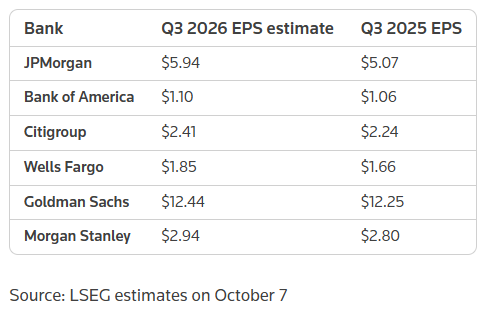
The four banks — Citibank, Goldman Sachs, J.P. Morgan Chase, and Wells Fargo — will release results before the US stock market opens on Tuesday, and Bank of America and Morgan Stanley are scheduled to announce them on Wednesday.
The cooling of the IPO market heightens investment banking business concerns
But the sharp rise in bond yields has clearly dampened capital market activity. At the end of the third quarter, smart ring manufacturer Oura and SoftBank-backed AI data center developer SB Energy successively postponed their IPO plans. According to Renaissance Capital statistics, 7 companies announced the postponement or withdrawal of their listing plans in the third quarter, up from 4 in the second quarter and 3 in the first quarter. Only 30 IPOs were completed in the third quarter, a record low in ten quarters, with a total financing of US$32.8 billion, far below the level of 48 in the second quarter and the average of 49 in the past ten and three quarters.
UBS Bank analyst Erika Najarian pointed out in a client report that the weakness of bank stocks is directly related to surging yields, and investors need guarantees that capital market reserves are still sufficient, loan growth is on track, and deposit costs are rising under control.
Cheryl Pate, senior portfolio manager at Angel Oak Capital Advisors, believes investors will focus on guidance on credit growth and deposit costs. “We don't expect a massive outflow of deposits — where customers are chasing higher returns — nor a sharp rise in deposit costs,” said Pate. She also pointed out that despite recent interest rate increases, analysts do not expect banks to once again face unrealized losses in their securities portfolios as during the 2023 banking crisis. “Most banks have since shortened their portfolios and managed the associated risks.”
AI “Panic Trading” and Midterm Election Risks
In addition to interest rate factors, bank stocks also face multiple non-traditional risks. The potential impact of artificial intelligence (AI) intelligence on traditional bank deposit and loan business models, as well as possible policy variables brought about by the November midterm elections, have all become the focus of investors' attention.
Analysts at J.P. Morgan Chase previously predicted that if the Republican Party unexpectedly wins a big victory, it may benefit lenders such as Bank of America, Citigroup, and Wells Fargo, as the Republican Party has always preferred more relaxed regulation of the financial industry. However, polls show that the Republican Party is losing ground due to voters' dissatisfaction with the economic situation and the war in Iran.
Manulife's Miskin pointed out that the recent trend in sectors that “have historically benefited more from Republican policy”, such as banking and industry, is weakening, which may indicate that the market is digesting the Democratic Party's full victory expectations ahead of schedule.
On the AI issue, Meta (META.US) recently launched Muse, a consumer-grade AI agent, which has raised market concerns that AI agents may erode the banking industry's deposit base and wealth management business. This time, bank stocks fall into AI “panic trading.”
A report published by the research agency Citrini Research provides a theoretical framework for this panic. The report makes a chilling judgment for the banking industry: a significant portion of US banking profits is based on customer “inertia” — consumers store funds in low-interest accounts due to convenience and habits, and banks can obtain capital at a very low cost and invest in high-yield assets.
Citrini Research further pointed out in the report “Breaking The Wall” released later that autonomous AI agents will operate programmatically, around the clock, and across applications, and that capital and financial assets will eventually flow in the same way, which will greatly increase the demand for programmable financial infrastructure.
Torsten Slok, chief economist at Apollo Global Management, conceptualized this threat as a “smart bank rush.” In his September report, he indicated that AI agent assistants such as Muse may soon automatically transfer household cash from checking accounts with average interest rates of only 0.1% to fintech accounts with interest rates between 3.3% and 5.0%.
“If every household uses AI intelligence to optimize cash returns, banks may lose large amounts of cheap deposits they use to lend, which will be a problem for the entire financial system,” Slok wrote in the report.
Divided institutional opinions: bottom out or reduce positions?
Faced with a deep correction in bank stocks, Wall Street analysts' views were clearly divided.
Wells Fargo analyst Mike Mayo is more optimistic. In his September report, he pointed out that the midterm elections may “have a certain impact on deregulation, but it will not derail it,” and he expects AI “panic transactions” to be reversed as banks release results, because “banks' trust moats guarantee deposits.”
This means that although AI agents can technically perform capital transfers, whether consumers are willing to hand over financial control to technology companies known for “acting fast and breaking the rules” is still a major obstacle. Bank of America's Global Research Division also held a similar view, pointing out that although Muse's popularity is impressive, there is no indication that users are willing to hand over their financial account login credentials to AI agents so far.
According to an investor survey conducted by Truist at the end of September, more than half of bank investors still believe that the Fed's interest rate hike is the biggest risk facing valuations, and only a few people mentioned the threat of AI agents.
Morgan Stanley analyst Manan Gosalia called the recent sell-off an “attractive entry point” and advised investors to use this to plan for stronger performance in 2027. He pointed out that AI-related investments and an overall healthy economy will provide support for bank stocks, and although rising interest rates have raised banks' capital costs, “revenue should rise at the same time.”
However, CIBC Capital Markets strategist Christopher Harvey is more cautious. He expects bank executives to be more cautious about consumer health and economic prospects than they were a few months ago. Despite this, he still believes that the sector may usher in a round of “mitigating rebound” — when bank stocks lag behind before earnings are announced, they often rebound after earnings reports. But he added that if a rebound were to occur, “we will use this opportunity to reduce our exposure,” and given the macroeconomic headwinds facing companies, he would prefer the communications services and utilities sector over financial stocks.
In the options market, traders took a partial stance on J.P. Morgan Chase, the largest bank in the US before the earnings report was released. Trading at the end of last week showed that demand for bullish options betting on a 10% increase surpassed the demand for insurance to hedge against a 10% drop, and there were more bullish contracts unclosed than bearish contracts, which constituted a potential bullish signal. However, the options market's implied expectation of J.P. Morgan Chase's share price fluctuation after the earnings report was about 3.57%, which is higher than its actual fluctuation of 2.36% on average after the past four quarters.